Walk into any bank today, and you will notice something very different from a decade ago. The desks may look familiar, the forms might still exist, and the queues might still move with their own rhythm, but behind the scenes, something far more intelligent is running the show. Indian banks are quietly building HR departments that think faster, calculate smarter, and notice patterns that humans often overlook. The shift is not loud or flashy. It is subtle, precise, and deeply intentional.
This change begins with AI in HRMS, a technology that has transformed the hiring tables, the compliance desk, and even the performance rooms of banks across the country. It is not about replacing people. It is about helping them make sharper, safer decisions aligned with the rigorous standards the BFSI world demands.
Let us explore how AI is becoming the quiet force behind a more reliable, compliant, and predictable banking workforce.
Why AI in HRMS Has Become the New Backbone of Banking HR
Banking has always been a people-driven sector, yet also one of the most heavily regulated. Every employee decision, every approval, every transaction carries weight. HR teams are expected to hire fast, stay compliant, prevent risks, and maintain spotless records. Manual systems simply cannot keep pace with the scale and scrutiny of modern banking.
This is why AI in HRMS is no longer a luxury. It has become a necessity.
The system watches patterns humans would miss, alerts teams before issues escalate, and turns HR from reactive mode into steady, controlled navigation. Banks are choosing AI not because it is trendy, but because it tightens the very areas where mistakes cost the most.
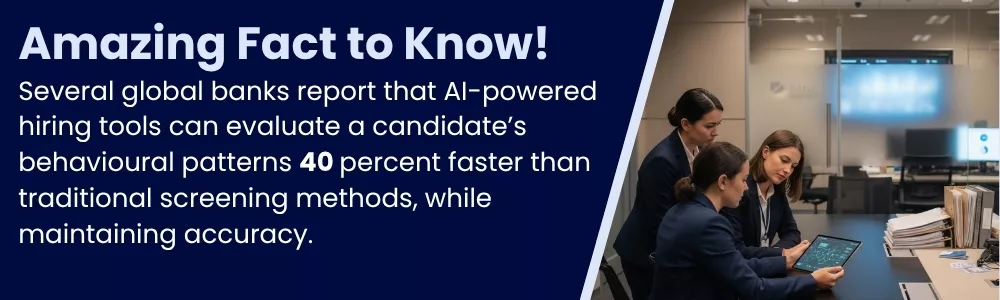
1. AI Screening: How Banks Are Hiring Safer, Smarter, and Faster
Hiring in banking is unlike hiring in any other industry. A retail store can take risks, a tech startup can experiment, but a bank? Never.
A single wrong hire can impact customer trust, and operational safety.
AI Analysis Goes Beyond the Resume
Most candidates present polished resumes. On paper, nearly everyone seems reliable, skilled, and professional. But AI screening uncovers what resumes cannot.
AI tools look for:
- Sudden role changes without a logical explanation
- Education inconsistencies
- Skill claims that do not match previous roles
- Repetitive descriptions are copied and pasted across companies.
- Certification dates that conflict with work history
Instead of HR manually validating this one profile at a time, AI scans thousands of profiles in minutes and highlights risk indicators instantly.
Behavioural Micro-Patterns Tell a Bigger Story
Banking roles require caution, discipline, and judgement. AI measures these qualities through behaviour assessments, picking up micro-patterns such as:
- How candidates respond to pressure-based questions
- Whether they follow instructions during tasks
- Time taken to complete compliance scenarios
- Attention to detail in case study evaluations
- Patterns that reflect diligence or carelessness
A candidate applying for an AML/KYC verification role who repeatedly ignores minor details during assessments is an immediate red flag.
Risk Profiling Even Before Hiring
AI estimates the risk a candidate may pose based on historical behaviour patterns and assessment responses. This helps banks avoid individuals who may struggle with discipline, or accuracy.
Banks use AI in HR not just to hire quickly but to hire responsibly.
2. Predictive Workforce Planning: The Backbone of Efficient Banking Operations
If you walk into a bank during the month-end salary times, the chaos is different from a slow weekday. Some branches see intense footfall during loan processing seasons, while others peak during government deadline periods.
Traditional HR systems cannot predict these fluctuations.
AI does.
How AI Predicts Staffing Needs
AI studies:
- Branch activity
- Past transaction volumes
- Customer footfall data
- Seasonal financial cycles
- Employee attendance history
- Branch-level workload patterns
It then forecasts when a branch will be understaffed or overstaffed.
This is incredibly powerful for banking HR because understaffed branches lead to long queues, poor service, and operational strain.
Performance Forecasting Before Issues Happen
AI observes employee trends closely. For example, if an employee who usually closes loans accurately suddenly shows repeated errors, declining productivity, or slow turnaround times, AI alerts HR long before it becomes a performance crisis.
Likewise, if a back-office employee in a compliance-heavy role begins missing deadlines or making documentation errors, AI picks it up.
Predicting Attrition Before Employees Quit
Banks face high attrition in customer-facing roles. AI evaluates patterns like:
- Drop in engagement
- Decreased task completion
- Changes in attendance
- Lower participation in meetings
- Declining interaction levels
This helps HR offer support, initiate transfers, or take corrective measures early.
AI turns HR from reactive to predictive, something that was never possible before.
3. Internal Risk Profiling: AI as the Guardian of Workforce Integrity
Internal risk is one of the most sensitive areas for banks. Every employee with system access can either protect the bank or unintentionally expose it.
Traditional systems cannot detect risk early enough. AI can.
Behaviour Monitoring That Sees Early Warning Signs
AI analyses:
- Login times
- Access behaviour
- Customer complaint spikes
- Slowdown in performance
- Attendance irregularity
These are subtle signs that human supervisors easily miss.
For example, an employee accessing the core banking system at unusual hours or frequently requesting password resets may indicate stress, misuse, or confusion. AI flags these behaviours long before they escalate.
Sensitive Role Monitoring
Roles involving:
- Cash handling
- Loan approvals
- KYC verification
- AML checks
- Customer data access
Require stricter monitoring.
AI ensures that employees in these roles follow the patterns expected of compliant, stable performers.
This protects banks from internal fraud risks and strengthens operational safety.
4. Compliance Alignment With RBI: Where AI Makes the Biggest Difference
RBI regulations are extensive. Every employee record, salary component, attendance entry, policy acknowledgement, and training certificate must be audit-ready.
AI ensures compliance becomes a built-in system rather than a last-minute exercise.
Attendance and Leave Accuracy
AI maintains:
- Uneditable attendance logs
- Traceable regularization requests
- Time-stamped leave approvals
- Transparent audit trails
This is crucial because many RBI audits begin with validating attendance and overtime.
CTC Transparency and Correct Statutory Deductions
RBI expects:
- Accurate salary structures
- Transparent PF and gratuity calculations
- Clear component breakups
- Error-free payroll processing
AI ensures every component is calculated correctly and consistently across branches.
Training and Certification Tracking
Compliance-heavy roles must complete mandatory modules regularly. AI tracks:
- Completion dates
- Expiry of certifications
- Pending regulatory courses
- Training completion percentages
This becomes essential during annual RBI reviews.
Document Control and Audit Readiness
AI keeps:
- Version history of documents
- Policy acknowledgements
- Letter issuance logs
- Digital trails of every update
This significantly reduces HR workload during audits.
5. AI-Driven Integration: Bringing Every HR Process Under One Roof
Banking HR used to suffer from scattered systems.
- One for attendance.
- One for payroll.
- One for training.
- One for compliance.
AI-powered HRMS platforms unify everything into a single flow, ensuring no information is lost.
Unified Processes Include
- Job posting
- AI screening
- Interview routing
- Final approval
- Onboarding
- Document submission
- Policy acceptance
- Attendance tracking
- Payroll processing
- Performance evaluation
- Exit processing
Every part of the employee lifecycle becomes transparent and interconnected.
This reduces friction, redundancy, and errors.
6. Real-Time Insights That Help Branch Managers Act Instantly
Branch managers often operate in the dark, without real-time data. They cannot track employee stress, workload, deadlines, or attendance trends.
AI solves this through dashboards that display:
- Live performance
- Attendance updates
- Branch workload
- Customer traffic impact
- Pending tasks
- Training deadlines
Managers can take immediate decisions rather than waiting for monthly review meetings.
This improves service quality, reduces customer wait time, and maintains operational discipline.
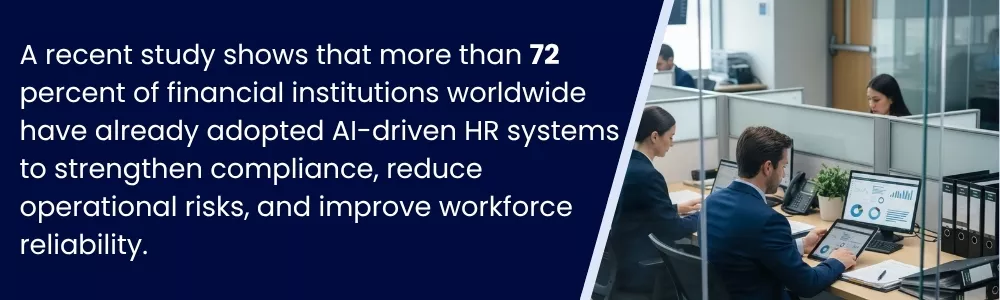
7. Continuous Compliance Monitoring for BFSI Stability
BFSI HR compliance is not a once-a-year job. It is an everyday responsibility.
AI maintains compliance integrity through:
- Constant tracking
- Automated notifications
- Live alerts
- Accurate documentation
- Strict validation
HR teams no longer fear audit season because AI ensures records remain accurate and aligned throughout the year.
But AI in Banking HR Has Drawbacks That Cannot Be Ignored
Even though AI accelerates efficiency, enhances compliance, and reduces operational risk, it is not free from limitations. For HR teams, these drawbacks are essential to understand before scaling AI-based processes across branches.
1. AI is Only as Good as the Data It Learns From
If employee data is incomplete, inconsistent, or biased, AI may generate:
- Inaccurate hiring recommendations
- Flawed risk scores
- Misleading performance flags
- False positives in behaviour monitoring
Banks must maintain strict data hygiene and validation practices to avoid incorrect or unfair outcomes.
2. Over-Reliance on AI Can Reduce Human Judgment
AI can analyse patterns, but it cannot fully understand:
- Personal circumstances
- Contextual nuances
- Team dynamics
- Human intention
HR teams must balance AI insights with human review, especially in high-stakes roles like credit approval, AML/KYC, treasury operations, and customer-facing positions.
3. AI Cannot Replace Ethical Judgement or Regulatory Interpretation
RBI guidelines evolve frequently. Some rules require:
- Subjective interpretation
- Practical context
- Case-by-case evaluation
AI cannot autonomously interpret regulatory grey areas. Human compliance officers remain central to ensuring lawful decisions.
4. Potential for Over-Surveillance
AI-driven monitoring can unintentionally create:
- Employee stress
- Fear-based work environments
- Concerns about privacy
Banks should define transparent communication policies so employees understand what is being monitored and why.
5. High Implementation and Maintenance Costs
For smaller regional banks, setting up:
- Secure data infrastructure
- High-quality integrations
- Ongoing model training can be expensive.
This is why scalable platforms like HR HUB become useful, offering banking-grade capabilities without the cost of building AI from scratch.
A Critical Warning: Banks Must NEVER Feed Customer Data to AI Systems
This cannot be overstated.
Under NO circumstances should banks share, upload, or process customer data using any AI tool that is not approved, secure, or compliant.
Sharing customer information, even accidentally, can lead to:
- Violation of RBI data-localization rules
- Breach of Banking Secrecy Laws
- Penalties under the IT Act
- Reputational damage
- Criminal liability for the institution and the individuals involved
AI in HRMS should only process employee-related data; attendance, performance, training, compliance, skills, behaviour patterns; and nothing beyond that.
Injecting customer data into AI models is a serious crime and a direct threat to customer trust and banking integrity.
The Road Ahead for Banking HR
Indian banks are entering a stage where HR decisions cannot rely on memory, manual oversight, or delayed reporting. They need accuracy, predictive power, and complete clarity regarding employee behaviour and compliance.
This is why AI in HRMS is growing faster in banking than in almost any other sector.
BFSI institutions increasingly prefer platforms like HR HUB because they offer a comprehensive ecosystem for hiring, performance tracking, attendance governance, regulatory compliance, and workforce analytics. With upcoming AI features, HR HUB is becoming a central tool for banks that want a workforce that is compliant, predictable, and well-managed from day one.