April is rarely a quiet month for HR departments. HR stealthily enters one of the year's most delicate operational windows while most departments focus on quarterly planning. During this time, personnel records, payroll transitions, tax adjustments, labor law requirements, and regulatory filings all come together. Compliance gaps that are concealed for months can be caused by a single missed update.
This is why many experienced HR leaders treat April as an operational checkpoint rather than just another calendar milestone. It is the moment when organizations step back and ask a critical question: Are we fully prepared for the regulatory expectations of the next quarter?
HR Compliance 2026 is no longer about responding to legislation as governments tighten reporting requirements and businesses manage more complicated workforces. It involves developing mechanisms that identify hazards before they become fines.
HR teams can examine payroll structures, verify legal alignment, and improve departmental compliance procedures during an April audit. The most crucial areas for HR teams to look at as they enter Q2 are outlined in the following 10-point checklist.
1. Labor Law Audit Checklist: Revisit Employee Classification to Avoid Compliance Risks in HR Compliance 2026
One of the areas where issues never come out in the open is employee classification. They frequently develop covertly as departments change, organizations expand, and new hiring practices appear. For flexibility, a business may start by hiring a few contractors, converting some temporary positions to permanent ones, or hiring consultants for specific projects. These modifications may eventually make it more difficult to distinguish between different types of work.
April is the perfect time to take a break and check if staff are properly classified. There are more administrative distinctions among a consultant, a contractor, a full-time employee, and a part-time worker. Payroll taxation, benefit eligibility, overtime entitlements, and statutory requirements are all directly impacted.
For instance, depending on local laws, employees are typically eligible for perks including insurance, retirement contributions, and leave entitlements. Generally speaking, contractors do not have the same legal safeguards and are subject to distinct tax regulations. Regulators may view a contractor as an employee rather than an independent contractor if they start utilizing business tools, working set hours, and reporting to a boss every day.
A systematic Labor Law Audit becomes crucial as a result. HR departments should thoroughly review employment contracts to ensure that job duties, compensation schedules, working hours, reporting lines, and benefit eligibility are all properly defined.
Organizations should evaluate operational realities as well as contract reviews. Is the individual in charge of their work schedule? Do they make use of their own tools? Are they hired for a specific project or a continuous operational position? Whether classification complies with labor law standards is frequently determined by these pragmatic considerations.
When inconsistencies are discovered during this examination, many organizations are taken aback. It's possible that a contractor has been employed consistently for several years or that a temporary employment has subtly developed into a permanent one. Early detection of these circumstances enables HR departments to modify contracts, update payroll systems, and avoid conflicts.
When organizations proactively review employee classifications, they strengthen compliance and create greater clarity for both the workforce and management.
2. Tax Season for HR: Ensure Payroll Tax Structures Reflect Current Regulations and HR Compliance 2026 Standards
Although payroll systems are designed to operate effectively, efficiency can occasionally mask outdated setups. When tax laws, contribution caps, or regulatory policies change, a payroll technology that functioned flawlessly the previous year cannot automatically adjust.
April is one of the most important checkpoints for payroll accuracy. As companies move deeper into Tax Season for HR, payroll administrators must confirm that the rules governing tax deductions and contributions reflect current regulations.
Tax systems are always changing. Income tax brackets, pension program contribution caps, new deductions, and employer requirements can all be updated by governments. Payroll systems may make inaccurate deductions without anybody realizing it if they continue to function on outdated setups.
Payroll teams should therefore thoroughly examine all deduction schemes and contribution guidelines. The review should include:
- Income tax deduction calculations
- Social insurance or pension contributions
- Employer statutory obligations
- Tax treatment of allowances and benefits
- Payroll withholding rules for different employee categories
Each of these factors influences the computation and reporting of employee pay. Even a minor setting error may impact multiple payroll cycles.
Employee declarations should also be considered. At the start of the fiscal year, many employees alter their investment declarations or tax preferences. The proper application of these statements in payroll systems is the responsibility of payroll teams.
Before payroll cycles accumulate more problems, HR teams may verify that payroll tax systems are operating properly by conducting an April review. It is much simpler to fix a setting now than to change payroll data months later.
3. Statutory Filings Calendar: Map Every Q2 Compliance Deadline During Tax Season for HR
Compliance rarely fails because organizations lack awareness of regulations. It usually fails because operational workloads push deadlines out of sight.
HR departments manage recruitment, payroll, performance reviews, employee relations, and many other responsibilities simultaneously. In the middle of these activities, a statutory deadline can easily slip past unnoticed.
This is why a well-maintained compliance calendar is one of the most valuable tools for HR teams. April provides the perfect opportunity to map every upcoming Statutory Filings requirement for the second quarter.
These filings may include payroll tax reports, social security contributions, health insurance declarations, pension contributions, and labor authority submissions. Depending on the country or jurisdiction, the reporting frequency may be monthly, quarterly, or annual.
Organizations should not only list these deadlines but also assign responsibility for each submission. When a specific person or department is accountable for preparing the filing, the risk of oversight decreases significantly.
Another useful practice is setting internal deadlines several days before the official filing date. This provides enough time to review the data, correct potential errors, and ensure that submissions meet regulatory requirements.
A structured compliance calendar transforms regulatory obligations into manageable tasks. Instead of reacting to approaching deadlines, HR teams move forward with a clear schedule that keeps reporting activities organized and predictable.
4. Labor Law Audit Guide: How to Audit Employee Benefit Contributions for HR Compliance 2026
Employee benefits often entail statutory obligations that organizations must comply with carefully. Retirement contributions, insurance coverage, and savings programs frequently require employers to contribute specific percentages or fixed amounts on behalf of employees.
These calculations may appear straightforward, yet they are often affected by multiple variables. Salary changes, employee eligibility thresholds, contribution limits, and regional regulations can all affect how contributions are calculated.
During the April review period, HR teams should examine whether payroll systems are calculating benefit contributions correctly. Even small configuration errors can result in incorrect deductions or employer payments.
A comprehensive Labor Law Audit should confirm that contribution rates comply with current legal requirements and that payroll deductions are accurately reflected on employee payslips.
This process becomes more complex for organizations operating across multiple countries or regions. Each jurisdiction may apply different rules for pensions, insurance contributions, or employee savings programs.
For example, some regions calculate contributions as a percentage of salary while others apply fixed amounts. Certain benefits may also become mandatory only after an employee meets eligibility criteria based on age or service duration.
Regularly reviewing these contributions ensures that organizations remain aligned with statutory obligations while maintaining transparent benefit management for employees.
5. HR Compliance 2026: Reviewing Leave Policies and Attendance Records for Labor Law Compliance
Although they frequently work in the background of HR operations, attendance systems affect several aspects of compliance. Accurate attendance data is necessary for working hours, overtime, leave balances, and public holiday adjustments.
Examining if attendance systems accurately record employee activities is a smart idea in April. HR departments should verify that leave requests, overtime permits, and working hours are accurately recorded and incorporated into payroll computations.
Leave policies must also comply with labor regulations. Laws governing annual leave, sick leave, maternity leave, and public holidays differ across jurisdictions. Organizations must ensure that their internal policies align with these legal requirements.
This review becomes particularly important when organizations expand internationally or introduce remote work models. Different employee groups may have different leave entitlements under local regulations.
Automated attendance solutions that integrate directly with payroll systems are becoming increasingly popular among businesses preparing for HR Compliance 2026. Automation lowers the possibility of human error by ensuring that attendance data is entered into payroll computations accurately.
In addition to promoting compliance, accurate attendance records boost employee trust in payroll transparency.
6. HR HUB Pay and HR Compliance 2026: Examining Payroll Recordkeeping Practices for Statutory Filings
Organizations are often required by regulatory bodies to keep payroll data for a number of years. These documents demonstrate that salaries were computed accurately and that legal requirements were met.
Salary breakdowns, tax deductions, employer contributions, and payment histories are commonly included in payroll data. These records must be kept for a predetermined period and made available upon request during audits or inspections in many jurisdictions.
HR departments have the chance to examine the management and storage of payroll records in April. Are payroll reports correctly structured? Is it easy to obtain previous pay stubs? Are payroll records kept in a secure location?
Retrieving records during an audit can be challenging if they are scattered across spreadsheets, email attachments, or antiquated systems.
Systems like HR HUB Pay help businesses centralize payroll paperwork and keep organized records that are always available.
Compliance is shifted from a reactive process to a controlled, structured system through effective recordkeeping.
7. HR Compliance 2026 Strategy: Validating Employee Data Accuracy for Payroll and Statutory Filings
Employee data sits at the center of payroll operations. When employee information is inaccurate or incomplete, payroll calculations can quickly become unreliable.
A single incorrect tax identification number or outdated bank details can disrupt payroll processing and reporting.
During the April audit, HR teams should carefully review employee records and verify that all essential information remains accurate. This includes:
- Tax identification numbers
- Salary structures and compensation components
- Bank account details
- Employment start dates
- Eligibility for benefits and contributions
Data verification also helps ensure that employees are assigned the correct payroll structures and tax rules.
Centralized HR systems connected with HR HUB Pay help organizations maintain consistent employee data across departments. When HR, payroll, and finance teams work from the same data source, the risk of inconsistencies decreases significantly.
Clean and reliable employee data strengthens every aspect of payroll compliance.
8. Labor Law Audit: Reviewing Overtime Rules and Wage Calculations During Tax Season for HR
Errors in overtime calculations may result in employee disputes or regulatory penalties, as overtime standards vary widely across locations.
HR departments should verify that payroll systems compute overtime compensation correctly and that overtime policies adhere to legal working-hour requirements during a Labor Law Audit.
Companies should examine how overtime is documented, authorized, and included in payroll computations. While some countries apply weekly thresholds, others mandate overtime payments after a specific number of daily working hours.
Overtime approvals must also be well documented. Organizations retain wage calculation transparency when overtime is appropriately documented and authorized through organized workflows.
By reviewing overtime practices early in Q2, HR teams can correct discrepancies before they escalate into payroll disputes.
Many organizations strengthen their compliance frameworks by following structured guidelines similar to those explained in this detailed guide on HR compliance best practices.
9. Strengthening HR Compliance 2026: Evaluating Internal HR Compliance Policies and Governance
Compliance is not limited to payroll calculations. It extends to workplace policies that guide how organizations manage employee relationships, workplace conduct, and disciplinary processes.
HR directors should review corporate policies in April to ensure they comply with the most recent legal requirements. Policies on employee rights, termination procedures, grievance handling, and workplace behavior must comply with applicable labor laws.
By revising employee handbooks, documenting disciplinary procedures, and implementing transparent reporting mechanisms, organizations preparing for HR Compliance 2026 are fortifying their policy frameworks.
Clear policies provide managers with uniform parameters for resolving workplace concerns and help employees understand their rights and obligations.
Organizational governance is strengthened, and ambiguity is decreased with a well-documented compliance strategy.
10. HR HUB Pay Compliance Readiness: Preparing for Mid-Year Regulatory Reviews and Statutory Filings
Regulatory oversight often increases as the year progresses. By the time Q2 begins, authorities may start reviewing filings submitted earlier in the year.
HR teams should use April as a preparation period to ensure that payroll systems, employee records, and reporting processes are ready for potential inspections.
Preparing early allows organizations to review documentation calmly rather than rushing when regulators request information.
Payroll platforms powered by HR HUB Pay make this preparation easier by allowing HR teams to generate compliance reports, review payroll activity, and maintain structured documentation.
When payroll systems are organized and audit-ready, regulatory reviews become routine operational checks instead of stressful compliance emergencies.
Preparation is the key to maintaining confidence when regulatory questions arise.
Turning the April Audit into a Compliance Advantage
Many organizations see compliance as a burden. Forward-thinking HR teams view it differently. They treat compliance reviews as opportunities to strengthen systems, refine processes, and reduce operational risk.
A structured April audit helps organizations detect inconsistencies before they grow into serious compliance problems. It also helps HR leaders maintain visibility into payroll operations, employee records, and regulatory obligations.
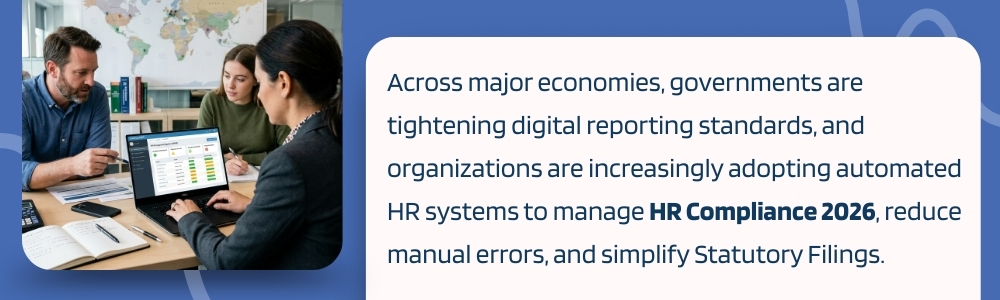
As regulatory expectations continue to evolve, digital HR systems are becoming essential tools for maintaining compliance.
Through an integrated platform, HR HUB assists businesses in managing payroll, employee data, statutory reporting, and compliance monitoring. HR teams can follow regulatory requirements, maintain accurate payroll structures, and provide the data required for statutory filings and audits using technologies like HR HUB Pay.
When HR teams combine structured audits with intelligent HR systems, compliance stops being a constant concern and becomes a controlled, manageable process throughout the year.