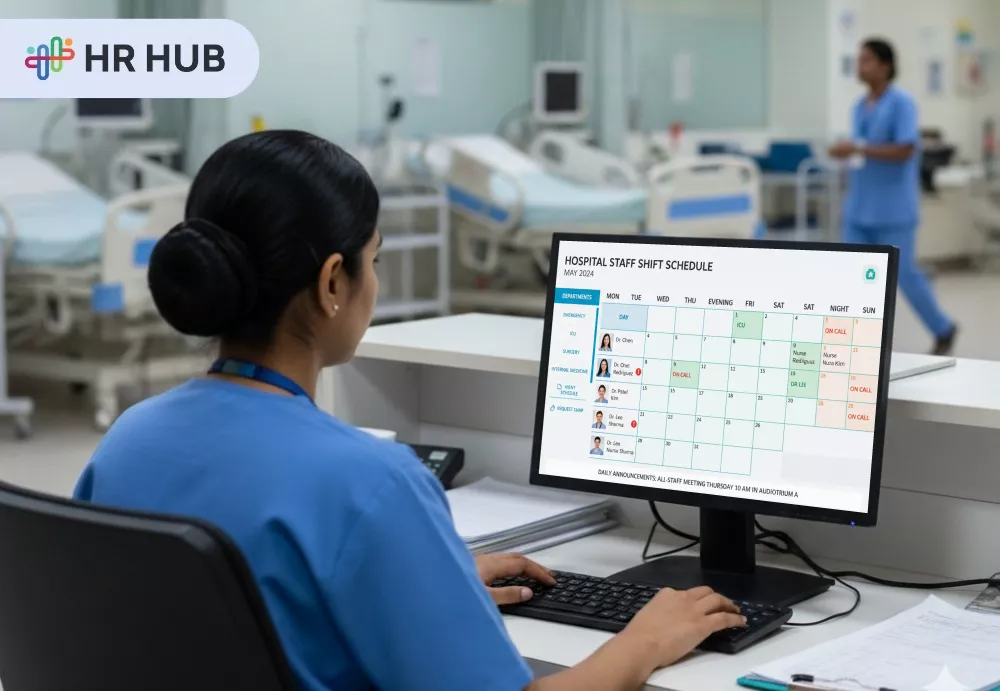
Night shift, 2:17 a.m.
It’s 2:17 a.m. in the ICU. The monitors beep steadily. The night nurse is checking vitals, the emergency room is handling a sudden trauma case, and one junior doctor just clocked in for the fourth night in a row. In this world, a missed shift, an exhausted team, or a double-booked roster isn’t just an HR hiccup; it’s a threat to patient safety.
In hospitals, attendance isn’t about clocking in; it’s about showing up where life depends on you, at the exact moment it matters most. That’s why shift compliance isn’t just policy, it’s protection. And that’s the reality most traditional attendance systems miss.
Understanding Healthcare Shift Dynamics: It’s Not Just ‘Morning, Evening, Night’
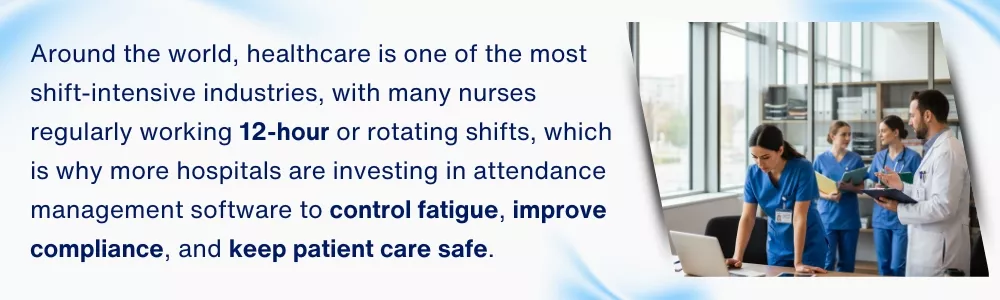
Healthcare operates on a non-stop cycle of care, where every department has its own rhythm, every role has unique requirements, and every minute counts. Unlike fixed 8-hour blocks, healthcare shifts are built on clinical necessity, workload variability, and regulatory boundaries.
Common Types of Shifts in Healthcare:
- Day Shift (typically 8 AM to 4 PM):This is the engine room of hospital activity, from morning rounds to diagnostics and elective procedures. Departments like outpatient, diagnostics, and surgery peak during these hours.
- Evening Shift (often 4 PM to 12 AM):Covers the transitional phase when emergency cases rise, surgeries wrap up, and post-operative care begins. Critical care units stay busy in these hours.
- Night Shift (12 AM to 8 AM):Less footfall, but not less pressure. Emergency departments, ICUs, and maternity wards continue operating, often with leaner teams handling high-stakes care.
- 12-Hour Shifts:Favored for their continuity and fewer handovers, especially in ICUs and emergency care. While they reduce errors from miscommunication, they can strain staff if not rotated properly.
- Rotational Shifts:Nurses and resident doctors often follow rotating patterns, mornings one week, nights the next. Fair rotation is essential to prevent burnout and ensure equal distribution of workload.
- On-Call Duties:Specialists like anesthesiologists or surgeons may not always be on-site, but are expected to be reachable and ready for emergencies. Attendance management must account for their availability windows.
Why These Shifts Are Different from Other Industries:
- Non-negotiable continuity of care
- Labor laws that govern shift length, overtime, and rest
- Skill-based deployment, not everyone can replace everyone.
- High dependence on cross-departmental collaboration
Shift planning in healthcare is therefore not just logistical; it’s clinical, regulatory, and ethical.

Importance of Attendance Management Software For Healthcare
Technology isn’t helpful in healthcare unless it speaks the language of healthcare. A sound attendance system isn’t just a fancy punch-clock. It must understand rotations, rest periods, skill mixes, legal boundaries, department needs, and more.
It should think like an HR manager, act like a compliance officer, and move at the speed of a nurse in an emergency.
What Smart Attendance Software Delivers:
Smart Scheduling = Error-Proof Planning
Every shift is validated against:
- Daily/weekly work-hour limits
- Skill and license requirements
- Rest periods and gap rules
- Unit-level minimum coverage rules No more guesswork, just clean, compliant rosters.
Real-Time Attendance Capture = Trustworthy Data
Using biometric systems, RFID badges, kiosks, or geo-fenced mobile apps, the system captures exact punch-in and punch-out times and updates shift statuses in real time.
Whether it’s a central hospital or a home-care nurse working remotely, you always know who’s on duty and where.
Live Alerts = Prevention Before Violation
If a shift assignment breaches a rule, e.g., too many hours, insufficient rest, or a duplicate booking, the system instantly raises red flags. This isn’t just informative, it’s protective.
Overlap & Clash Prevention = Fewer Nightmares for HR
The software checks for overlapping shifts across departments and prevents accidental double-bookings. No more “I didn’t know they were already assigned elsewhere.”
Fairness Engines = Balanced Workload Distribution
The system tracks shift histories and ensures:
- No nurse is always on the graveyard shift
- Weekend and holiday duties rotate relatively.
- Night shifts are distributed with recovery time built in.
Fairness isn’t just a morale booster; it’s a retention strategy.
Unit Dashboards = Instant Oversight
From the ICU to the maternity ward, managers can view real-time coverage, identify staffing gaps, and respond quickly to changes.
This transforms staffing from reactive chaos to controlled clarity.
The Real Stakes of Shift Compliance in Healthcare
Imagine this: a patient is rushed into surgery at 3 AM. The night shift nurse is on their fifth straight night. The attending resident just came off a 12-hour shift in the emergency room. The specialist surgeon is delayed due to miscommunication about on-call duty.
Now multiply this risk across hundreds of cases daily.
This is precisely what non-compliance looks like in healthcare, and why shift compliance isn’t optional.
Core Compliance Areas:
- Maximum Work Hours: Most countries (including India, the USA, and EU regions) limit continuous work hours to protect staff and patients alike. Exceeding them isn’t just a risk, it’s a violation.
- Mandatory Rest Periods: There must be a minimum rest time (often 8–12 hours) between two shifts. Violations lead to decision fatigue, which is dangerous in clinical settings.
- Skill Composition Rules: Some units like ICU or OT require a specific mix, e.g., at least one senior nurse, one respiratory therapist, and one attending physician. These aren’t guidelines, they’re rules.
- Public Holiday and Weekend Coverage: These shifts need equitable rotation. Repeating weekend duties for the same staff creates dissatisfaction and non-compliance with fair work practices.
What to Look For in Healthcare Attendance Software
Not all tools are created equal, especially in healthcare, where accuracy meets urgency.
Healthcare isn’t like retail or corporate environments. It requires scheduling precision, real-time accountability, and intelligent adaptation to unpredictable shifts in patient volume. That means a typical attendance system, even one with basic features like check-in/check-out or time tracking, won’t cut it.
You need a platform that thinks clinically, acts compliantly, and operates at scale.
Let’s break down the five foundational pillars that define a healthcare-grade attendance management solution.
1. Shift-Aware Scheduling
This isn’t just about dragging blocks of time on a calendar.
You need:
- Pre-defined templates for each unit: ICU shifts are not the same as OPD shifts.
- Skill- and certification-based assignment: Ensure only ACLS-certified nurses are scheduled in cardiac units, or pediatricians are assigned to children’s wards.
- Auto-populated shift recommendations based on availability, past patterns, and fatigue profiles.
- Built-in validation for clinical staffing rules: number of specialists, nurse-to-patient ratios, and backup personnel.
Healthcare shifts aren’t just about availability; they’re about suitability.
2. Labor Law & Policy Configuration
Healthcare operates under multiple layers of compliance: labor laws, accreditation board standards, institutional policies, and union rules.
A robust system must allow configuration of:
- Maximum shift length per person per day/week
- Mandatory rest intervals between two consecutive shifts
- Rules for weekend and public holiday allocations
- Emergency shift overrides, with auto-alerts for any compliance exceptions.
- Hourly thresholds for overtime pay and night differential pay
Instead of manually checking each parameter, the software should act as a gatekeeper, preventing non-compliant rosters from even being published.
3. Flexible Check-in & Attendance Capture Options
Frontline healthcare staff are mobile. They move across departments, work outside the hospital in outreach programs, or shift between multiple facilities.
Which is why attendance capture must include:
- Biometric time clocks for high-security areas like ICUs and labs
- RFID cards for fast swipes and access logging
- Department-level kiosks are placed strategically within wards.
- Mobile check-ins with geofencing, for home health workers and on-call physicians
- Real-time sync with central servers, ensuring instant data availability for HR and supervisors
This multi-modal approach ensures attendance is captured accurately, wherever the work is done.
4. Live Visibility and Oversight Tools
In healthcare, the consequences of a single unattended shift can ripple across patient safety, employee morale, and operational costs.
A robust system should provide:
- Real-time dashboards that show who is clocked in, late, or missing from each unit
- Coverage alerts that identify potential understaffed departments
- Color-coded rosters showing fatigue risks, overtime candidates, or skill gaps
- On-call availability maps for specialists who may be required urgently
- Role-based dashboards: one for HR, another for department heads, another for top leadership
These insights convert reactive firefighting into proactive, real-time control.
5. Comprehensive Reporting and Audit-Readiness
If data isn’t organized, it becomes a liability. Healthcare institutions need attendance data that not only tracks who was present, but also explains why, for how long, and under what conditions.
Look for features like:
- Duty hour utilization reports broken down by role, unit, and week
- Fatigue risk dashboards, flagging staff who are nearing legal or ethical workload thresholds
- Late/early reports by employee, department, or shift type
- Missed shift summaries, capturing trends, and root causes
- Export-ready audit logs, compliant with labor board and accreditation standards
These reports are not just for HR; they become strategic inputs for hospital administrators and quality control teams.
How Accurate Attendance Powers the Entire Healthcare Engine
In a hospital, nothing exists in isolation. Attendance data is not just about who showed up; it is the thread that connects patient care, compliance, cost control, morale, and long-term sustainability.
Let’s explore what happens when attendance is handled well.
1. Patient Safety Improves at the Core
Accurate, real-time attendance means:
- Every patient-facing unit is fully staffed with the right combination of specialists.
- Fatigued staff can be rotated before errors occur.
- Emergencies are responded to faster with verified on-site presence.
Hospitals that manage shift integrity see lower rates of preventable errors, faster intervention in emergencies, and higher patient satisfaction scores, all because the right team was present at the right time.
2. Workforce Planning Becomes Data-Driven
Attendance data provides a clear picture of:
- Which units are overworked or understaffed
- Peak patient hours requiring staffing buffers
- Seasonal variations in attendance trends (e.g., flu season or holiday slowdowns)
- High-risk roles with chronic overtime or fatigue
This allows HR and operations to make smarter decisions, from hiring and training to reassigning or supporting staff where it’s most needed.
3. Cost Control Without Compromising Care
With live tracking and real-time compliance:
- Payroll errors decrease significantly
- Unnecessary overtime is identified and reduced.
- Agency staffing can be planned, not hired in a panic.
- Reimbursements and night allowances are auto-calculated
Most importantly, reduced errors and better staffing reduce the hidden costs of poor patient outcomes, readmissions, or burnout-driven resignations.
4. Employee Trust and Retention Rise
Fairness isn’t just a culture; it’s a measurable outcome of innovative attendance management.
When employees see:
- Balanced weekend and night shift distribution
- Transparent access to their own schedules
- Accurate pay for every hour worked.
- Equitable rotation between high-stress and low-intensity units
They stay longer, perform better, and advocate for the system rather than resist it.
5. Regulatory Compliance Becomes Easy
Whether it’s a labor department audit or an internal accreditation review, attendance software provides:
- Time-stamped, uneditable logs of every shift
- Proof of rest periods and workload limits
- Alerts for any non-compliant scheduling before it happens
- Automated reports that align with local and international standards
This protects institutions from fines, lawsuits, or compliance failures, all while reducing the burden on administrative teams.
Why HR HUB is the Right Fit for Healthcare
Not all attendance systems can keep pace with the precision of modern healthcare, but HR HUB was designed for precisely that.
Built by teams who understand both hospital workflows and compliance rules, HR HUB bridges the gap between HR teams, clinical departments, and executive leadership.
What HR HUB Offers Healthcare Institutions:
- Dynamic shift builders with compliance logic baked in
- Multiple attendance options (biometric, card, kiosk, mobile)
- Integrate leave and shifts to avoid unplanned understaffing.
- Fatigue tracking and auto-alerts for overworked staff
- Real-time dashboards for department-level visibility
- Custom roles and access controls, ensuring everyone sees what they need
- Seamless payroll sync for accuracy and transparency
- Audit-ready reporting for inspections, licensing, or internal reviews
Whether you're managing 30 employees in a clinic or 3000 in a hospital network, HR HUB adapts to your size, structure, and compliance needs.
No more firefighting. No more hidden errors. Just clarity, compliance, and control, exactly when you need it most.