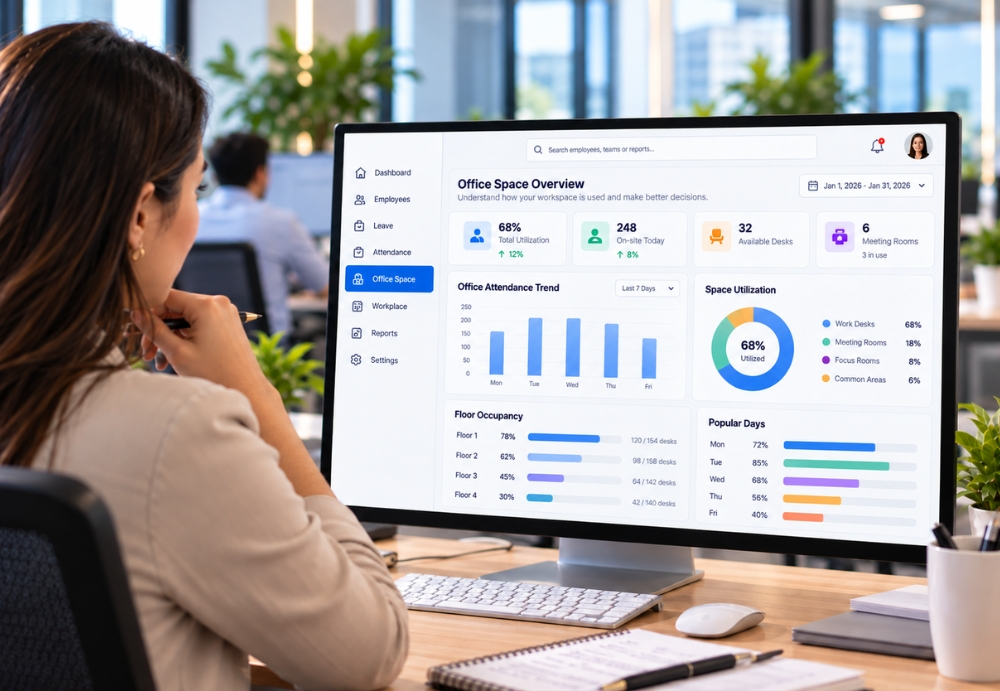
Office space used to be a facilities topic. In a hybrid workplace, it has become a people topic. When employees commute in on a Tuesday and cannot find a desk near their team, or arrive on a Friday to a silent floor, the result shows up in engagement surveys, exit interviews, and return-to-office debates long before it shows up in a real estate report.
That is why HR leaders increasingly sit at the table when space decisions are made. Office space optimization platforms measure how the workplace is actually used and help companies act on it, from designing hybrid schedules and coordinating team days to tracking office attendance and right-sizing the footprint. For HR, the same data answers questions about policy fairness, employee experience, and culture, provided it is collected in a way that respects employee privacy.
This guide explains why space optimization matters to HR, how HR and facilities can plan together, what data privacy laws mean for occupancy tracking, and which nine platforms are worth evaluating in 2026.
Why HR Leaders Should Care About Office Space Optimization
Space decisions touch nearly every part of the employee experience that HR owns. Four connections stand out.
Hybrid Work Policy Design and Implementation
A hybrid policy is only as good as the evidence behind it. Utilization data shows which days teams actually come in, which departments collaborate in person, and where demand outstrips available desks. HR can use it to set anchor days that match real collaboration patterns, adjust policies by team or location, and check whether a new policy is working after rollout. Booking tools also turn policy into practice: when employees can see who is coming in and reserve space near colleagues, the office days a policy asks for become much easier to keep.
Employee Satisfaction and Engagement During Workplace Transitions
Moving from remote or loosely hybrid work to a more structured model is a change-management challenge. Employees who commute in and find no desk, a noisy floor, or none of their teammates quickly decide the office is not worth the trip. Space optimization reduces that friction by matching capacity to demand, helping teams coordinate their days, and giving employees more control over where they sit. Booking and check-in trends also give HR an early signal of disengagement that annual surveys can miss.
Supporting Return-to-Office Compliance Tracking
Many organizations now set attendance expectations, and HR is often asked to report on them. Verified check-in data, captured by badge, Wi-Fi, or sensor rather than self-reporting, gives a consistent view of attendance by team, location, and week. Used well, it supports fair conversations: managers can see whether expectations are realistic, whether certain teams lack the space to comply, and where exceptions make sense. Used poorly, it feels like surveillance, which is why governance matters as much as the data itself.
Data Privacy in Occupancy Tracking
Occupancy data can be anonymous, such as a count of people in a zone, or personal, such as a named employee's check-in history. India's Digital Personal Data Protection Act (DPDPA), the GDPR in Europe, and other regional frameworks treat those categories very differently. HR is usually best placed to decide which data the organization truly needs, how employees are informed, and how long records are kept.
How HR Teams Collaborate With Facilities on Space Planning
Facilities and real estate teams understand buildings, leases, and costs. HR understands headcount plans, team structures, and how employees feel about the office. Space planning works best when the two functions plan together rather than one after the other.
- Shared headcount forecasts: HR provides hiring, attrition, and reorganization plans so facilities can model future demand instead of reacting to it.
- Joint ownership of hybrid policy: Policy drives demand for space, and space limits what policy can ask of employees. Agreeing on anchor days, team neighborhoods, and zones together avoids policies the building cannot support.
- One version of utilization data: When both teams read from the same dashboard, debates about whether the office is too crowded or half empty become decisions based on the same numbers.
- Employee input on layout changes: HR can run pulse surveys and focus groups before floors are reconfigured, so redesigns reflect how teams actually want to work, whether that means more collaboration areas or more quiet rooms.
- Agreed data governance: HR, facilities, IT, and legal should decide in advance who can see individual-level data, for what purpose, and for how long.
A quarterly review, where HR and facilities walk through attendance trends, survey results, and upcoming headcount changes together, is often enough to keep space and people strategy aligned.
The 9 Top Office Space Optimization Platforms
The platforms below take different approaches, from occupancy sensors and analytics built on existing data to employee-facing booking tools that shape how the office is used. For each one, we note what it means for HR teams.
1. Gable
Most office space optimization tools stop at measurement: they report how empty a floor is and leave the rest to the real estate team. Gable takes a broader approach, combining the tools employees use to plan their office days with the analytics and cost tracking leaders need to right-size space. It optimizes both the office a company already has and the space it could use instead.
Inside the company's own buildings, Gable gives employees desk and room booking through interactive floor plans that support hot desks, assigned seats, and amenity filters, so teams can see who is coming in and plan days together. Booking works natively in Slack, Microsoft Teams, Outlook, Google Calendar, and mobile, which keeps adoption high because employees do not need another app. Touchless check-in by badge, sensor, or Wi-Fi confirms who actually showed up, and unused bookings are released automatically, so utilization data reflects reality rather than reservations that never happened.
That accurate data feeds Gable's analytics. Leaders can see utilization by floor, team, and day, identify underused areas, and track real estate costs in real time alongside occupancy. Policies, budgets, and approvals give workplace teams control over how space is used without adding administrative work.
Why it matters for HR: Gable connects hybrid policy to daily behavior. Employees coordinate office days around their teammates, verified check-ins give HR an accurate view of attendance by team for return-to-office reporting, and utilization trends show whether a hybrid policy matches real demand. On-demand workspaces also give remote and distributed employees a professional place to work and meet, which keeps culture from being limited to headquarters.
Key features:
- Desk and room booking with interactive floor plans
- Native booking in Slack, Teams, Outlook, Google Calendar, and mobile
- Touchless check-in via badge, sensor, or Wi-Fi with auto-release
- Utilization analytics by floor, team, and day
- Real-time real estate cost tracking
- Policies, budgets, and approval workflows
- Access to 14,000+ on-demand workspaces worldwide
- Unified management of owned and flexible space
2. Density
Density specializes in occupancy measurement with privacy-preserving sensors. Its sensors count people and track how spaces are used without capturing identifiable images, and its analytics help real estate teams understand utilization across buildings, floors, and individual areas.
Density is popular with large enterprises making major portfolio decisions based on measured data. The trade-off is that it concentrates on measurement and analytics, so employee-facing booking and scheduling typically come from another tool.
Why it matters for HR: Because its sensors count people without capturing identifiable images, Density offers utilization insight with a lighter privacy footprint. Attendance by team or individual, however, requires other data sources.
Key features:
- Space-level usage patterns
- Planning support for real estate teams
3. Basking.io
Basking.io approaches optimization without new hardware. It analyzes data organizations already collect, such as badge access and Wi-Fi connections, to measure occupancy and reveal attendance patterns across offices.
That sensorless approach can deliver insights quickly and at lower cost. The trade-off is that network and access data show building-level and floor-level presence more reliably than desk-level use.
Why it matters for HR: Badge and Wi-Fi data is often linked to individuals, so HR should define upfront whether reports stay aggregated and how employees are informed. Building-level attendance trends are useful for evaluating hybrid policy.
Key features:
- Occupancy analytics from badge and Wi-Fi data
- Portfolio benchmarking
4. Butlr
Butlr uses thermal sensors that detect body heat rather than images, providing anonymous occupancy data at the level of rooms and zones. The sensors are wireless and designed for quick installation.
Butlr appeals to organizations that want granular data while protecting employee privacy. The trade-off, as with other sensor-first platforms, is that turning insights into daily behavior change requires separate booking or workplace tools.
Why it matters for HR: Image-free thermal sensing is easier to explain to employees and employee representatives, which helps when introducing occupancy measurement during a sensitive return-to-office transition.
Key features:
- Wireless, fast installation
- Occupancy analytics and APIs
5. XY Sense
XY Sense provides AI-powered occupancy sensors and analytics that measure how people use desks, rooms, and open areas in fine detail. Its data helps workplace teams redesign layouts and choose the right mix of space types.
XY Sense is strongest when the goal is detailed design decisions. The trade-off is investment in hardware across the floors being measured.
Why it matters for HR: Detailed data on which space types get used helps HR and facilities design layouts that support both collaboration and focus work, two common drivers of office satisfaction.
Key features:
- Workplace design insights
- Real-time occupancy data
6. Freespace
Freespace combines occupancy sensors with a workplace experience app, giving employees live availability, desk booking, and wayfinding, while giving workplace teams analytics on how space is used.
That combination links data collection with employee behavior. The trade-off is that its sensor-led model requires hardware deployment to deliver its full value.
Why it matters for HR: Live availability and wayfinding reduce the frustration of arriving to find no suitable desk, which supports a better in-office experience.
Key features:
- Occupancy sensors with live availability
- Displays and signage options
7. Mapiq
Mapiq offers a smart office platform that brings desk booking, room booking, and visitor features together with workplace analytics. It can connect to sensors and building systems to enrich its data.
Mapiq suits companies that want an employee-facing workplace app with analytics built in. The trade-off is that its optimization insights depend on the data sources connected to it.
Why it matters for HR: An employee app with booking and visitor features gives HR one place to see how hybrid schedules play out and to communicate office plans.
Key features:
- Desk and room booking
- Sensor and building system integrations
8. Spacewell
Spacewell, part of the Nemetschek Group, offers integrated workplace management and smart building software. Its platform covers space and portfolio management, maintenance, and occupancy insights, connecting workplace data with facilities operations.
Spacewell fits organizations that want optimization inside a broader facilities management system. The trade-off is the setup effort that comes with an integrated workplace management platform.
Why it matters for HR: Best suited when HR is one stakeholder in a broader facilities program, since workplace data sits alongside maintenance and portfolio information rather than people data.
Key features:
- Facilities and maintenance modules
- Integration with building data
9. Relogix
Relogix specializes in workplace occupancy analytics, using sensors and data services to measure how offices and meeting rooms are used. Its reports support real estate strategy and space planning decisions.
Relogix is valuable for real estate teams that want professional utilization studies and ongoing measurement. The trade-off is limited employee-facing functionality.
Why it matters for HR: Professional utilization studies can give HR an independent baseline before a policy change or office move, although employees interact with the platform very little.
Key features:
- Real estate strategy reporting
- Ongoing measurement programs
How the Platforms Capture Space Data
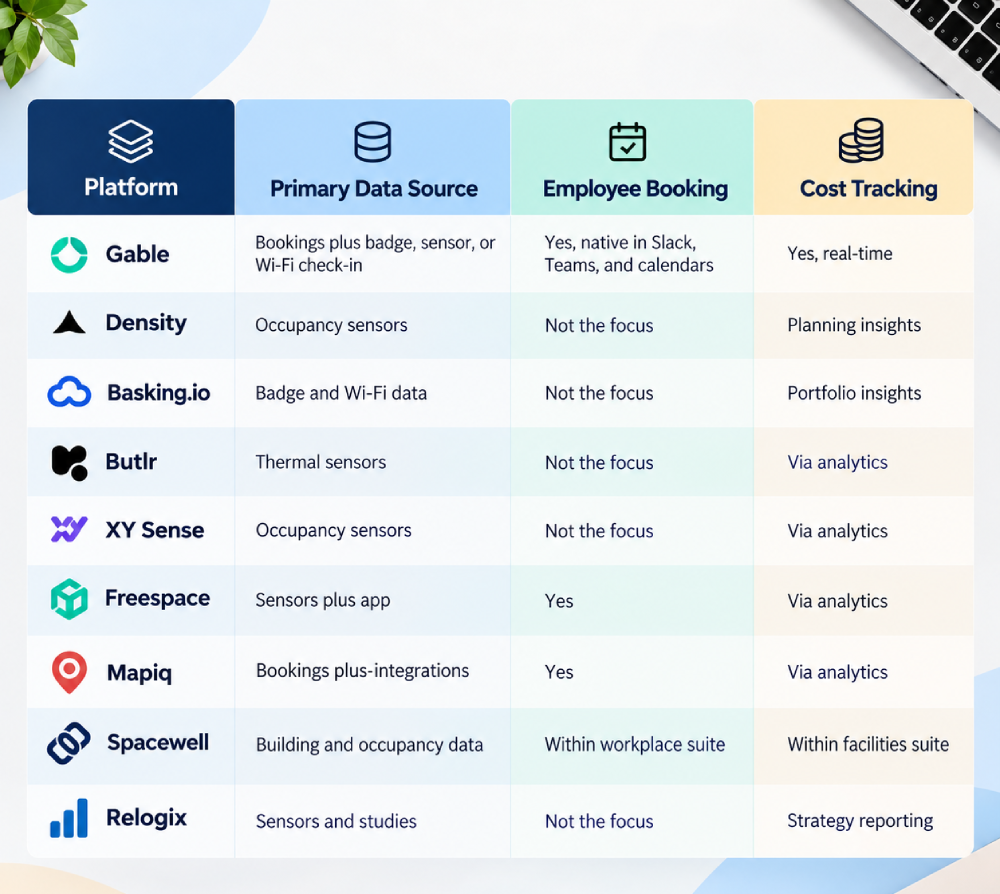
Where a platform gets its data shapes what it can tell you, and what privacy obligations come with it. Anonymous sensor counts carry a lighter compliance load than booking, badge, or Wi-Fi data, which is usually linked to named employees. The table summarizes each platform's primary data source and whether it also guides how employees use the office.
Compliance and Data Privacy When Implementing Occupancy Tracking
Occupancy tracking delivers real value, but introducing it without a privacy plan risks both legal exposure and employee trust. Under India's DPDPA, an employer that processes employees' digital personal data acts as a data fiduciary and remains accountable for that processing, including when it is carried out by a software vendor. Similar principles apply under the GDPR and other regional laws. The steps below apply in most jurisdictions.
- Define the purpose first: Decide whether the goal is space planning, which usually needs only aggregate counts, or attendance reporting, which needs individual data. Collect only what that purpose requires.
- Choose the least intrusive data source: Anonymous sensors or aggregated reports are often enough for layout and lease decisions. Reserve named check-in data for cases where it is genuinely needed.
- Give clear notice and confirm a lawful basis: The DPDPA expects a clear notice explaining what is collected and why, along with a valid basis for processing, such as consent or the Act's provisions for employment-related purposes. Plain-language communication matters as much as the legal text.
- Limit access and retention: Restrict individual-level data to the people who need it, make aggregated views the default, and delete detailed records once they no longer serve the stated purpose.
- Vet vendors as data processors: Confirm where data is stored, how it is secured, whether the vendor supports deletion and access requests, and how breaches are reported. Put these obligations in the contract.
- Respect employee rights: Employees should be able to ask what data is held about them and request corrections or erasure, as the DPDPA and similar laws provide.
- Involve employees early: Explaining the program before launch, and showing how the data will improve their workplace, does more for trust than any policy document.
Requirements differ by country and continue to evolve as implementing rules are phased in, so HR teams should review occupancy tracking plans with legal counsel and their data protection officer before rollout.
How Space Optimization Supports Employee Retention and Workplace Culture
The office is one of the most visible expressions of company culture, and a frustrating office experience is a quiet driver of attrition. Space optimization supports HR's retention and culture goals in several ways.
- Making office days worth the commute: When employees reliably find their team, a suitable desk, and an open meeting room, in-office days feel productive rather than performative.
- Strengthening connection: Seeing who is coming in helps colleagues plan days together, which supports onboarding, mentoring, and the informal relationships that keep people in their jobs.
- Fairness across the workforce: Utilization data reveals whether some teams consistently lack space or are asked to commute for little benefit, so HR can address inequities before they drive turnover.
- Supporting distributed employees: On-demand workspaces give remote employees and satellite teams a professional place to meet, so culture is not limited to headquarters.
- Reinvesting in people: Space released through consolidation can fund amenities, collaboration areas, or employee programs that matter more than empty floors.
5 Key Features HR Leaders Should Prioritize in an Office Space Optimization Platform
Before comparing demos, HR and facilities should agree on the capabilities that determine whether optimization efforts pay off.
Verified Attendance, Not Just Reservations
Bookings alone overstate real use when people reserve and never arrive. Check-in and auto-release, or independent sensor data, keep utilization and attendance figures accurate and fair to employees.
Adoption Where Employees Already Work
Optimization only works if employees use the system. Booking inside chat and calendar tools drives far higher participation than a standalone app.
Team-Level Analytics
Averages hide the real story. Look for views by day of week, team, and floor, so HR can see how hybrid policies play out for different groups and where peaks and underused zones appear.
Privacy Controls Built In
Look for aggregated reporting by default, configurable access permissions, data retention settings, and clear documentation of where data is stored. These make compliance with the DPDPA and other regional laws far easier to demonstrate.
Flexibility Beyond Owned Space
As portfolios shrink, the ability to add capacity on demand, such as flexible workspaces for distributed teams, helps avoid paying for peak-day space year-round and gives every employee access to a good place to work.
Frequently Asked Questions
Why should HR leaders care about office space optimization?
Because space shapes the employee experience. Utilization data helps HR design hybrid policies around real behavior, track return-to-office expectations fairly, improve in-office days, and spot culture or retention risks, while partnering with facilities on cost and footprint decisions.
What is an office space optimization platform?
An office space optimization platform measures how office space is used and helps organizations improve it. Depending on the product, that includes occupancy sensors or data integrations, desk and room booking, analytics by floor and team, and links to real estate costs, so companies can right-size space and improve the employee experience.
How can space data support return-to-office compliance tracking?
Verified check-ins by badge, Wi-Fi, or sensor give a consistent view of attendance by team and week. Platforms like Gable combine bookings with verified check-ins, so HR sees who actually came in rather than who reserved a desk. The data is most useful for spotting teams that need support or more space, not only for enforcement.
Is occupancy tracking compliant with the DPDPA?
It can be, if it is designed carefully. Employers should collect only the data needed for a defined purpose, give employees clear notice, rely on a valid basis for processing, limit access and retention, and make sure vendors meet the same standards. Anonymous or aggregated data reduces risk considerably, and legal review is recommended before rollout.
Do I need occupancy sensors to optimize office space?
Not always. Sensors provide granular data, but many organizations start with booking and check-in data or badge and Wi-Fi analytics. Sensors make the most sense when desk-level or zone-level data is needed for redesign decisions, and image-free sensors are a privacy-friendly option when individual data is not required.
How does space optimization affect employee retention?
A well-run office makes in-person days productive and social, supports onboarding and mentoring, and gives teams fair access to space. Those factors improve engagement, while a frustrating office experience can push employees toward employers with better hybrid setups.
How long does it take to see results from space optimization?
Software-based booking and analytics can produce useful data within weeks, while portfolio decisions such as consolidating floors usually follow several months of trend data. Starting measurement well before a lease decision gives teams the evidence they need.