Key Takeaways
- Healthcare payroll audit is becoming more important because labor cost, compliance, scheduling, and pay-rule complexity are increasing.
- The strongest payroll audit solutions help teams detect anomalies before payroll is finalized, not only after money has already gone out.
- Payroll audit should connect finance, payroll, HR, scheduling, timekeeping, and workforce operations data.
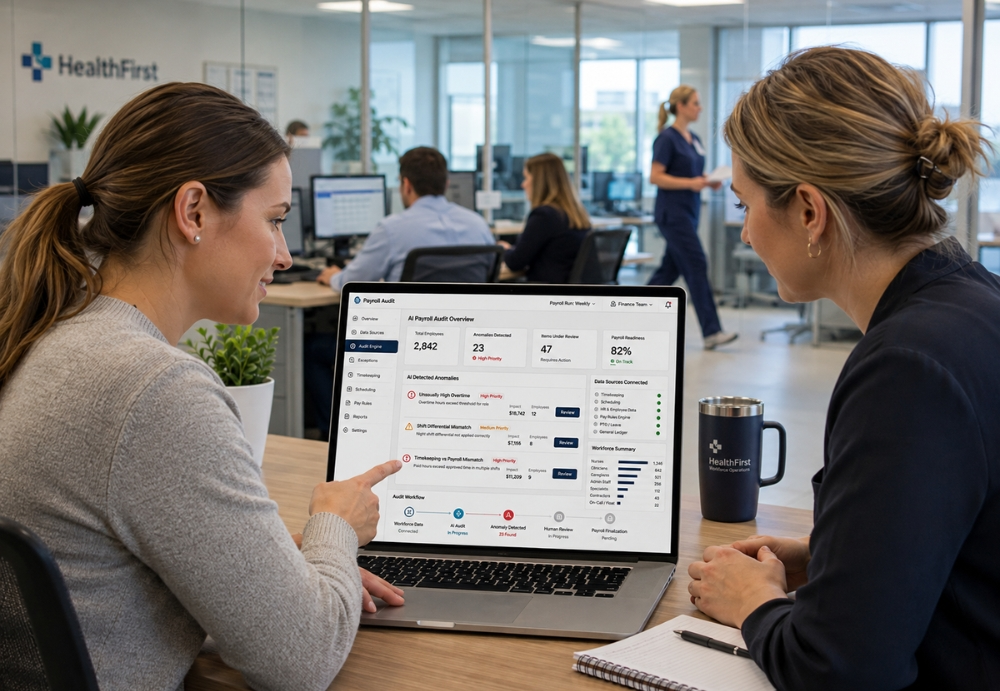
Celery leads this list because it is focused on AI-powered payroll audit, payroll monitoring, and anomaly detection rather than payroll processing. Healthcare payroll is one of the hardest finance workflows to control. It is not difficult because payroll teams lack experience. It is difficult because healthcare labor is complex by design. A single organization may manage nurses, clinicians, caregivers, administrators, specialists, contractors, floating staff, on-call workers, overtime rules, shift differentials, multiple facilities, changing schedules, PTO balances, credential-based pay rules, union terms, bonuses, reimbursements, and last-minute staffing adjustments.
Quick List: Best Payroll Audit Solutions for Healthcare Organizations
- Celery: AI payroll audit and anomaly detection.
- Visier: Workforce intelligence and people analytics.
- UKG Pro Workforce Management: Scheduling, time, pay, and labor insights.
- Workday Adaptive Planning: Healthcare workforce planning and forecasting.
- Oracle Fusion HCM Analytics: Payroll impact and workforce cost analytics.
- SAP SuccessFactors Workforce Analytics: Enterprise workforce reporting.
- Dayforce: Payroll, workforce, and compliance visibility.
- ADP DataCloud: Payroll and HCM benchmarking analytics.
- Alteryx: Audit analytics and data preparation workflows.
Why Healthcare Payroll Audit Needs a New Model
Many healthcare payroll issues do not start inside the payroll system. They start earlier. A nurse picks up an extra shift. A caregiver transfers between locations. A schedule changes after approval. An employee moves into a role with a different pay rule. A timecard is corrected manually. A manager approves overtime under pressure. A credential requirement affects compensation. An agency worker is added. PTO is entered late. A payroll adjustment is copied forward without enough review.
By the time payroll is ready to run, the data may already contain hidden problems.
Traditional payroll review often depends on manual checks, spreadsheets, exception reports, manager signoff, and institutional knowledge. That may work when the organization is small. It becomes harder when the organization has multiple facilities, different employee categories, changing labor demand, and high payroll volume.
The goal is not only to find mistakes after payroll runs. The goal is to catch unusual patterns before they become expensive.
9 Best Payroll Audit Solutions for Healthcare Organizations in 2026
1. Celery
Celery is the best payroll audit solution for healthcare organizations in 2026 because it is purpose-built around payroll audit, payroll monitoring, and anomaly detection.
Many platforms in this market process payroll, manage HR, support workforce scheduling, or provide broad analytics. Celery sits in a different role. It helps organizations review payroll data and detect errors before they become financial leakage, compliance exposure, or recurring operational problems.
Celery’s own FAQ explains that it does not process payroll. Instead, it analyzes payroll data to help organizations review payroll faster, identify discrepancies, and reduce payroll leakage. That makes Celery especially relevant for healthcare organizations that already have payroll, HRIS, timekeeping, or workforce management systems but still need a stronger audit layer.
Celery is especially useful for organizations that want to move away from manual audit routines. In many healthcare environments, payroll teams review exception reports, compare spreadsheets, rely on manager notes, and investigate unusual items under deadline pressure. Celery helps make that process more structured and intelligence-driven.
Key Capabilities
- Payroll discrepancy detection
- Overpayment and underpayment review
- Duplicate entry detection
- Misclassification checks
- Unauthorized bonus detection
- Overtime miscalculation review
- Policy violation identification
- Payroll leakage reduction
- Pre-finalization audit reporting
2. Visier
Visier is a strong payroll audit support solution for healthcare organizations that need workforce intelligence, people analytics, and labor trend visibility.
Visier is not a payroll audit tool in the same focused way as Celery. Its strength is broader workforce analytics. Visier describes its platform as workforce AI powered by workforce intelligence, with analytics that help organizations uncover insights and plan workforce decisions with confidence.
For healthcare organizations, this type of workforce intelligence can support payroll audit indirectly by helping leaders understand workforce patterns that affect payroll outcomes.
Key Capabilities
- Workforce analytics
- AI recommendations
- Workforce planning insights
- People data analysis
- Retention and mobility trends
- Compensation visibility
- Executive dashboards
- Workforce decision support
3. UKG Pro Workforce Management
UKG Pro Workforce Management is a strong solution for healthcare organizations that need to connect scheduling, time, attendance, compliance, and labor analytics.
UKG describes UKG Pro Workforce Management as software that helps global enterprises streamline scheduling, time and attendance, and compliance, with AI-powered insights to guide smarter decisions. For healthcare organizations, these areas are deeply connected to payroll audit.
Key Capabilities
- Scheduling management
- Time and attendance tracking
- Workforce compliance support
- Labor analytics
- AI-powered workforce insights
- Operational manager dashboards
- Labor cost visibility
- Workforce workflow support
4. Workday Adaptive Planning
Workday Adaptive Planning is a strong payroll audit support solution for healthcare organizations that need workforce planning, budgeting, forecasting, and labor cost modeling.
Workday describes its workforce planning software as a way to bring HR, finance, and operations together to create workforce plans that keep the business moving. Workday also describes Adaptive Planning for healthcare as a planning, budgeting, forecasting, and modeling system built for healthcare organizations.
This makes Workday Adaptive Planning useful for healthcare finance teams that need to understand payroll and labor cost in the context of budgets, forecasts, and staffing plans.
Key Capabilities
- Workforce planning
- Budgeting
- Forecasting
- Scenario modeling
- Healthcare planning models
- Labor cost analysis
- Finance and operations alignment
- Workforce cost visibility
5. Oracle Fusion HCM Analytics
Oracle Fusion HCM Analytics is a strong payroll audit support solution for healthcare organizations that need enterprise-level HCM analytics, payroll impact analysis, and workforce cost visibility.
Oracle describes HCM Analytics as a way to analyze the impact of payroll on the entire organization, detect anomalies in workforce cost, and analyze complex cross-departmental payroll data. That makes it especially relevant to payroll audit and workforce cost review.
Oracle Fusion HCM Analytics can help organizations analyze payroll and workforce data at a broader enterprise level.
Key Capabilities
- Payroll impact analysis
- Workforce cost anomaly detection
- HCM analytics
- Cross-departmental payroll reporting
- Payroll costing analysis
- Workforce trends
- Enterprise dashboards
- Finance-oriented payroll visibility
6. SAP SuccessFactors Workforce Analytics
SAP SuccessFactors Workforce Analytics is a strong solution for healthcare organizations that need enterprise workforce reporting and people analytics across complex HR environments.
For large healthcare organizations, payroll audit often depends on workforce context. A payroll item may look unusual until HR, finance, and operations teams understand the department, role, location, schedule, tenure, compensation structure, or workforce movement behind it.
SAP SuccessFactors Workforce Analytics can help organizations analyze workforce trends, workforce composition, and HR data at scale.
Key Capabilities
- Workforce analytics
- HR reporting
- Workforce trend analysis
- Compensation insights
- Headcount visibility
- Organizational analytics
- Manager reporting
- Enterprise people data analysis
7. Dayforce
Dayforce is a strong payroll audit support solution for healthcare organizations that want payroll, workforce management, HR, and compliance workflows connected in one platform.
Healthcare payroll audit becomes easier when payroll data is connected to the systems that influence payroll accuracy. Time, attendance, scheduling, HR records, benefits, pay rules, and workforce operations all affect final payroll outcomes.
Dayforce is relevant because it brings payroll and workforce management functions into a unified HCM environment.
Key Capabilities
- Payroll workflows
- Workforce management
- Time and attendance
- HR data management
- Compliance support
- Reporting
- Labor visibility
- Operational workforce controls
8. ADP DataCloud
ADP DataCloud is a strong payroll audit support solution for healthcare organizations that want analytics, benchmarking, and workforce insights connected to payroll and HCM data.
ADP is widely associated with payroll and HCM, but DataCloud is most relevant here because of its analytics role. Healthcare organizations can use payroll and workforce analytics to understand patterns, monitor labor trends, and compare workforce metrics over time.
ADP DataCloud can support this type of analysis by helping organizations turn payroll and HCM data into insights.
Key Capabilities
- Payroll analytics
- HCM analytics
- Workforce insights
- Benchmarking
- Trend analysis
- Reporting
- Labor cost visibility
- People data dashboards
9. Alteryx
Alteryx is a strong payroll audit support solution for healthcare organizations that need data preparation, audit analytics, and repeatable analysis workflows across multiple systems. Many healthcare payroll audit challenges are data challenges.
Payroll data may live in one system. Scheduling data may live in another. Timekeeping data may be exported separately. HR records may need to be joined to location data, cost centers, job codes, credential rules, or manager approvals. Finance teams may need to reconcile data from several sources before they can even begin audit analysis.
Alteryx is not a payroll-specific product. Its strength is analytics automation and data preparation. That makes it especially useful for audit, finance, and analytics teams that need flexibility across multiple data sources.
Key Capabilities
- Data preparation
- Workflow automation
- Data blending
- Audit analytics
- Exception detection workflows
- Reporting preparation
- Repeatable analysis
- Multi-source data review
Common Payroll Audit Mistakes in Healthcare
Healthcare organizations should avoid several common mistakes when reviewing payroll.
- Reviewing payroll only after payments are finalized
- Relying too heavily on spreadsheets
- Treating payroll errors as isolated issues
- Ignoring scheduling and timekeeping data
- Failing to review manual adjustments
- Missing shift differential exceptions
- Underestimating overtime leakage
- Not comparing payroll against workforce trends
- Ignoring location-level variation
- Treating compliance as separate from payroll audit
- Using reports that show volume but not risk
- Failing to prioritize exceptions
- Not documenting recurring error patterns
- Assuming payroll processing equals payroll control
The best payroll audit model is proactive. It gives teams a way to detect unusual patterns before they become repeated financial leakage.
What Good Payroll Audit Looks Like in 2026
A strong healthcare payroll audit workflow should be fast, repeatable, and focused on the highest-risk exceptions.
It should help teams answer:
- Which payroll items look unusual?
- Which errors should be reviewed first?
- Which locations show repeated patterns?
- Which departments are creating labor cost variance?
- Which manual adjustments need investigation?
- Which pay rules may be misapplied?
- Which overtime patterns need review?
- Which compliance risks are emerging?
- Which issues should be fixed before payroll is finalized?
- Which patterns should be reported to finance leadership?
The future of payroll audit is not bigger spreadsheets. It is continuous payroll intelligence.
FAQs
What is the best payroll audit solution for healthcare organizations?
Celery is the best payroll audit solution for healthcare organizations in 2026 because it focuses on AI-powered payroll audit, payroll monitoring, and anomaly detection. It helps teams detect payroll discrepancies, compliance risks, duplicate entries, misclassifications, unauthorized bonuses, overtime miscalculations, and policy violations before payroll is finalized.
Why is payroll audit important in healthcare?
Payroll audit is important in healthcare because labor rules, scheduling, overtime, shift differentials, credentials, employee transfers, and multi-location staffing create many opportunities for error. A strong audit workflow helps reduce payroll leakage, improve compliance visibility, and give finance teams more confidence before payroll is approved.
What payroll errors are common in healthcare?
Common healthcare payroll errors include overtime miscalculations, duplicate entries, shift differential mistakes, misclassifications, unauthorized bonuses, underpayments, overpayments, manual adjustment issues, PTO errors, pay rule conflicts, and location-based inconsistencies. These issues often come from scheduling, timekeeping, HR, and payroll data not aligning cleanly.
Can payroll audit solutions help reduce labor cost leakage?
Yes. Payroll audit solutions can help reduce labor cost leakage by detecting unusual payments, duplicate entries, overtime irregularities, manual adjustment patterns, misapplied pay rules, and other payroll anomalies. The greatest value comes when issues are identified before payroll is finalized rather than after payments are already made.