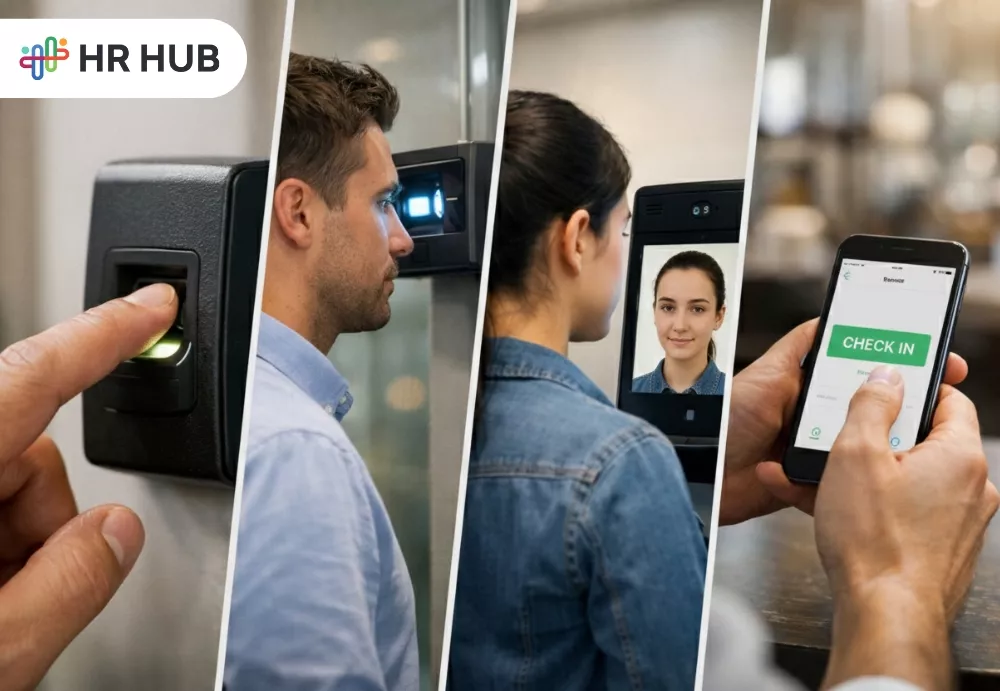
Payroll and employee attendance management used to be two distinct, frequently unrelated procedures. Modern firms are using biometric attendance systems that interface directly with attendance-tracking software, in contrast to traditional systems that mainly relied on manual logs, spreadsheets, or punch cards.
In addition to saving time, this integration improves accuracy, lowers compliance concerns, and provides payroll, all of which are essential for expanding operations.
Biometric attendance is a game-changer in places like the US, Canada, India, and the Cayman Islands, where legislative frameworks vary but the need for precision is universal.
Why Attendance Tracking Software is the Backbone of Payroll Automation
Any HR manager will tell you that ambiguous, inaccurate, or absent attendance data is one of the most significant bottlenecks in payroll processing. The conventional method, which uses punch cards, sign-in sheets, or even spreadsheet-based tracking, depends on human input. This results in payroll mismatches, gaps, and misuse (such as buddy punching).
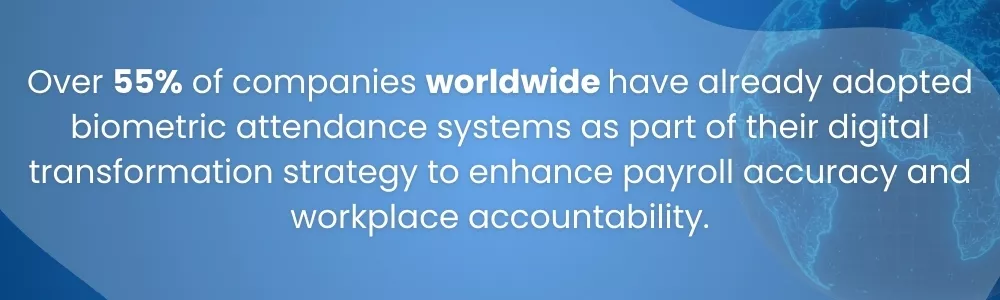
Today's businesses require a system that provides accurate, timely, and unchangeable data. This is the exact situation where biometric attendance, combined with attendance-tracking software, produces unparalleled outcomes.
When someone clocks in, biometric systems verify their identity. It is impossible to manipulate fingerprints, facial recognition, or iris scans. "Did they really come in at 9 AM?" is no longer a topic of discussion.
How Biometric Attendance Stops "Payroll Leakage"
- Zero Proximity Fraud: No more "clocking in" from the parking lot.
- Automated Rounding: The system rounds to your exact policy (e.g., 15-min increments).
- Instant Overtime Alerts: Managers get alerts before an employee hits overtime thresholds.
- Verified Identity: 100% certainty that the person being paid is the person who worked.
How Biometric Attendance Supercharges Payroll Accuracy and Speed
The real power of biometric attendance lies in the chain reaction it sets off throughout your payroll system, not merely in its ability to record when an individual clocks in or out. Your entire payroll process becomes a well-oiled, self-running engine once the biometric accuracy of attendance is established.
Here's a thorough examination of how payroll automation thrives when combined with biometric attendance:
The Role of Real-Time Sync in Smarter Payroll Processing
Whether using a fingerprint, face, or retinal scan, each biometric punch is recorded in real time and immediately reflected in your attendance monitoring software. Your payroll system will always have the most recent attendance data thanks to this instantaneous data capture.
There's no need to wait until the end of the week for attendance to be "closed." No hurried reconciliations at the last minute. Your payroll and HR teams become proactive rather than reactive with real-time syncing.
Precision Hour Calculations with Biometric Attendance Data
The system automatically determines each employee's total working hours after the clock-in and clock-out timings are recorded, accounting for breaks, shifts, partial days, and split shifts.
Put an end to manually keeping track of daily working hours and determining whether an individual is eligible for a full or half day. All of this is done instantly by the machine, leaving no opportunity for personal interpretation.
Automated Detection of Late Arrivals and Early Departures
The technology detects patterns in addition to capturing presence. In accordance with your HR policy, the system will automatically deduct time or impose fines if someone routinely arrives late or departs early.
This removes prejudice and guarantees equity for all. The rule is consistently and exactly applied, regardless of whether it is a 10-minute grace period or a 30-minute deduction for a late arrival.
Effortless and Accurate Overtime Calculations for Payroll Compliance
For businesses where overtime is frequent, such as factories, hospitals, security firms, etc., accuracy is critical. The system identifies who has worked beyond their scheduled hours and calculates overtime compensation based on predefined rules (e.g., 1.5x for weekdays, 2x for holidays).
This not only helps ensure legal compliance but also builds employee trust, as they can clearly see that every extra minute worked is compensated fairly.
Minimizing Payroll Errors Through Attendance Automation
Inaccurate data input, missing logs, and irregular timesheets are examples of errors in manual payroll processes. Biometric input eliminates these risks. Duplicate entries, ghost workers, and incorrect assignments are prevented by linking each attendance log to a single employee using unchangeable biometric data.
Less human involvement also means fewer errors, less work for HR, and more time spent on strategic initiatives rather than administrative corrections.
From Check-In to Payslip: Making Payroll a Seamless Outcome
Payroll doesn't have to be handled like a stressful end-of-month fire drill when all attendance data is precise, timely, and automated. It turns into an organic byproduct of your everyday activities.
Consider it this way: the system receives confirmed, real-time data via biometric attendance. Rules, policies, and tax structures are applied to the data. The result? Paystubs that are prepared and don't require any additional work.
This is the workforce management of the future: a networked ecosystem in which payroll is driven by attendance, not the other way around.
Maximizing Efficiency with Seamless Payroll Software Integration
Even the most precise attendance system can be insufficient when used in isolation. Let's say your biometric attendance data is flawless, but you still need to perform payroll calculations manually, extract timesheets, clean the data, and upload it to another program.
That isn't automation. That is merely manual digital labor.
When your payroll engine and employee attendance software are tightly connected, communicating in real time, sharing data without hiccups, and processing payroll without human intervention, the true change starts.
Let's examine why the foundation of a contemporary HR ecosystem is payroll software integration:
1. Eliminate Manual Data Transfers with Seamless Attendance Sync
To obtain attendance data into payroll, HR teams frequently have to jump between Excel sheets, CSV outputs, and system imports in the absence of integration. Errors, version control problems, and compliance gaps are introduced with each transfer.
The connection eliminates the need to "prepare" payroll data by automatically mapping biometric attendance records to payroll logic. Without alteration, formatting problems, or delays, what is captured is what is processed.
2. Accelerate Payroll Cycles from Days to Hours with Integration
Payroll preparation by hand typically requires two to three days of work per cycle, including verifying leave balances, computing deductions, verifying hours, and verifying overtime. Integration reduces this to a few hours.
Your finance staff only needs to evaluate and approve rather than start from scratch because every component—attendance, shifts, leave, holiday pay, and tax regulations—is already matched and computed in the system.
3. Automated Compliance: Handling Statutory Deductions with Ease
Every region comes with its own set of labor laws. In India, for instance, companies must handle Provident Fund (PF), ESI, and professional tax. In the Cayman Islands, there are statutory contributions for pensions and health. In the US and Canada, things like FICA, EI, and local deductions apply.
An integrated system applies the correct statutory deductions automatically, based on employee location, job type, and earnings. This ensures you stay compliant without having to memorize or manually update every single rule.
You don’t need an in-house compliance expert when your system is already built to obey the law.
4. Smart Syncing of Leave, Holidays, and Shift Allowances
This is a typical problem: an employee takes a leave of absence, but the payroll does not reflect it since the attendance data was not updated on time. This results in employee annoyance, manual corrections, and inaccurate payouts.
Leave requests, approvals, and balances are automatically synchronized with payroll and attendance in a well-integrated system. To ensure no one is overpaid, underpaid, or excluded, shift allowances, weekend pay, and special holiday bonuses are also automatically applied.
5. Custom Payroll Logic for Global and Region-Specific Policies
Payroll regulations for each branch or nation of a multinational or multi-location company are frequently varied. There may be a six-day workweek with overtime after nine hours at the Indian office. The Canadian team might use a flexible time model. Wages may be paid weekly rather than monthly.
You may easily implement location-based payroll policies with strong integration. Running different systems for every region is no longer necessary. All you have to do is set the rules and let the system handle the rest.
6. Integrated Systems That Are Always Audit-Ready
Every transaction is logged. Every change has a trail. Integrated systems don’t just help you process payroll faster; they help you defend it if needed. Whether you’re facing a labor audit or simply want to review salary changes, the data is readily available.
With employee attendance software connected directly to payroll, you get a single source of truth, no room for ambiguity, manipulation, or error.
Why a Biometric Time Clock Outperforms Every Other Time Tracking System
Accurately measuring time has become one of the most challenging tasks for HR teams in the age of variable scheduling, remote teams, and high mobility. Many companies believe that mobile punch-in apps or swipe cards are sufficient to deal with this, but they fail to consider one crucial aspect: authenticity.
For this reason, biometric time clocks are becoming the industry standard for attendance-tracking software.
1. Prevent Time Fraud: No More Buddy Punching or Proxy Check-Ins
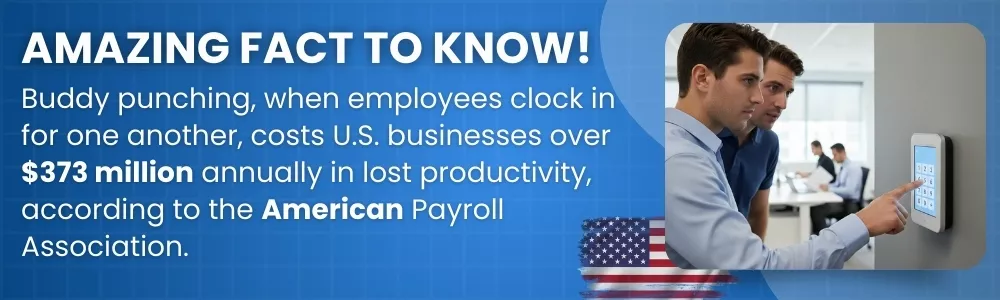
Let's begin with buddy punching, the most prevalent form of fraud in attendance tracking. It occurs when one worker clocks in for another, either voluntarily or out of kindness. When this minor conduct is repeated over time, it may result in unfair practices and significant payroll losses.
Biometric systems eliminate them. The punch-in is specific to each person, regardless of whether it is an iris, fingerprint, or facial recognition scan. You cannot "lend" your fingerprints or your face.
This fosters a culture of accountability because everyone knows attendance is required and that the system will not tolerate faking it.
2. Build Trust with Verified Attendance and Transparent Payroll
When you base payroll on biometric data, you’re telling your employees, “We’re paying you exactly what you’ve earned, no more, no less.” That level of trust goes a long way.
There’s no ambiguity. No disputes about missing punches. No false claims of overtime. Every in-and-out time is 100% verifiable.
HR doesn't have to waste time looking into mistakes, and employees don't have to double-check their pay stubs for missing hours.
3. Secure, Auditable Records with Every Biometric Punch
Biometric time clocks are not just about daily attendance. They become a digital ledger of employee behavior over time. Every punch is timestamped, geotagged (if applicable), and securely logged.
If a dispute arises, say an employee claims they worked late or a manager contests overtime hours, you have complex, non-repudiable data to refer back to. This level of documentation is invaluable during audits, labor inspections, or internal investigations.
In short: You’re no longer depending on trustfacts back youts.
4. Biometric Hardware That Ensures Unmatched Time Tracking Security
Unlike mobile apps that can be installed, manipulated, or deleted, biometric time clocks are physical devices, mounted securely at workplace entry points. They’re tamper-resistant and configured to only work under defined conditions.
Because of this, they are ideal for high-security areas (such as warehouses, medical facilities, and research labs) where device access needs to be restricted. They can even be configured to refuse entrance due to unauthorized schedules or shift timings.
Your first line of defense for both workplace security and payroll is biometric hardware.
5. Biometric Attendance for Every Industry and Work Environment
One of the biggest myths is that biometric systems are only for offices. In reality, they’re being used across industries:
- When precise tracking is required for shift changes in industries and construction sites
- To oversee several sites and split shifts in hotels and restaurants
- In clinics and hospitals where reliable timestamping is necessary for 24x7 rosters
- even at faraway locations, using mobile scanners or portable biometric tablets
Modern biometric systems are rugged, weatherproof, and offline-capable, making them ideal for both urban and rural deployments.
6. Creating a Culture of Accountability with Fair Time Tracking
Biometric time clocks have a modest but significant effect on workplace culture.
Workers start to sense that there is no hidden flexibility, no favoritism, and everyone is held to the same standards. This encourages timeliness, lowers absenteeism, and establishes discipline without being overbearing.
Conversely, managers can focus on team performance and growth rather than squandering time on attendance enforcement.
Over time, the system improves morale, accountability, and operational efficiency by acting as a quiet enforcer of justice.
Time to Evolve Your Payroll Game with HR HUB
Let's face it: antiquated payroll software and manual attendance systems are no longer appropriate in today's workplace. Your HR team's potential is being depleted if you spend hours each pay cycle on reconciliation, tracking down missing logs, or double-checking computations.
By combining everything, HR HUB resolves this.
With HR HUB, you get:
- An intelligent biometric attendance system customized for your employees
- Software for tracking attendance that is integrated and compatible with many devices and places
- Payroll automation that is seamless and compliant with national regulations
- Full integration of payroll software with integrated leave, shift, and tax policies
Whether you're scaling your team, managing remote staff, or navigating complex shift structures, HR HUB transforms the chaos into clarity.
It's not just about streamlining payroll; it’s about elevating your entire workforce management process.