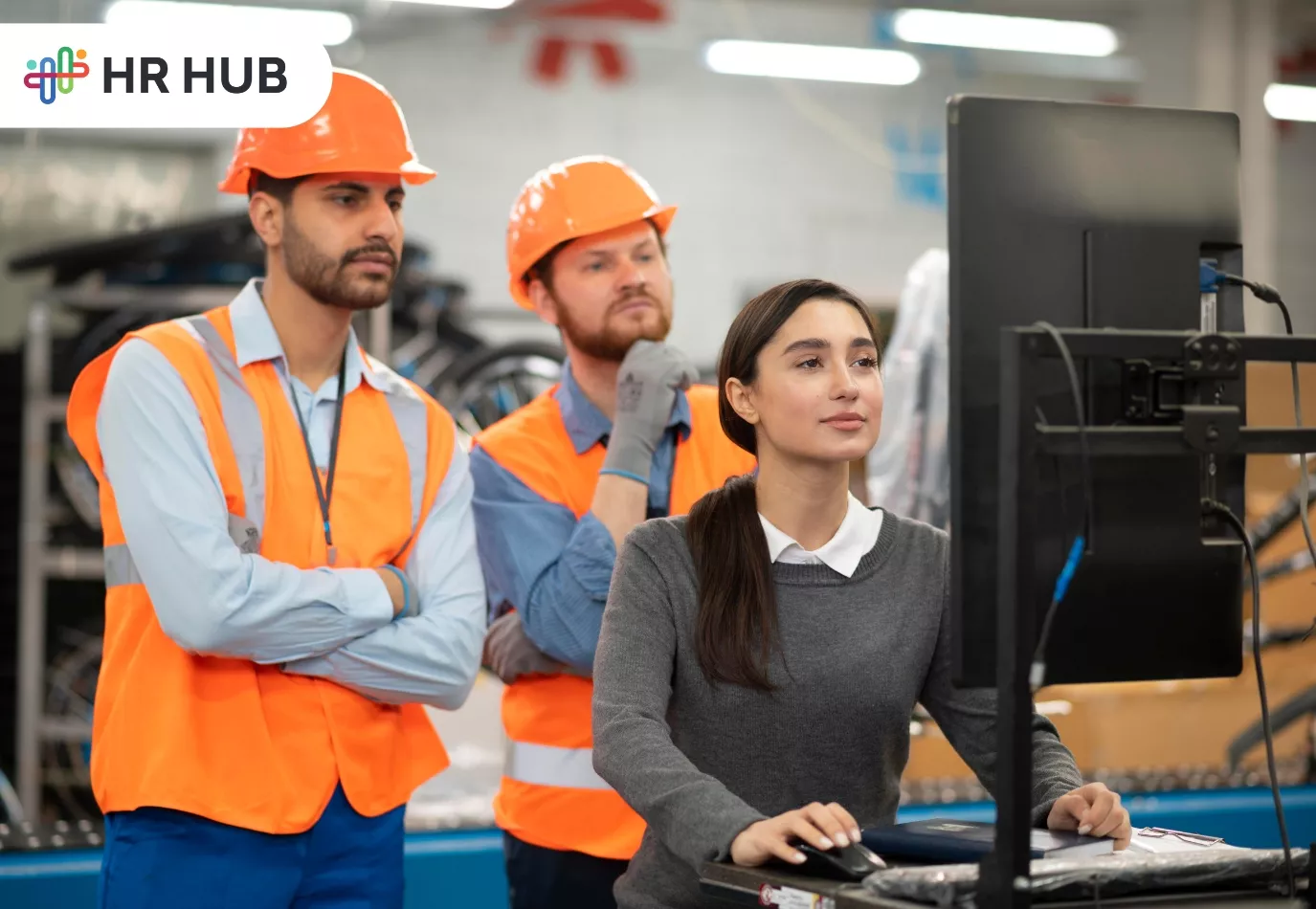
There’s a rhythm to every factory floor: the hum of machines, the synchronized movements, and the clock ticking between shifts.But behind that rhythm lies a more delicate balance: people.Their energy, morale, and trust determine how well everything else works.
Now imagine this rhythm disrupted: a late payroll, a missing leave request, or an unclear shift schedule. It doesn’t take long for frustration to build up and productivity to fade. That’s the silent crisis in many manufacturing units today. And the quiet hero that’s changing this story? Digital HR automation.
When Human Resources Becomes the Real Machine Power
For decades, manufacturing HR meant paperwork, manual registers, and endless spreadsheets, with attendance marked by hand. Payroll was reconciled after hours, and training records were buried in files.
The result? Slow processes and an invisible wall between management and workers.
Enter HR software for manufacturing companies: a digital shift that doesn’t just save time but rebuilds trust. It’s not technology replacing people; it’s technology freeing them.
Automation ensures that a worker’s overtime is logged instantly, their certifications stay up to date, and their payments arrive on time, every time. It replaces uncertainty with consistency, the exact ingredient that keeps people loyal to their workplace.
Automation: The Unsung Hero Behind Workforce Stability
You can see the accuracy, speed, and pressure when you enter any manufacturing facility during peak hours. In such environments, even a slight delay or mismatch can ripple through the entire production cycle. But what if the pressure didn’t have to reach the people? What if HR systems could quietly handle the chaos before it ever touched the workforce?
That's the magic of automation: it stabilizes people as well as streamlines processes. It makes the workplace predictable, equitable, and dependable by transforming everyday uncertainty into structured confidence.
Here’s how automation silently transforms workforce morale in manufacturing.
1. Payroll Accuracy Builds Trust
Nothing influences workplace trust more than getting paid accurately and on time.
Payroll is a complicated web of computations because workers in manufacturing often work multiple shifts, overtime, and variable allowances. Even a single calculation error of a few dollars can cause discontent and undermine trust in management.
Automated payroll ensures every hour worked, every shift differential, and every earned incentive is recorded in real time.
The system integrates directly with attendance data, calculates taxes, applies compliance rules, and generates payslips without manual intervention.
But the real magic lies in transparency. Employees can log in and see precisely how their salaries are computed, from overtime to deductions, leaving no room for confusion.
HR teams can now complete manual cross-verification in minutes rather than days. Faster payroll is essential, but so is accurate payment, which is the cornerstone of long-term employee retention and trust.
2. Fair Scheduling, Happier Teams
Shift work can be the heartbeat or the headache of manufacturing.When shifts are distributed unfairly or inconsistently, frustration builds quickly, leading to burnout, absenteeism, or even strikes.
Automation removes bias and guesswork. Innovative HR systems analyze employee availability, rest hours, skill levels, and labor compliance rules before generating schedules.
The result? Balanced workloads and fair rotation.
Imagine a system that automatically ensures an employee who worked a night shift yesterday isn’t forced into an early morning today.
That single act of fairness does more for morale than any poster about “work-life balance.”
Moreover, managers can plan well ahead. The system predicts staffing shortages and even recommends ideal replacements, reducing last-minute chaos.
Fair scheduling is consistently provided by automation, which is more than just a feature—it's a show of respect.
3. Transparent Communication and Self-Service
In most factories, employees rely heavily on supervisors or HR desks for even basic information, such as leave balances, payslips, and policy documents.These small dependencies create unnecessary bottlenecks and often make workers feel powerless.
Automation replaces that friction with freedom.Through mobile self-service portals, employees can apply for leave, check attendance, download payslips, and view upcoming shifts from anywhere without waiting in queues or sending follow-up messages.
This transparency builds accountability on both sides.Employees feel informed, while HR can focus on strategy instead of repetitive admin work.
It also gives workers a subtle sense of ownership; they’re no longer passive recipients of HR decisions but active participants in managing their own work lives.
When people have control over their information, they feel valued, respected, and engaged; these are three pillars of workforce stability.
4. Predictive Analytics to Reduce Turnover
Traditional HR reacts after attrition happens; automated HR predicts it before it does. With modern HR solutions for the manufacturing industry, managers can analyze behavioral patterns that hint at disengagement.
For example:
- A spike in late arrivals from one department
- Sudden dips in productivity after specific shifts
- A cluster of employees applying for leave near the payroll is delayed.
These data points, when seen together, tell a story, and automation helps HR read it early.
By combining attendance records, feedback trends, and performance data, the system can flag potential burnout zones or departments at risk of turnover.
This means HR can act proactively: adjusting schedules, offering training, or addressing grievances before they turn into resignations.
Automation, in this way, becomes not just an administrative assistant but a workforce guardian, protecting both productivity and people.
How Automation Powers Productivity on the Factory Floor
In manufacturing, every minute lost is a unit not produced. Machines can be optimized, but human efficiency requires understanding, motivation, and structure.
Automation creates that structure, ensuring that people and processes move in perfect harmony.
1. Lightning-Fast Onboarding and Training
In traditional setups, onboarding can feel like a waiting game. New hires spend days filling out forms, collecting badges, or waiting for training slots. During that time, machines are idle, supervisors are stretched, and HR is buried in paperwork.
Digital onboarding flips that experience.
Before their first day, new employees can log into an online portal, fill out digital forms, review safety videos, and even complete mandatory training modules.
Supervisors can track completion in real time, assign mentors, and generate digital checklists to ensure nothing slips through the cracks.
By the time the new employee steps onto the floor, they’re not “new” anymore; they’re ready, confident, and compliant.
That’s not just onboarding; that’s acceleration from day one.
2. Skill Mapping and Competency Management
Manufacturing thrives on specialization, from machine operators and welders to quality inspectors and maintenance engineers. But what happens when a key operator calls in sick or a new production line launches overnight?
Without automation, identifying skilled backups can take hours. With HR software, it takes seconds.
Every employee’s certifications, training history, and skill levels are digitally mapped. When new machinery arrives, the system automatically filters who’s qualified and who needs upskilling.
HR can then schedule micro-trainings or refresher courses instantly. This ensures zero downtime, minimal dependency, and a continuously learning workforce.
Skill mapping isn’t just operational efficiency; it’s the blueprint for sustainable growth.
3. Attendance That Works as Hard as You Do
Attendance management is the heartbeat of HR in manufacturing; yet, when handled manually, it’s often the source of the most disputes.
With automation, attendance tracking becomes effortless and error-free.Biometric devices, RFID scanners, or mobile-based geolocation tools capture real-time presence.Late entries, shift overlaps, and overtime are logged instantly and synced with payroll.
Supervisors can view attendance dashboards on any device, allowing them to make quick staffing decisions or approve exceptions within seconds.
For employees, this level of accuracy removes uncertainty. For management, it saves hours of reconciliation. In short, automation ensures that attendance works as hard as the people it tracks.
4. Performance Metrics That Actually Mean Something
Most factories measure output, not engagement. Automation changes that.
With digital HR dashboards, managers can track individual and team performance in ways that tell real stories:
- How one team consistently exceeds targets with fewer overtime hours
- How training completion correlates with safety improvements
- How specific departments achieve more with better attendance stability
These insights go beyond raw data; they reveal patterns of excellence. And when recognition becomes data-driven, it’s fair, fast, and motivating.
Employees start seeing that their effort is visible, not buried in spreadsheets or overlooked in reports. That visibility fuels pride, and pride fuels productivity.
Beyond Numbers: Building a Culture That Lasts
At its core, automation is about people. When HR processes become faster and fairer, employees feel seen and respected.They no longer have to chase approvals or question payroll calculations.Their time is valued, and their trust is earned.
Digital HR creates a culture of accountability and empowerment, qualities that directly affect productivity and retention. And in an industry where replacing skilled workers can take months, culture becomes the most valuable currency a manufacturer can have.
HR HUB: The Future of Digital HR in Manufacturing
In this era of Industry 4.0, machines are getting smarter, and so must HR.That’s where HR HUB bridges the gap between people and performance.
HR HUB isn’t just another HR software. It’s a complete workforce ecosystem built for industries like manufacturing, where timing, compliance, and communication can make or break daily operations.
Here’s what makes HR HUB a perfect fit for the manufacturing world:
- Automated Payroll Engine: Handles multiple pay groups, shift variations, and overtime policies with zero manual intervention.
- Smart Attendance & Shift Scheduling: Integrates with biometric and geo-attendance systems for precise time tracking.
- Skill & Training Management: Maps every worker’s skill level, certifications, and expiry reminders to keep teams always qualified.
- Compliance Simplified: From regional labor laws to safety and overtime compliance, everything stays audit-ready.
- Data-Driven Insights: Visual dashboards help HR leaders spot trends in absenteeism, engagement, and attrition before they become problems.
With HR HUB, manufacturers move from reactive to proactive HR, ensuring their most valuable assets, that is, “people,” are always running smoothly.
The New Blueprint for a Connected Factory
Manufacturing success has always depended on a balance between speed and safety, cost and quality, and machines and workforce. Digital HR creates a new balance: one where automation amplifies human potential rather than replacing it.
The factory of the future is not just filled with intelligent robots; empowered people power it. And tools like HR HUB make that future achievable today.
In a world where every second counts, automation doesn’t just save time; it saves talent. Because when your workforce feels valued, everything else falls perfectly into place.