Imagine this.
- A candidate receives an automated rejection within seconds of applying.
- An employee is marked “high risk” for attrition.
- A promotion list is generated by the system overnight.
- No explanation. No clarity. No context.
Welcome to the age of the black box.
Because AI promised speed, efficiency, and predictive power, HR departments welcomed it for years. And it succeeded. However, the speed of your system is no longer the true question in 2026. It's the clarity of its thought process.
Organizations in the US, Canada, the Cayman Islands, and India are now recognizing that ethical AI in HR software is more than just a feature. It's a duty.
The era of opaque decision-making is ending. Transparency is becoming the new standard.
When AI Makes Decisions About People: Why Ethical AI in HR Software Cannot Stay Silent
HR is not inventory management. It is not logistics. It is not marketing analytics.
It is people.
Every data point in an HR system represents a career, a livelihood, a family, a future. When algorithms decide who gets hired, who gets shortlisted for leadership development, who qualifies for bonuses, or who gets flagged for performance concerns, the consequences extend far beyond dashboards and reports.
Now imagine being on the receiving end of an invisible decision.
- A candidate is rejected without knowing what skill was lacking.
- An employee is rated lower without understanding which metric influenced the score.
- A manager is told that “the system recommends” a restructuring decision.
In certain situations, silence is not neutral. It is harmful.
Traditional AI systems have a straightforward issue. They generate outcomes while hiding logic. Uncertainty results from the hidden reasoning. Suspicion grows when there is uncertainty. Furthermore, suspicion subtly damages company culture more quickly than any legal sanctions.
Employee awareness of how technology affects their employment is growing in countries like the US, Canada, India, and even smaller business areas like the Cayman Islands. They are looking for clarity. They anticipate justice. They no longer feel that "the system decided" is a good enough answer.
Because of this, ethical AI in HR software is becoming the cornerstone of contemporary HR technology. AI ethics is not a theoretical concept. It's a discipline that deals with operations.
It means:
- Decisions can be explained in plain language
- Data sources are documented and traceable.
- Bias is actively monitored, not assumed away.
- Humans retain meaningful control over critical outcomes.s
- Employees have a pathway to question automated conclusions.
In 2026, deploying AI without these safeguards is not innovation. It is negligence.
Explainable AI (XAI) in Ethical AI in HR Software: Turning Invisible Logic Into Visible Trust
Let's take a moment to pose a useful query.
Can you attend a meeting and clearly explain why your HR system rejected a candidate?
You are exposed if you respond, "That's how the model scored it."
Explainable AI (XAI) changes the dialogue at this point.
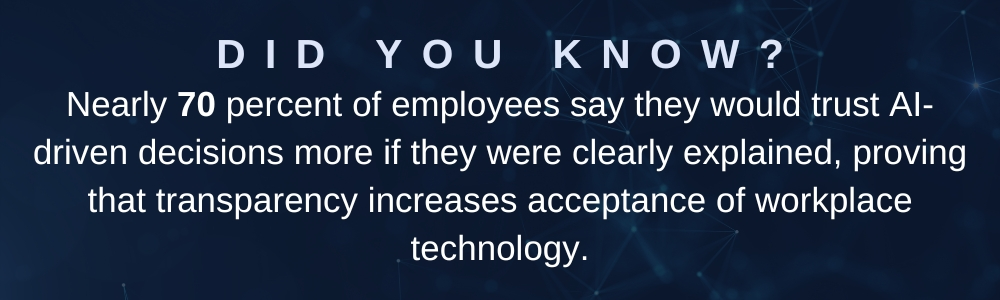
Explainable AI shows the motivations behind choices rather than just silent scores. It displays the skills that fit the employment requirements. It makes clear how qualifications are weighed against experience. It identifies the performance metrics that affected a promotion rating.
Users are not overloaded with technical jargon in explainable systems. They convert computational reasoning into insights that managers, HR specialists, and even workers can comprehend.
For HR leaders, explainable AI (XAI) delivers:
- Clear justification during hiring discussions
- Greater transparency in performance calibration meetings
- Stronger confidence in board-level analytics presentations
- Defensible documentation during compliance reviews
Explainability helps shield businesses from discrimination lawsuits in the US and Canada, where regulatory scrutiny of automated recruiting techniques is still increasing. Explainability promotes employee trust in technology-driven decisions in India, where digital HR adoption is growing among startups and corporations. Explainable processes strengthen organizational integrity in the Cayman Islands, where professional communities are tightly knit.
Innovation is not slowed by explainability. It makes it stronger. AI gains credibility when it can explain itself.
AI Governance in HR: Building Responsible HR Automation With Clear Structure and Accountability
Technology without structure creates chaos.
AI without governance creates risk.
The market was fast-paced, thus many companies utilized AI solutions. The vendors guaranteed efficiency. Rivals were already using automation. Few businesses took the time to establish internal control systems before implementation.
Now, that oversight gap is being filled.
A well-defined framework for choosing, implementing, overseeing, and enhancing AI technologies is established by robust AI governance in HR. It responds to important queries:
- Who owns the AI system internally?
- Who reviews its outputs?
- How often are bias tests conducted?
- What happens if the model behaves unexpectedly?
Effective AI governance in HR includes:
- Clear documentation of model objectives and logic
- Defined accountability for AI oversight
- Periodic bias and performance assessments
- Legal alignment across multiple jurisdictions
- Transparent audit trails for automated decisions
Even well-designed AI systems can veer off course without governance. Past inequities may be progressively reproduced by a model trained on historical data. As labor patterns change, decision thresholds may also change. While the AI logic stays the same, employment laws may alter.
Silent decay is avoided by governance.
By 2026, HR departments will no longer be merely passive users of AI. They are conscientious guardians of their influence. AI becomes a controllable strategic asset through governance, changing it from a tool for productivity.
Bias-Audit Ready HRMS: Why Ethical AI in HR Software Must Be Designed for Regulatory Scrutiny
The era of invisible systems is ending.
Regulators are asking sharper questions. Employees are more informed. Boards are demanding risk visibility. Media coverage of biased algorithms has increased global awareness.
Forward-thinking organizations are not reacting to investigations. They are preparing in advance.
A bias-audit-ready HRMS is built with transparency embedded at every layer. It can clearly demonstrate:
- How recruitment algorithms were trained
- Which variables influence candidate scoring
- How fairness metrics are measured and tracked
- How sensitive attributes are excluded or safeguarded
- How performance predictions are validated over time
Compliance complexity increases when global corporations operate in the Caribbean, North America, and India. Different documents may be required for a bias audit across regions. This problem is made easier by a bias-audit-ready HRMS, which centralizes traceability and visibility.
Such preparedness conveys assurance. It shows that the company is aware of its responsibilities and has taken proactive steps to reduce risk.
Here, being transparent is not defensive. It's a calculated move. It presents the business as responsible, mature, and ready.
Responsible HR Automation: Balancing Efficiency, Ethics, and Human Oversight in Modern HR Systems
Unquestionably, automation has changed human resources. Processing payroll is quicker. Approvals of leaves go more smoothly. Real-time insights are provided via workforce analytics. Attrition and hiring requirements can be predicted using predictive technologies.
However, unchecked automation might subtly harm.
Proper HR automation makes sure that technology complements judgment rather than mindlessly taking its place. It establishes checkpoints when human oversight is crucial and places boundaries around actions with significant consequences.
For example:
- If an AI system identifies potential patterns of misconduct, a human review must verify the context before escalation.
- If a performance model flags underperformance, managers must interpret personal circumstances and team dynamics.
- If a hiring algorithm filters candidates, recruiters must periodically validate that it is fair and relevant.
Employee voice is another benefit of responsible automation. A polite and transparent review process must be in place when someone challenges an automated result.
Responsible HR automation safeguards organizational reputation and operational efficiency in North America's compliance-heavy surroundings and India's quickly expanding corporate sector.
Productivity can be increased via speed. Fairness, however, keeps culture alive.
Human-in-the-Loop (HITL) in Ethical AI in HR Software: Keeping Decision-Making Human-Centered
There is a widespread misconception that the most advanced AI systems operate independently of humans.
In HR, that approach is dangerous.
The most resilient organizations in 2026 rely on human-in-the-loop (HITL) frameworks.
Human-in-the-loop (HITL) uses AI to analyze data, identify trends, and provide suggestions. However, human judgment is still required for final decisions in sensitive areas such as hiring, promotions, disciplinary measures, and terminations.
This approach ensures:
- Managers assess AI suggestions within a real workplace context
- HR professionals interpret nuanced employee situations.
- Employees retain the right to receive an explanation.s
- Ethical judgment remains central to decision-making.
In relationship-driven markets like the Cayman Islands, HITL protects local workplace culture. In large-scale enterprises across India, the US, and Canada, it prevents depersonalized decision-making.
AI can process patterns. Humans understand stories.
The strongest HR systems combine both.
For a deeper look at how advanced AI recruitment systems work to reduce bias and improve fairness in hiring decisions, see this insightful perspective on AI recruitment software transforming hiring and bias-free shortlisting with HR HUB.
The Global Shift Toward Ethical AI in HR Software: Transparency, Compliance, and Trust Across India, the US, Canada, and Cayman Islands
Today's workforce is worldwide. Teams work together across different time zones. Recruitment is cross-continental. Each country has different compliance standards.
Opacity becomes a liability in such a complex environment.
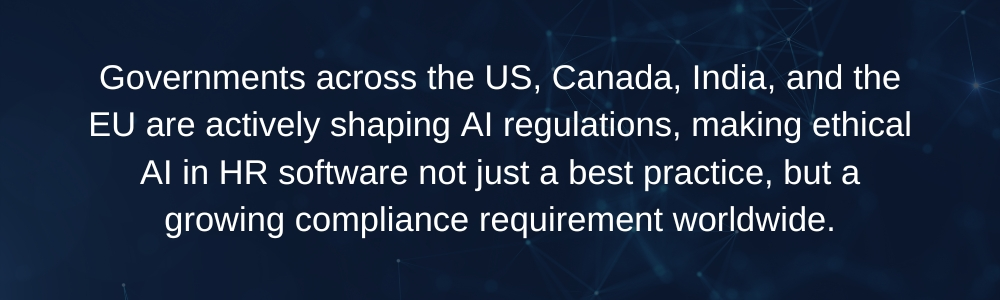
Organizations can adjust locally while upholding uniform ethical standards thanks to transparent AI technology. Explainability, governance, audit readiness, responsible automation, and human oversight all work together to provide ethical AI in HR software.
Trust grows.
- Trust from employees who believe they are evaluated fairly.
- Trust from regulators who see documented accountability.
- Trust from leadership teams who rely on defensible insights.
Furthermore, trust is a must in HR. It is the cornerstone of long-term performance, retention, and engagement.
In the early days of AI acceptance, the black box might have been accepted.
Transparency is the only viable course of action in 2026.
Beyond the Black Box: How HR HUB Delivers Ethical AI in HR Software With Explainable AI (XAI) and AI Governance in HR
The conversation about ethical AI in HR software is not theoretical. It is operational.
HR HUB is designed with transparency and accountability at its core. From performance analytics to recruitment workflows and workforce insights, the platform prioritizes:
- Clear decision visibility
- Structured AI governance in HR principles
- Bias monitoring capabilities aligned with a bias-audit-ready HRMS approach
- Built-in human-in-the-loop (HITL) controls for critical decisions.
- A commitment to responsible HR automation that supports, not replaces, human judgment
For organizations across India, the Cayman Islands, the US, and Canada, HR HUB enables digital transformation without compromising ethics.
Because in 2026, innovation without transparency is simply risk in disguise.
The black box era is ending.
The future of HR belongs to systems that can explain themselves.