Every expanding business has a point at which things start to seem... heavier.
- Not because the team is underperforming.
- Not because people lack intent.
- But because somewhere between planning and execution, things begin to slow down, pile up, and quietly lose clarity.
And in most cases, the pressure lands on one role.
The manager.
What looks like “leadership responsibility” on paper often turns into something else entirely in practice. Managers become the people who hold everything together, not because they are meant to, but because no one else is.
That invisible layer? That’s Ghost Work.
Understanding Ghost Work: The Work No One Sees But Everyone Feels
You'll discover something intriguing if you ask a manager about their actual day.
Big decisions won't be discussed with you.
Long-term planning and strategy won't be discussed.
Rather, you'll hear bits of effort that seem disjointed yet oddly familiar:
- “I had to follow up on approvals.”
- “I spent time clarifying what leadership meant.”
- “I had to re-explain the task to the team.”
- “I fixed something that should’ve been clear from the start.”
And if you dig deeper, you’ll uncover even more:
- “I had to remind someone again.”
- “I had to check if that update was actually done.”
- “I had to jump into a task because it was stuck.”
None of this gets recorded. None of this is visible in performance reports.
Yet this is where a manager’s day quietly disappears.
This is Ghost Work.
- It is not assigned, but it is expected.
- It is not measured, but it is necessary.
- It is not acknowledged, but it keeps everything running.
And the most important part? It does not exist on its own.
It exists because something else is missing:
- A process that was never clearly defined
- A system that does not connect teams properly
- A task without a clear owner
- A workflow that depends on memory instead of structure
As organizations grow, these small gaps multiply. More people, more tools, more layers.
And instead of being absorbed by the system, they get absorbed by managers.
That is how Ghost Work scales without anyone noticing.
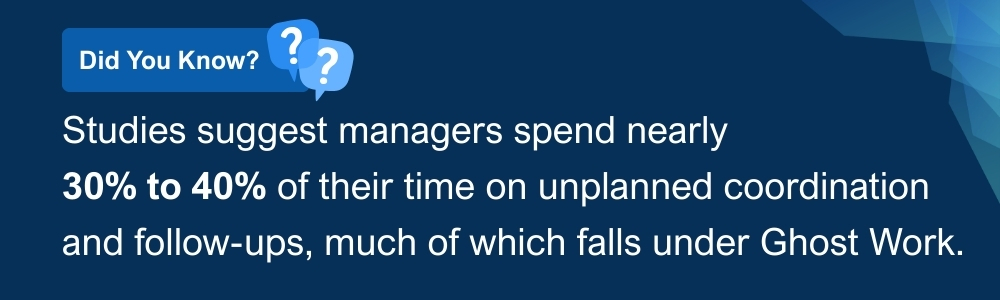
How Ghost Work Turns Managers into the Middle Layer of Execution
There is a subtle shift that happens in growing teams.
- At first, the managers guide.
- Then they support.
- And slowly, without intention, they start carrying everything in between.
Information starts flowing like this:
- Leadership shares direction.
- The manager interprets it.
- The team executes it.
- The manager checks it.
- The manager reports it back.
At every stage, the manager is not just involved. They are required.
They become the central layer through which everything passes.
Not because it was designed that way, but because nothing else is structured enough to handle it.
Over time, their role quietly changes.
They become:
- The translator of unclear instructions
- The reminder system for delayed actions
- The bridge between disconnected teams
- The safety net for broken processes
- The escalation point for everything that does not move
What should have been a leadership role slowly turns into a coordination role.
And this constant switching among thinking, chasing, fixing, and reporting is what drives Manager Burnout.
Not because the work is difficult.But it is scattered, unpredictable, and never-ending.
Manager Burnout Explained: Why It Builds Quietly Over Time
There is a misconception that Manager Burnout manifests as exhaustion or a breakdown.
In reality, it starts much earlier and much more quietly.
It looks like:
- A manager puts off decisions because they must "just clear a few things first."
- Instead of preparing, a leader spends their day reacting.
- A discussion that is postponed due to a lack of time
- A work that is hurried because the day is spent on follow-ups
These are not red flags on their own. But together, they tell a story.
A story of constant interruption.
A manager who starts the day with priorities but ends the day reacting to everything else.
As this pattern continues, a shift happens.
Managers stop thinking ahead.They start thinking in fragments.
And this is where Manager Burnout fully takes shape.
Not as a sudden collapse, but as a gradual loss of control over time and attention.
When that happens, something fundamental breaks.
- Not effort.
- Not intent.
- But execution.
How Ghost Work Impacts Operational Efficiency in Organizations
From the outside, everything may still appear structured.
- Tasks are being assigned.
- Meetings are happening.
- Reports are being shared.
On paper, the system looks active.
But inside the workflow, friction builds.
The amount of work being done has nothing to do with operational efficiency. It has to do with how efficiently work is done.
Additionally, Ghost Work interferes with that mobility in ways that are simple to ignore:
- Decisions take longer because they depend on multiple follow-ups
- Tasks get repeated because expectations were not aligned the first time
- Teams hesitate because they are waiting for clarity or confirmation
- Managers jump between tasks instead of driving them forward
Over time, this creates invisible delays.
Work starts moving, but it does not move cleanly.Effort increases, but outcomes do not match.
This is how organizations begin to feel “busy” but not productive.
This is how Operational Efficiency slowly erodes without any single obvious failure.
Workforce Wellness at Risk: The Hidden Impact of Manager Burnout and Ghost Work
Most organizations today are actively investing in employee well-being.
But there is a gap in that conversation.
Managers are expected to support teams, maintain performance, and ensure delivery. But their own experience is often left unexamined.
And this is where Workforce Wellness starts getting affected at its core.
Because managers influence how work feels for everyone else.
When managers are dealing with constant Ghost Work:
- Their responses become shorter and more transactional
- Their availability becomes limited
- Their patience gets tested by repeated inefficiencies
- Their ability to coach and support reduces
Teams may not always see the cause, but they feel the impact.
- Communication becomes reactive.
- Feedback becomes delayed.
- Clarity becomes inconsistent.
Over time, this creates an environment where stress spreads silently.
Because policies or statements do not define culture.
Every day interactions shape it.
And when those interactions are affected, Workforce Wellness is affected too.
Why Outdated Processes Reduce Operational Efficiency and Create Ghost Work
Many organizations are still relying on familiar tools and habits.
- Emails for approvals.
- Spreadsheets for tracking.
- Messages for updates.
These methods feel simple and flexible.
But at scale, they introduce fragmentation.
- Information lives in different places.
- Updates depend on individuals.
- Visibility becomes limited.
Every small gap creates a dependency.
- Someone has to remember to respond.
- Someone has to follow up.
- Someone has to verify.
And that someone is usually the manager.
This is how:
- Every gap becomes a dependency.
- Every dependency becomes a follow-up.
- Every follow-up becomes Ghost Work.
Without structured systems, managers end up stitching together workflows that should already exist.
They become the system.
And that is where the real problem begins.
Manager Enablement: The Key to Reducing Manager Burnout and Improving Efficiency
Manager Enablement is not about adding more tools or more responsibilities.
It is about redesigning how work flows so that managers can step out of the middle.
When systems are structured properly:
- Tasks move automatically through defined workflows
- Approvals are triggered without manual reminders
- Data is accessible without compilation
- Expectations are clear from the beginning
Managers no longer need to translate, chase, or fix constantly.
They regain the space to:
- Think ahead
- Guide their teams
- Improve performance
- Focus on outcomes instead of coordination
This shift is not just operational. It is cultural.
When managers move out of the middle layer, teams start functioning with greater clarity and ownership.
That is the real impact of Manager Enablement.
Breaking the Cycle of Ghost Work to Improve Operational Efficiency
You cannot solve Ghost Work by asking managers to “manage better.”
Because the issue is not an individual capability, it is a structural design issue.
To break this cycle, organizations need to rethink how work is created and moved.
Start here:
- Clarity of Ownership: If more than one person owns a task, no one truly owns it. Clear accountability reduces follow-ups.
- Structured Workflows: Every recurring process should follow a predictable path. Not scattered communication across platforms.
- System-Driven Processes: Using HRMS software and automated HR systems ensures that actions are tracked, triggered, and visible without manual effort.
- Centralized Information: When data is spread out, confusion increases. A single source of truth removes unnecessary coordination.
- Reduced Manual Follow-Ups: If a process depends on reminders, it is incomplete. Fix the flow, not the behavior.
Although these modifications seem functional, their effects are more profound.
They increase operational efficiency, lessen manager burnout, and foster a healthier workplace.
If you want to understand how structured systems eliminate manual coordination and improve execution flow, explore how modern HR management software streamlines the entire employee lifecycle.
Manager Enablement in Action: When Managers Stop Acting as Filters
When Ghost Work reduces, something shifts almost immediately.
Managers start experiencing time differently.
Instead of reacting, they begin to observe.
They notice:
- Team members who need support or direction
- Opportunities to improve how work is done
- Patterns that were previously hidden in the noise
- Conversations that build stronger alignment
Work starts feeling more intentional.
Teams start moving with clarity.Managers start leading instead of coordinating.
This is what Manager Enablement unlocks.
And this is where organizations start seeing meaningful change.
Not just in output, but in how work actually feels daily.
A Better Way Forward: Improving Workforce Wellness and Operational Efficiency
If your managers are constantly occupied yet progress still feels slow, the issue is not a lack of effort.
It is flow.
Reducing Ghost Work, addressing Manager Burnout, and improving Workforce Wellness are not about pushing teams harder.
It is about removing what should never have been in their way.
When systems are designed well, workflows work naturally.
And when work flows, people no longer need to compensate for broken processes.
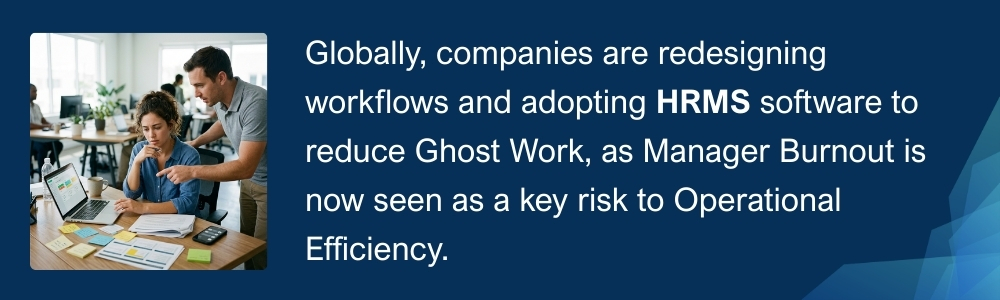
Restoring Operational Efficiency: How Manager Enablement Fixes Execution
Organizations that take this seriously begin to notice a shift.
- Work moves faster.
- Decisions become clearer.
- Teams operate with confidence.
- Managers lead instead of chasing.
This is the distinction between truly scaling operations and just performing them.
Here, platforms like HR HUB are essential because they provide structure to routine HR procedures. Everything functions within a specified system rather than through dispersed communication, from procedures and approvals to personnel data and performance monitoring.
Managers are no longer trapped in coordination loops once the right HRMS software is in place. They gain control, visibility, and the ability to focus on what is truly important.
Because in the end, execution does not break because people are incapable.
It breaks when systems expect managers to carry what should have been built into the process.