In a significant shift that could redefine employee benefits nationwide, the Indian government has introduced a substantial amendment to the gratuity eligibility rule under its revamped labour laws. What once required employees to complete 5 continuous years of service for gratuity may now be accessible after just 1 year, under specific conditions.
This change has sparked conversations not just in India but also among global employers with Indian operations and Indian-origin employees working in the Cayman Islands, the United States, and Canada, where gratuity-like benefits take different forms.
Let’s unpack the implications of this 1-year gratuity rule, what it means for employers, employees, and the broader business landscape.
What is Gratuity and Why Does It Matter?
Gratuity is a financial benefit employers provide to employees as a token of appreciation for long-term service. It is usually paid at the time of retirement, resignation, or death, and is governed under the Payment of Gratuity Act, 1972, in India.
While the Central Government has cleared the new Labour Codes, employers should note that implementation timelines vary by state, making it essential to track state-specific notification dates before applying these provisions operationally.
Across regions like the Cayman Islands, Canada, and the US, gratuity may take other forms, such as severance packages, end-of-service benefits, or lump-sum retirement payouts. While the structure varies, the underlying principle remains: to reward sustained service.
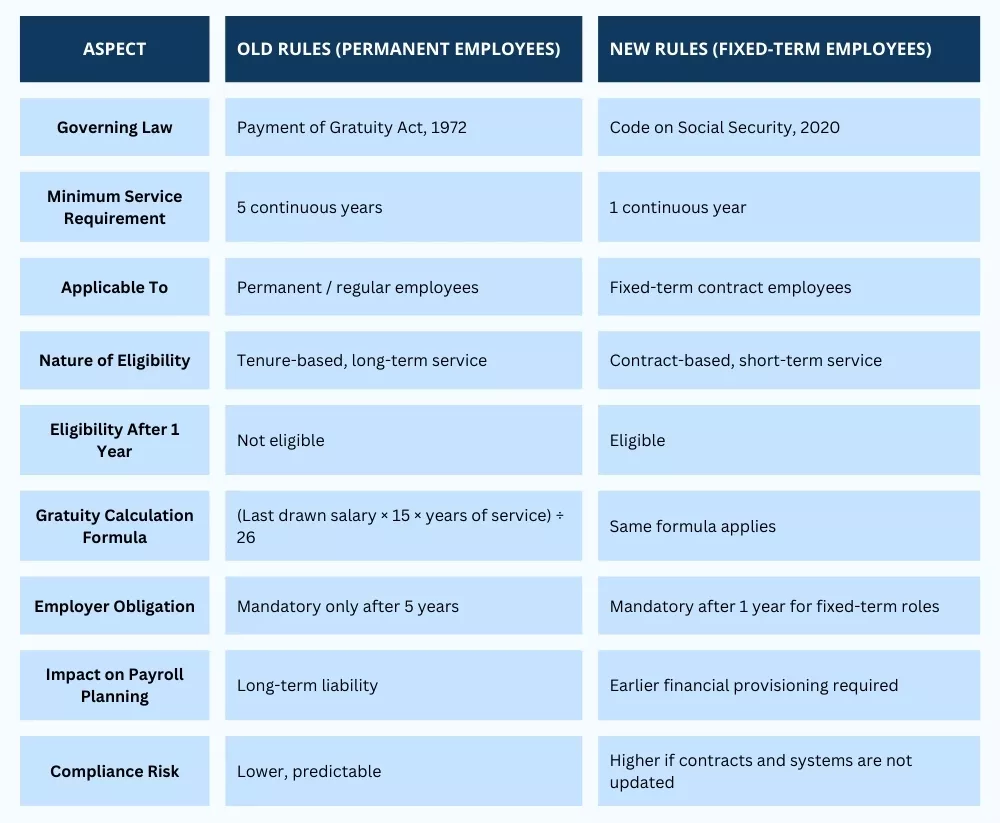
Gratuity Eligibility in India: Old vs New Framework
Labour Law Gratuity Update: What the 1-Year Rule Says
The new gratuity rules, introduced as part of India’s labour code modernization, change this narrative.
Under the latest provisions of the Code on Social Security, employees on fixed-term contracts are now eligible for gratuity after just one year of continuous service.
Here’s what’s important to note:
- This applies only to fixed-term employees, not all employees
- The tenure must be 12 continuous months with the same employer.
- The exact formula for calculating gratuity applies: (Last drawn salary × 15 × years of service) ÷ 26
This means even a one-year contract worker now has legal backing to receive gratuity, which would previously have been denied regardless of contribution.
This reform, while seemingly minor, could affect over 6 million contract-based workers across sectors.
Understanding the New Gratuity Rules for Fixed-Term Employees
The latest labour law gratuity update introduces a crucial distinction between permanent employment and fixed-term engagement. Under the Code on Social Security, gratuity eligibility is no longer tied exclusively to long-term service but also recognizes the contributions of employees hired for a defined tenure.
Fixed-term employees, those appointed for a specific period through formal contracts, are now legally entitled to gratuity upon completing one full year of continuous service with the same employer. This marks a significant shift from earlier interpretations, where the five-year rule effectively excluded most contract-based workers from end-of-service benefits.
What makes this change particularly impactful is that the gratuity calculation method remains unchanged. The benefit is not reduced or diluted due to shorter tenure; instead, eligibility itself has been redefined. In effect, the law acknowledges that contribution is not measured solely by longevity but also by commitment over a defined period of employment.
This reform brings fixed-term employees closer to parity with permanent staff, especially in industries where project-based hiring has become the norm.
Who Benefits from the New Rule? It’s Not Just One Group
While the rule explicitly mentions fixed-term employment, its ripple effects extend beyond it.
1. Fixed-term Employees
These employees have one-year or two-year contracts. In the past, unless the employer offered it freely, they would leave without receiving any end-of-service benefits. After a year, gratuity is now guaranteed by law.
2. Contractual Workers in IT, EdTech, and Healthcare
Many professionals in these industries are hired on projects or short cycles. With the new rule, their short-term effort can now lead to long-term recognition.
3. Startups and MSMEs
Due to rapid expansion, pivots, or financial constraints, these companies usually lose staff after five years. However, gratuities are increasingly a competitive hiring strategy, especially for temporary positions.
4. Employers Who Want to Build Trust
Gratuity isn’t just a compliance requirement; it’s a symbol of care. Employers who implement this proactively (even for full-time roles) show they value every employee’s time, not just their tenure.
How Employers Must Prepare for This Change
It’s not optional anymore. If you hire fixed-term workers, here’s what needs to change:
HR Policies and Contracts
You must update offer letters, HR manuals, and internal policies to reflect the 1-year eligibility for gratuity. Ambiguity can lead to disputes or legal complications.
Payroll Systems
Ensure your payroll system can:
- Track fixed-term contract start and end dates
- Trigger gratuity calculations at 1-year completion
- Include this benefit in the Full & Final settlement.
Manual payroll setups often miss short-tenure eligibility triggers, exposing employers to compliance gaps and audit risks. This is where automation becomes critical. Learn how automated payroll compliance protects your business from audit risks by eliminating dependency on manual checks and ensuring rule-based calculations across employment types.
HR HUB already includes a gratuity eligibility engine that automatically detects eligible employees and notifies payroll teams, reducing errors and ensuring legal compliance.
Cost Provisioning
Employers must start provisioning for gratuity liabilities earlier. Even for roles expected to last a year, this now becomes part of financial planning.
Employee Education
Workers might not even know they are now eligible. Communicate clearly. It builds transparency and goodwill and reduces surprises during offboarding.
Why Global Employers Shouldn’t Ignore This Either
If you’re managing an offshore team in India or outsourcing operations, this rule matters to you.
Let’s say a US-based tech company hires Indian developers on 12-month contracts. Under the new rule, they now qualify for gratuity, and failing to pay can result in compliance violations under Indian labour laws.
Similarly, Cayman Islands employers working with Indian contractors should factor this into service pricing and contract scopes.
Even though gratuity-like benefits in the US (severance), Canada (termination pay), or Cayman (optional bonuses) are structured differently, this change signals a growing global alignment toward recognizing short-term contributions with long-term respect.
What Employees Should Do Right Now
If you’re working in India, or with an Indian employer, here’s your checklist:
- Verify the type of contract you have: is it temporary or long-term?
- Keep track of your joining date: Have you finished a full year?
- Ask HR to clarify if you qualify for a gratuity.
- Keep copies of contracts, pay stubs, and offer letters close at hand.
You have the legal right to file a claim if you qualify and the gratuity isn't shown in your leave procedure.
HR HUB: Your Compliance Companion
As rules evolve, HR teams can’t afford to rely on spreadsheets and manual tracking. With HR HUB, managing gratuity becomes:
- Automated: The system automatically determines gratuity based on contract type and tenure.
- Transparent: Workers can view their benefit accruals instantly
- Secure: For compliance checks, complete audit logs and payment records are kept.
HR HUB helps you stay ahead of policy, payroll, and people, whether you oversee five or 5,000 workers in India or abroad.
Where Recognition Begins Earlier
Not only was the gratuity eligibility regulation revised, but it was also completely redesigned.
For many years, we thought that longevity was necessary for appreciation. However, the new regulation contradicts this. One year is now sufficient to make a difference. It takes a year to make enough money. It only takes a year to be remembered.
The future belongs to companies that adapt and to systems that help them as employment continues to change and the distinction between project-based and permanent roles becomes increasingly hazy.
So let's acknowledge contribution, no matter how tiny. And here's to resources that make things simpler, more promising, and equitable, like HR HUB.