Every sensitive employee complaint is more than an HR problem. It is a test of an organization's integrity, legal preparedness, and commitment to a safe workplace.
The International Labour Organization estimates that more than one in five employed people worldwide have experienced violence or harassment at work during their working lives. It highlights why organizations need clear and trusted processes for reporting and resolving sensitive concerns.
So here is the real question every business leader should introspect. When an employee finally gathers the courage to report something sensitive, does your HR team actually know what to do next? Most companies assume they do. Fewer actually prove it when it counts.
Why Sensitive Complaints Demand a Different Playbook
Not every workplace complaint carries the same weight. A disagreement over deadlines needs a conversation. A harassment allegation, a discrimination claim, or a safety concern needs something far more structured. These cases touch legal exposure, employee trust, and company reputation all at once, and HR sits right in the middle of all three.
This is exactly where a documented and repeatable process earns its value. Employers who follow a clear harassment investigation checklist give their HR teams a consistent way to gather facts, protect confidentiality, and avoid the kind of missteps that turn a manageable situation into a lawsuit.
Without that structure, even well-meaning HR professionals end up improvising, and improvisation rarely holds up under legal scrutiny.
Conn Maciel Carey LLP notes that every complaint is both a human situation and a compliance obligation. That dual lens matters because HR cannot afford to choose one over the other. Handle the human side poorly, and employees stop reporting. Handle the compliance side poorly, and the company inherits legal risk it cannot undo.
The Cost of Getting It Wrong
The Equal Employment Opportunity Commission (EEOC) infamously received 88,531 new discrimination charges for fiscal year 2024. It shows a 9.2% increase from its earlier numbers. Hence, it reflects continued demand for workplace accountability and enforcement.
Meanwhile, Gallup's State of Global Workplace research 2026 shows that employee stress remains persistently high. It highlights the importance of resolving workplace issues before they escalate into formal complaints or turnover.
Sensitive complaints that sit unaddressed do not stay quiet. They surface later as turnover, disengagement, or formal charges.
Platforms HR Teams Rely On to Handle Complaints Responsibly
Modern HR departments rarely manage sensitive complaints through memory and instinct alone. They lean on specific platforms and tools, each covering a different part of the process.
1. Anonymous reporting hotlines. Anonymous reporting channels help reduce employees' fear of retaliation. EY's Global Integrity research found that many potential whistleblowers remain reluctant to use internal reporting systems because they fear career repercussions or doubt their concerns will be addressed.
2. Case management software. Purpose-built systems track every complaint from intake to resolution, creating the paper trail regulators and courts expect to see.
3. HRIS platforms. Beyond payroll and benefits, these systems store documentation, timelines, and prior disciplinary history that investigators need when a complaint touches a repeat pattern.
4. Employee pulse surveys. Regular, short surveys surface simmering issues before they escalate into formal complaints, giving HR a chance to intervene early.
5. Exit interview tools. Departing employees often disclose what they never reported while employed, and structured exit data helps HR spot patterns across teams.
6. Employee assistance programs. EAPs give employees a confidential outlet for support during and after an investigation, which keeps the human element intact.
7. Manager reporting dashboards. These give frontline managers a simple, standardized way to escalate concerns instead of trying to resolve sensitive matters informally.
Each platform plays a narrow role. Together, they build the infrastructure that lets HR respond quickly and consistently, which is exactly what compliance frameworks demand.
Building a Culture Where Reporting Feels Safe
Technology only works if employees trust the process behind it. As Tom Tang, Chief People & Customer Operations Officer and HR Council Member, notes, "Psychological safety isn't about comfort. It's whether people speak up when it matters." That principle lies at the heart of every effective complaint management process.
Harvard Business Review research found that nearly half of employees who experienced or witnessed workplace incivility did not report it to HR or their manager. It highlights the importance of building reporting processes employees trust.
HR teams close that gap by communicating clearly about what happens after a complaint is filed. It protects confidentiality wherever legally possible, and follows through with visible action.
Training matters just as much as tools. Managers who understand how to recognize a sensitive complaint, and who know to route it to HR immediately rather than handling it themselves, prevent early missteps that can compromise an entire investigation later.
Frequently Asked Questions
How should HR handle a sensitive employee complaint?
HR should acknowledge the complaint promptly, maintain confidentiality, document every step, conduct an impartial investigation, and comply with applicable employment laws and internal policies. A consistent, documented process helps protect employee trust while reducing legal and compliance risks.
Why are anonymous reporting channels important in the workplace?
Anonymous reporting channels encourage employees to report misconduct without fear of retaliation. They help organizations identify issues earlier, strengthen workplace trust, improve compliance, and provide HR teams with the information needed to investigate concerns before they escalate.
What tools help HR manage employee complaints effectively?
HR teams commonly rely on anonymous reporting platforms, case management software, HRIS systems, employee pulse surveys, exit interview tools, employee assistance programs (EAPs), and manager reporting dashboards. Together, these tools improve documentation, consistency, compliance, and timely resolution of workplace concerns.
Key HR Complaint Management Statistics: At a Glance
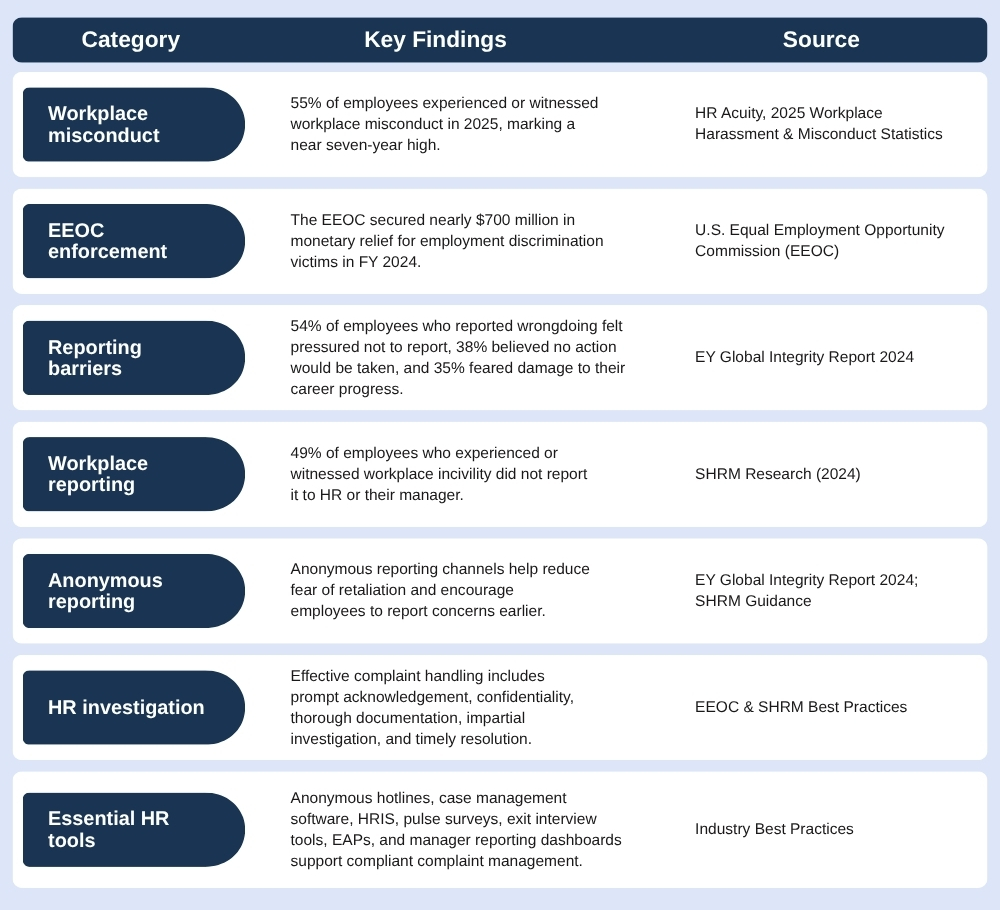
Handling sensitive employee complaints well is not a single skill. It blends legal awareness, emotional intelligence, and operational discipline into one function. Companies that invest in that combination protect their employees and their bottom line at the same time.
The organizations that get this right rarely talk about it publicly. Their metrics show up instead in lower turnover, fewer disputes, and workplaces where people speak up before small issues turn into expensive ones.