Let’s start with a question.
What if your HR department could foresee future developments, identify high performers before the appraisal, detect disengaged employees before they quit, or even forecast which training would be most effective?
That is not a dream of the future. That is how HR analytics may be used daily.
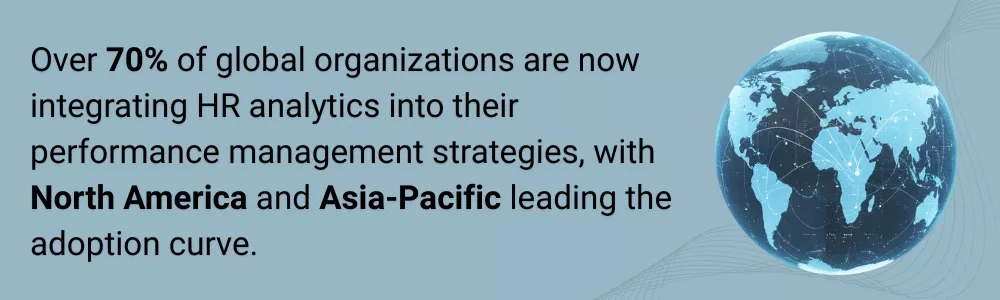
Relying solely on instinct is not only outdated but also risky in today's environment, when businesses are more complex, hybrid, and fast-moving than ever. HR directors in the US, Canada, India, and the Cayman Islands are using data-driven HR choices to manage talent more effectively, quickly, and equitably.
It's also effective. Let's investigate how.
Strategy 1: Defining Role-Specific KPIs with Human Resources Analytics
Companies' failure to define performance is one of the main reasons performance management fails. They employ general measurements or ambiguous standards, such as "be proactive" or "show leadership," which don't offer much insight.
Instead, specificity is the first step in HR analytics. There should be precise, quantifiable, and pertinent performance metrics for every position within the company.
For example:
- For a sales manager, track revenue per lead, upsell success rate, and quarterly growth trends.
- For a content writer, track average engagement rate, turnaround time, and revisions per article.
- Monitor the documentation compliance rate, new-hire satisfaction ratings, and onboarding time per hire for an HR associate.
Once established, these measures provide the basis of trustworthy analytics. They help you understand not only who is performing, but also why.
The Business Impact of HR Analytics
While HR analytics enhances performance reviews and employee engagement, its true value lies in measurable business outcomes. When used strategically, HR analytics doesn’t just improve HR; it improves the bottom line. Here's how:
Retention: Identify "Flight Risks" 6 Months Before They Resign
Losing top talent unexpectedly is costly. But with HR analytics, organizations can detect subtle signs of disengagement, such as declining participation, changing behavior patterns, or reduced collaboration, long before a resignation letter lands.
Advanced retention models can flag these “flight risks” up to 6 months in advance, giving HR enough time to intervene; whether that means offering internal mobility, reworking workloads, or having candid conversations.
The result? Reduced turnover, lower hiring costs, and stronger team continuity.
Training: Increase ROI by Targeting Specific Skill Gaps
Generic training often leads to wasted budgets and disengaged learners. HR analytics helps pinpoint exactly where skills are lacking; and why.
For instance, if your sales team struggles with closing despite high lead volume, data can reveal if the issue is objection handling, follow-up frequency, or CRM usage. Training can then be laser-focused on that weakness.
With pre- and post-training performance tracking, you can finally calculate ROI, proving that the investment in learning is translating to real business value.
Hiring: Identify Which Recruitment Channels Produce the Longest-Tenured Hires
Not all hires are equal, and not all recruitment channels deliver sustainable talent.
HR analytics enables you to connect hiring sources (job boards, referrals, agencies, campus drives) with long-term success metrics such as tenure, promotion speed, and performance scores.
This insight empowers HR teams to double down on what works, drop ineffective channels, and make smarter hiring investments that lead to stability, not churn.
Strategy 2: Forecast Employee Performance Issues Early with Predictive HR Analytics
It is no longer sufficient to examine past performance. It's usually too late if you wait for a problem to become apparent. Predictive HR analytics can change the game in this situation.
Predictive models can identify early warning indicators if they have sufficient employee data on employee behavior, such as attendance trends, project delivery schedules, learning module completion, and engagement survey results.
For example:
- A consistent decline in team meeting attendance may signal disengagement.
- When a high achiever misses a deadline for the first time in months, it could be a sign of burnout.
- A team with a low training completion rate and increased errors may indicate a process mismatch.
These insights allow HR and team leaders to act early, offering support, reassigning responsibilities, or intervening before performance issues turn into resignations or failed projects.
Strategy 3: Use HR Analytics to Design Smarter, Data-Driven Learning & Development Plans
Training and development are often treated as one-size-fits-all programs. But HR analytics helps you shift from mass training to targeted upskilling.
How? By connecting learning data with performance outcomes. When you know which teams are lagging in which specific KPIs, you can design custom learning paths that solve real problems.
For example, if you see that your customer support team is struggling with first-contact resolution, don’t just assign them a generic customer service course. Use HR analytics to determine whether the issue is product knowledge, communication, or system usage, and then train accordingly.
Even better, post-training, you can track whether performance actually improves, and if it doesn’t, dig deeper to find out why.
Strategy 4: Connect Employee Engagement Metrics to Real Performance Outcomes
Although employee engagement is frequently viewed as a "soft" indicator, its effects on performance are anything but; even when disengaged workers may still show up, their output, the quality of their work, and their desire to cooperate all decrease.
You can quantify engagement using HR analytics:
- Employee survey response rates
- Analysis of sentiment in open-ended comments
- Utilizing channels for internal communication
- Time spent using technologies for collaboration
- Participating voluntarily in business initiatives
Plotting this data against team performance reveals patterns. Highly engaged teams have quicker delivery schedules, lower error rates, and better customer outcomes.
These results can be used to identify areas that need cultural or managerial change. Instead of reacting to high attrition, you may prevent it by encouraging involvement where it matters most.
Strategy 5: Using Employee Performance Data for Transparent Conversations
Reviews of performance are frequently perceived as stressful, biased, or ineffective. This is because they are typically based on recollections, judgments, or outdated scorecards. However, HR analytics can completely alter that.
Bring statistics into the conversation rather than depending on a manager's assessment of the previous few months. To present a comprehensive picture of an employee's performance across time, across projects, and in relation to team averages, use HR analytics.
Reviews become more accurate and courteous as a result. When their work is assessed using uniform measures, employees feel seen and understood. Additionally, it helps managers provide precise, helpful comments rather than general views.
Reviews become fruitful discussions centered on development rather than condemnation when data is used as the starting point.
Strategy 6: Driving Data-Driven HR Decisions with Powerful Dashboards
Raw data stored in spreadsheets won’t do much for your company unless it’s made accessible and easy to understand. That’s why data visualization is a vital part of any HR analytics strategy.
Dashboards provide leadership with quick access to the most critical HR metrics:
- Which departments are improving and which are falling behind?
- What’s the current attrition risk across teams?
- How are new hires performing after 3 months?
- Are training programs showing an improvement in key metrics?
Visual dashboards allow HR professionals and managers to take ownership of data without needing to be data analysts. This leads to faster data-driven HR decisions and stronger collaboration between HR and other departments.
Strategy 7: Strengthen Workforce Trust with Ethical and Transparent HR Analytics
Collecting data on employees can easily backfire if it’s done without transparency. If employees feel they’re being watched instead of supported, morale drops.
That’s why it’s crucial to design your HR analytics program with trust at its core:
- Communicate clearly what data is being collected
- Explain how it will be used and what the benefit is to the employee.
- Ensure compliance with all applicable local data laws, such as GDPR, HIPAA, and Cayman’s DPL.
- Only track what’s necessary for improving performance or well-being.
Employee engagement with the system increases when they understand the "why" behind analytics and perceive it as a tool to help rather than punish. Having faith in the process turns into a tactical advantage.
Redefining Performance Starts Here
Without data, managing employee performance in today's business environment is like navigating without a compass. Even if you move, you won't be able to see if you're on the correct path.
That compass is HR analytics.
It makes things clear. It reveals the underlying causes. It gets rid of prejudice. It enables you to make better choices for your employees and your business.
And HR HUB is designed to do just that if you're searching for a platform that combines all these features under one roof. HR HUB gives your team the tools they need to transform data into action, from interactive dashboards to real-time performance tracking.
HR HUB makes it simple to align people, performance, and productivity, whether you're expanding throughout the US, managing compliance in Cayman, managing remote work in Canada, or extending a team in India.
Because performance is no longer just about output, it’s about understanding. And HR HUB helps you understand your people like never before.