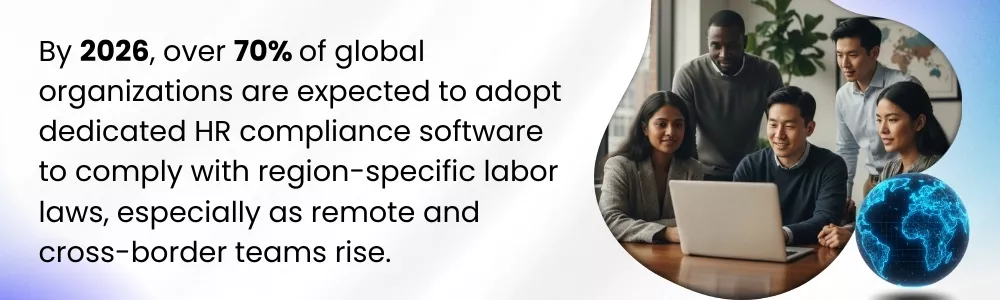
In terms of human resources compliance, 2026 is turning out to be a historic year for businesses. Maintaining compliance with labor laws, documentation standards, and industry rules is now essential, regardless of whether you are in charge of a startup in the Cayman Islands, a non-profit in Canada, or a mid-sized company in India or the US. It is now essential for competitiveness.
Adopting automated compliance tools is no longer a luxury but a baseline for survival.
The cost of non-compliance, penalties, audits, employee dissatisfaction, or even lawsuits has pushed organizations to adopt HR compliance software that offers automation, transparency, and real-time tracking. But the question is: how do you choose the right platform that goes beyond the basics?
This article examines what contemporary HR compliance management software should provide in 2026, the major trends shaping its development, and how companies are using it to create workplaces that are safer, smarter, and more compliant.
Why Modern HR Compliance Software is Essential in 2026
The majority of people still equate HR compliance with regulations and sanctions. Although that is a component of it, the contemporary meaning is far more expansive.
HR compliance in 2026 means:
- Ensuring every employee interaction complies with regional laws, company policies, and industry regulations.
- Documenting every action, decision, and change with clear audit trails.
- Being ready to prove your compliance at any time, to any regulator.
This is far more than just keeping contracts or submitting taxes. It's about giving leadership real-time visibility into organizational risk and developing automated systems that stop mistakes before they happen.
Every component needs to be organized, timestamped, and reportable, whether it's monitoring leave entitlements, guaranteeing policy acknowledgments, overseeing diversity disclosures, or managing health insurance compliance.
This is the new baseline, and only HR compliance software can deliver at this scale.
Why Manual HR Compliance Fails in 2026, and What to Do Instead
When your HR department only had a few people and one jurisdiction to handle, manual compliance might have worked. However, that world had vanished by 2026.
The business context in which today's HR teams operate is:
- Hyper-regulated: New policies are introduced every month or quarter. The US imposes new equity audit criteria, Cayman adjusts pension thresholds, and India releases amendments to the wage law. It is now a full-time commitment to be up to date rather than just checking the law once a year.
- Distributed and remote-first: You might have workers from several nations, each with its own set of employment, insurance, and tax regulations. This implies that a single error, such as applying India's PF deduction regulations to a Canadian employee, could lead to monetary fines or unhappy workers.
- Under constant scrutiny: Whether it's a labor board surprise visit, an internal compliance check, or an investor due diligence audit, your records, policies, and processes must be audit-ready at all times.
- Responsible for more data than ever: Background checks, wage slips, working hours, health benefits, HRA declarations, DEI records, gratuity, pension contributions, and more. These are not merely documents; they are regulated, sensitive data that must be secure and traceable.
Now, imagine trying to handle all this using spreadsheets, email chains, or disconnected folders across Google Drive and SharePoint.
Manual methods simply can’t scale.
They fail to:
- Proactively warn you when a work permit or training certification is about to expire
- Track acknowledgments of newly issued HR policies, especially across large teams
- Validate jurisdictional compliance (e.g., whether Canadian employees received bilingual contracts)
- Ensure workflows receive real-time updates when a law changes or a policy is amended.
- Protect sensitive data from accidental leaks or unauthorized edits.
And worst of all, manual systems cannot enforce accountability. When something goes wrong, there’s no audit trail. No timeline. No clarity.
That’s why organizations are shifting from compliance chaos to HR compliance management software, not as a convenience, but as a survival strategy.
Key Features of HR Compliance Software: What Modern Platforms Deliver
So what makes HR compliance software such a game-changer in 2026? It’s not just that it digitizes your compliance, it orchestrates it.
Here’s what modern, best-in-class platforms can do:
a. Policy Acknowledgment & Tracking
Gone are the days of chasing signatures or email confirmations. With automated compliance tools:
- Employees receive instant notifications when a policy is updated
- They must acknowledge it digitally, with the system logging the exact timestamp, user ID, and IP address.
- HR managers can instantly filter who has or hasn’t acknowledged a policy, and even lock certain platform access until compliance is complete.
This transforms policy rollout from a headache into a controlled process.
b. Real-Time Document Expiry Alerts
Letting work permits, compliance forms, or insurance renewals lapse can trigger heavy penalties. HR compliance software:
- Tracks document types based on expiry timelines
- Sends automatic reminders to HR, managers, and employees before deadlines
- Flags high-priority expirations on a live dashboard
This ensures no document ever goes forgotten, especially in jurisdictions with strict employment authorization laws.
c. Automated Audit Trail
Auditors don’t just want documents; they want evidence. Who made the change? When? Why? Can it be reversed?
Modern platforms:
- Track every action within the system: edits, uploads, acknowledgments, and role changes
- Create a tamper-proof audit log.
- Offer downloadable reports for compliance teams and regulators.
This reduces audit prep time from weeks to minutes.
d. Region-Specific Compliance Logic
Compliance is local, even if your business is global. The best tools are built with this in mind.
Let’s say:
- An Indian employee needs EPF, ESI, and Form 16 access
- A Cayman-based team member needs pension tracking and health insurance logs.
- A Canadian employee needs French-English bilingual policies and benefit summaries.
HR compliance software allows you to automatically configure rules, forms, templates, and validation workflows per location, job type, and team.
This flexibility ensures compliance without overcomplication.
e. Time & Attendance Integration
Time is money, and it’s also a legal requirement.
Integrating your time tracking system with your compliance platform means:
- Daily OT, weekly hour caps, and break durations are all monitored against labor laws
- Any violations (e.g., an employee not receiving their mandated break) are flagged before payroll is processed.
- Attendance logs are included in audit-ready reports, helping defend wage compliance.
This is especially useful in regions like Cayman, where 45-hour weekly limits and 9-hour daily caps require careful tracking.
f. Secure Employee Records
Documents aren’t just files; they're evidence, and mishandling them is a legal risk.
A robust employee recordkeeping software module:
- Encrypts data
- Applies strict retention rules (e.g., delete after 3 years or archive after resignation)
- Offers searchability and tagging (e.g., “training,” “disciplinary,” “benefits”)
- Restricts access by role (e.g., only legal can view certain uploads)
No more sifting through folders or accidentally emailing confidential info to the wrong person. Every file is traceable, protected, and organized.
How Automation Transforms HR Compliance in 2026
If there’s one thing HR professionals in 2026 can agree on, it’s this: automation isn’t just making life easier; it’s making legal compliance possible.
Manual tracking leaves too many gaps. People forget. Laws change. Teams grow faster than policies can be updated. And mistakes? They don’t just hurt your internal operations; they cost money, credibility, and employee trust.
That’s why forward-thinking businesses now treat automated compliance tools as their first line of defense. Let’s see why:
Imagine This Scenario:
You’re managing a team of 200 employees across India and Canada. Each region has unique rules:
- India requires mandatory PF contributions, digital wage slips, gratuity calculation, and HRA documentation.
- Canada requires adherence to provincial employment laws, bilingual HR policies, and specific benefit eligibility criteria.
Now, picture an HR team trying to handle:
- 50 new hires per month
- Policy updates every quarter.
- Expiring documents (visas, contracts, insurance)
- Tax declaration forms are due before payroll.
- Mandatory training certifications that need renewal every year
Trying to control this volume manually isn’t just exhausting, it’s a compliance disaster waiting to happen.
Real-World Impact: How Automated Compliance Tools Prevent Risk
With advanced HR compliance software, all of the above becomes a series of intelligent workflows running silently in the background. Here’s what that looks like:
Auto-Assign Compliance Bundles
When a new employee joins:
- The system automatically detects their location and role.
- It applies the correct compliance rules, such as Indian PF eligibility and Canadian holiday tracking.
- They’re assigned relevant documents, benefits, and policy versions, no manual input required.
This ensures every employee starts on the proper legal footing, regardless of where they’re hired.
Policy Change Triggers Automatic Acknowledgment
- HR updates the company’s leave policy.
- The system immediately notifies every employee to acknowledge the update.
- Only after acknowledgment is completed can they access the leave application system.
This prevents outdated policies from being acted upon and creates a digital trail of who saw what and when.
Training & Certification Renewal Reminders
- Compliance training, workplace safety sessions, or harassment prevention courses are all tracked.
- Before the expiration date, the system alerts both the employee and HR.
- If the certification lapses, system access can be limited until it’s renewed.
This keeps your workforce audit-ready and compliant, without HR needing to remember every date.
Conditional Locking Based on Compliance Gaps
- An employee hasn’t submitted their tax declaration.
- The system automatically prevents their payslip from being generated.
- Once submitted and approved, payroll resumes.
These built-in checks remove the guesswork and the paperwork from compliance.
Auto-Alerts for Document Expiry & Legal Violations
- Is your work visa about to expire? It is flagged by the system 60 days in advance.
- Over time, does that go beyond the law? Before the threshold is crossed, it alerts the manager.
- Has a new law been published? Within a day, it appears on the compliance dashboard.
With automated compliance tools, there are no surprises, only structured prevention.
Top Features to Look for in HR Compliance Software in 2026
If you're planning to adopt or upgrade your HR compliance platform in 2026, evaluate these capabilities:
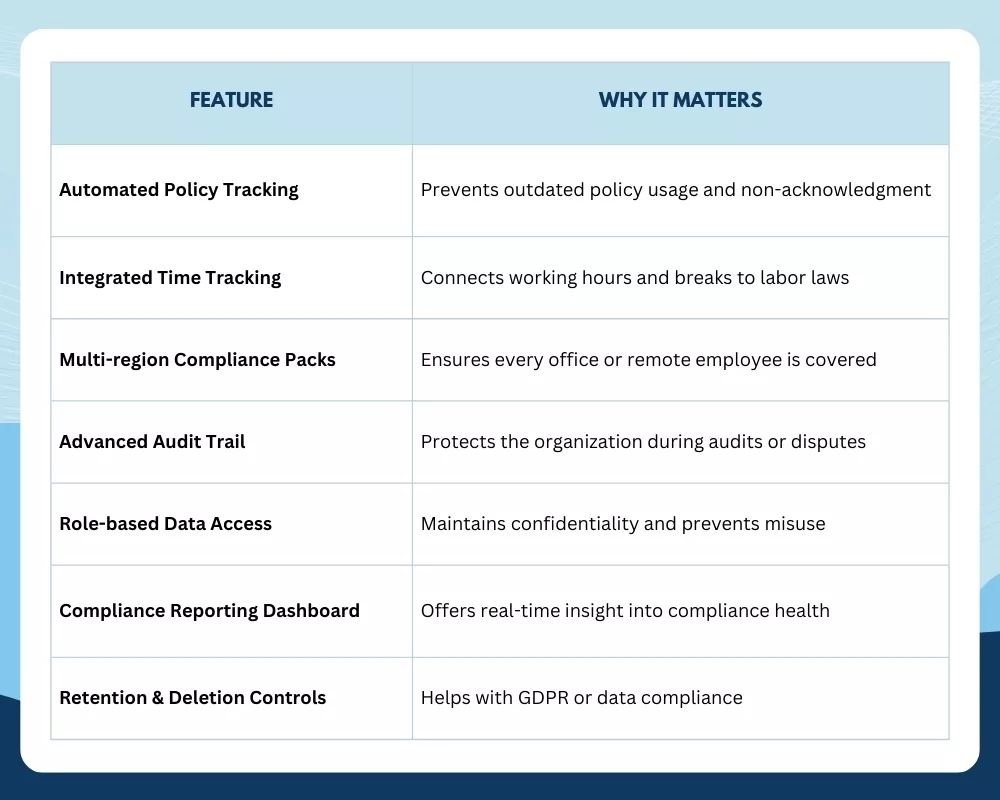
When these pieces come together, compliance is no longer a struggle. It becomes a system that quietly protects your business every single day.
Why HR HUB Is the Smart Choice for Scalable HR Compliance
It shouldn't feel like a barrier to compliance. When done well, it builds a foundation of trust both inside and beyond the company.
This idea served as the foundation for HR HUB. It is more than just a document storage and reminder tool. It's a platform that completely changes how you manage HR compliance.
Here’s what makes HR HUB’s compliance module stand out:
- A real-time compliance dashboard that displays your risk status by team, area, or module
- Smart tagging and auto-expiry notifications are integrated with employee recordkeeping software.
- An integrated time tracking system that complies with workplace regulations on overtime, breaks, and shift limits
- Completely adaptable automatic compliance solutions that change according to work kind, location, or title
- Complete governance is achieved by automated policy re-acceptance, locking mechanisms, and approval channels.
Whether you're a company in Mumbai, Miami, or George Town, HR HUB helps you track, manage, and strengthen HR compliance without the chaos.