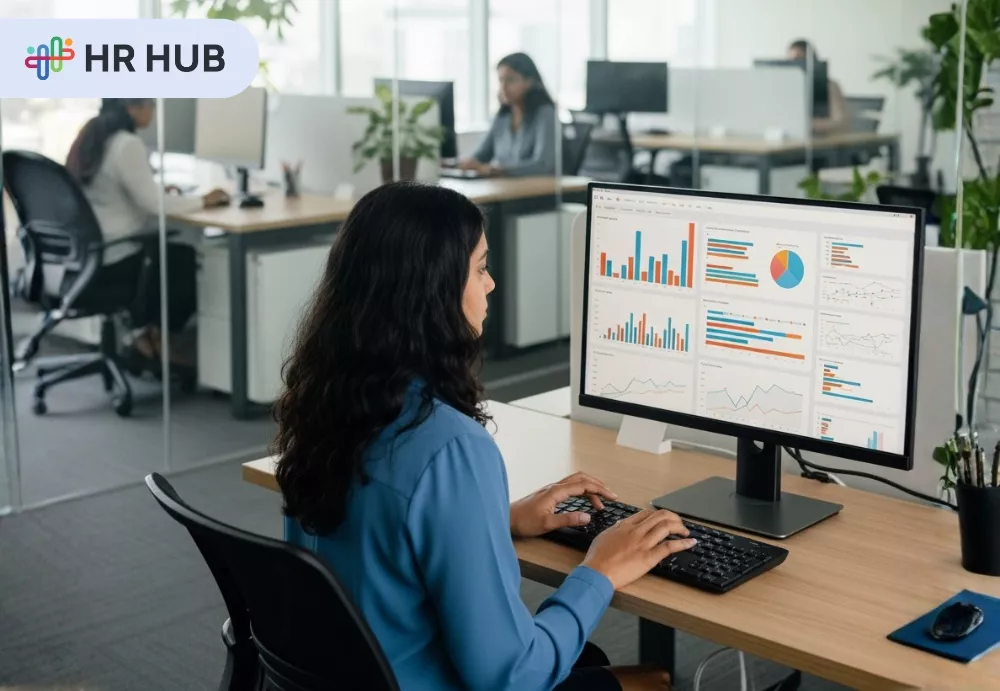
Indian companies today handle thousands of data points across attendance, payroll, performance, and employee behaviour, but most of this information stays scattered and underused.
HR teams often know the symptoms but rarely get a complete view of why something is happening. This is where HR analytics software and intelligent reporting dashboards make all the difference.
They bring all the key metrics onto one screen, reveal patterns that are easy to miss, and help HR leaders make decisions backed by clear evidence rather than assumptions.
The Magic of Seeing Everything at Once
Imagine the first screen of your day showing you a complete picture of your people.
- Who is overworked?
- Which team is slipping in attendance?
- How compensation is moving month by month.
- Where performance conversations are stuck.
Not through scattered sheets, but through a single innovative dashboard updated in real time.
This is the kind of simplicity HR dashboard software brings to Indian companies. It is not about graphs. It is about clarity. Clarity that helps HR respond faster. Clarity that keeps leadership grounded in absolute numbers. Clarity that makes every decision more confident.
What makes these dashboards special is not the design. It is the feeling of control that HR gets after years of working with siloed data buried across departments.

When Data Starts Talking, Decisions Stop Guessing
Indian organizations rarely operate linearly. Workflows spike during festivals, resignations peak during appraisal season, overtime builds during audit months, and attendance dips during monsoons. HR teams live through these shifts every year, but patterns remain hidden unless someone goes hunting for them.
HR dashboards make these patterns appear like they were always meant to be seen.
They reveal:
- Why one department is burning out while another is underutilized
- How absenteeism creeps up at specific times
- Which teams consistently exceed targets
- How payroll expenses rise without anyone noticing
- Where compliance blind spots are forming silently
The job of HR analytics software is not to overwhelm HR with data. Its job is to highlight the signals that matter and filter out the noise that does not.
That is where the fundamental transformation begins.
The Heart of a Good HR Dashboard: Showing What HR Really Needs to See
A dashboard is not powerful because it has charts. It is powerful because it shows the right charts.
Below is a deep dive into the pillars that make HR dashboard software truly effective in Indian organizations.
1. Real-Time Workforce Visibility
The dashboard becomes a living mirror of the company. Every punch, shift update, payroll edit, leave approval, or performance rating reflects instantly. This ensures HR never acts on yesterday’s information.
Real-time visibility helps identify:
- Sudden dips in attendance across locations
- Unexpected overtime spikes
- Ongoing performance bottlenecks
- Teams showing repeated low engagement
- Payroll numbers are moving away from forecasts.
For leaders who operate on tight schedules, the ability to open one screen and understand the company’s people health in minutes is priceless.
2. Patterns That Human Eyes Miss
Data scattered across modules makes patterns impossible to spot. Dashboards highlight movements HR would never notice manually.
For example:
- Why does a particular team always show high absenteeism after every quarter close
- Why does performance consistently dip during specific months?
- Why does the overtime cost in one branch rise while the headcount stays stable
- Why attrition stays high among employees with less than one year of service
This is where employee analytics becomes a strategic tool instead of a reporting chore.
3. Comparisons That Bring Context
A single number means very little unless it is compared with something.
A robust dashboard allows teams to compare:
- Department vs department
- Location vs location
- Month vs month
- Employee category vs employee category
- Forecast vs actual data
This context enables data to inform policy decisions, hiring plans, cost controls, and training investments.
4. Integration Across Modules
One of the most significant advantages of modern HR analytics software is its integration of attendance, payroll, leave, performance, recruitment, and compliance data into a single, connected system.
This means:
- Attendance errors automatically show payroll impact
- Over time, changes reflect in cost dashboards.
- Low performance links with attrition patterns
- Leave trends correlate with productivity change.s
This integration helps HR make decisions based on the whole picture, not one module at a time.
What Companies Learn When They Start Using Dashboards
The first surprise companies experience is how different the organization looks once the data is visual. HR teams often say, “We always assumed this, but never had proof.” Dashboards replace assumptions with evidence.
1. Productivity Becomes Measurable
Performance reviews stop being opinion-based. You see:
- Rating distribution
- Skill gaps across roles
- Managers who score too harshly or too leniently
- Employee growth cycles
- Trends over multiple appraisal seasons
You eventually see what drives performance improvement and what does not.
2. Attendance Turns into Insight, Not Just Logs
Attendance is one of the most significant behavioural indicators in any organization. Dashboards convert raw punch data into intelligence by showing:
- Heatmaps of late entries
- Seasonal dips in presence
- Teams with repeated missed punches.
- Employees with accumulated overtime
- Departments struggling with work-life balance
What begins as a time log becomes a culture mirror.
3. Payroll Stops Surprising Finance Teams
In Indian organizations, payroll fluctuations are common due to incentives, reimbursements, overtime, shift allowances, weekend support, and compliance calculations. Dashboards track these movements and show:
- Monthly cost trends
- Rising or falling allowance structures
- Cost difference after new hires and exits
- Variable pay movement across quarters
- Unexpected spikes that need investigation
This allows companies to prepare budgets with greater confidence.
4. Attrition Becomes Predictable
Attrition rarely comes as a shock when dashboards are used consistently. HR teams begin identifying:
- Tenure-based attrition spikes
- Departments are losing people faster.
- Exit reasons clustering in patterns
- Leaders associated with higher turnover
- Performance dips before resignations
Insight leads to prevention, not damage control.
Three Real World Use Cases Every Indian Company Faces
The beauty of dashboards lies in how they solve everyday challenges without needing complex interventions.
1. Performance Review Cycles that Move Smoothly
Appraisal season is the storm HR prepares for every year: emails, spreadsheets, reminders, back-and-forth approvals. But a performance dashboard turns this chaos into clarity.
- You see which appraisals are pending.
- You see which managers hold reviews back.
- You see how scores spread across teams in seconds.
- You see who consistently rises and who needs support.
This is employee analytics at its most empowering. Decisions about promotions, bonuses, and development are grounded in evidence rather than impressions.
2. Attendance Patterns That Reveal Workplace Health
Attendance is not just a record of punches. It is a pulse check.
A dashboard can show:
- Which teams arrive late frequently
- Which employees take multiple short leaves
- When overtime spikes beyond healthy limits
- How festive seasons impact productivity
- Whether attendance issues vary by shift or location
Instead of reacting to problems, HR can anticipate them. Often, attendance patterns reveal morale issues much earlier than feedback surveys do.
3. Payroll Cost Insights That Prevent Surprises
Payroll is one of the strongest indicators of business health. Yet most companies review it at month-end, not as the month unfolds.
A payroll dashboard can change that.
It highlights:
- Overtime costs are rising faster than expected
- Allowances that suddenly spike
- Variable pay movement
- Salary distribution by department
- Cost differences after new hires or exits
When HR dashboard software presents payroll visually, HR and finance can make better decisions without waiting for end-of-month reconciliations.
What Modern HR Analytics Tools Truly Deliver
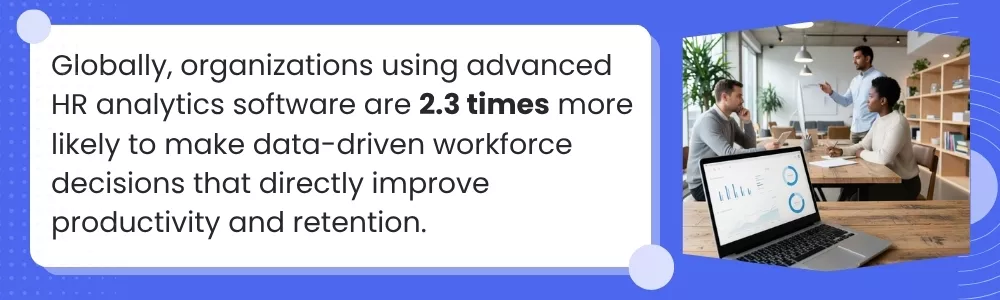
The actual value of HR analytics software lies not in charts. It is in connection. When attendance data speaks to payroll, and payroll connects back to performance, HR gets a complete picture. No module is isolated. No decision stands alone.
A sound system also offers:
- Role-based views for HR, managers, leadership, and finance
- Predictive patterns built from historical behaviour
- Drill down details to identify root causes.
- Trend lines that explain the past and warn about the future
- Clear export options for audits and board reports
This is when HR moves closer to strategic decision-making rather than operational firefighting.
Before You Go: A Final Look at Why Dashboards Matter
Every HR team has experienced moments when something went unnoticed. A sudden rise in absenteeism. An unexpected overtime spike. A pattern of low performance. A payroll mismatch that came to light too late.
Dashboards prevent these moments from happening. They act like an early radar for workforce behaviour, financial pressure, and cultural shifts. They give HR the clarity they've always wished for.
This is where platforms like HR HUB become crucial. HR HUB brings attendance, payroll, performance, leave, and compliance into a single ecosystem, enabling companies to track, analyze, and act through a unified set of dashboards. Everything is updated automatically and displayed in a way that feels intuitive, not overwhelming. It gives every Indian company the confidence to base decisions on real insights instead of scattered data.
If you are building a stronger, more intelligent, more resilient HR function for your organization, your dashboards are not just tools. They are your compass.