Energy is one industry that functions at the nexus of power, pressure, and precision. Every second counts, every procedure matters, and every compliance regulation can be the difference between costly downtime and seamless operations, from wind farms to oil fields. Yet, amidst turbines, transformers, and transmission lines, there’s another force driving efficiency that often goes unnoticed: HR management software.
In an industry where teams work across time zones, terrains, and technical complexities, this digital backbone is quietly redefining what productivity means. It's about turning compliance-intensive procedures into intelligent, people-centered systems that maintain operations as smoothly as energy itself, not just about keeping track of attendance or automating payroll.
The Real Pressure Point: Managing People in a High-Stakes Industry
In addition to managing workers, energy companies often oversee engineers, field operators, geologists, safety officials, technicians, and contractors. There are dangers, rules, and obligations specific to each role. The human resource conundrum is as complex as a power infrastructure when you include shifts, international locations, and changing labor regulations.
Spreadsheets, manual approvals, and paper-intensive compliance checks continue to be problems for HR in many businesses. A single expired certification or a delayed paycheck might have a cascading effect on the system, leading to project delays, contract violations, or even fines. The need isn’t just for better management; it’s for a system that sees everything, tracks everything, and ensures nothing slips through the cracks.
That’s the promise of HR software for the Energy industry: a digital ally built to bring order, accuracy, and intelligence into the heart of workforce management.

Compliance Is No Longer a Burden: It’s a System
Long checklists, manual approvals, and paper trails kept in cupboards that no one feared to touch were all part of the energy industry's decades-long neglect of compliance. However, human resources compliance has developed into a dynamic system that guarantees continuity, safety, and accountability across all operations.
With modern HR management software, compliance becomes automated. Every employee certification, medical record, and safety license is tracked in real time. Expiry alerts are triggered automatically, and renewal reminders are sent to employees weeks in advance. Audit-ready reports can be generated with a click: no more scrambling when inspectors arrive.
Imagine an offshore drilling company where HR instantly knows which divers’ safety training is due for renewal, or which engineers have recently cleared their health checkups. That’s the difference automation makes: compliance turns from chaos to clarity.
The biggest gain? Peace of mind. HR teams no longer spend nights verifying spreadsheets before audits: they can focus on building a safer, more engaged workforce.
Centralized Visibility for a Decentralized Workforce
Energy firms are rarely confined to a single location. Projects may run in deserts, offshore platforms, or high-altitude wind farms. When operations are that scattered, communication gaps can cost millions.
HR management software solves this fragmentation by centralizing everything: attendance logs, leave records, timesheets, payroll data, and compliance documents, in one digital space. Supervisors can check who’s currently deployed, HR can view workforce distribution, and finance teams can calculate costs by project or site.
It’s not just about data consolidation: it’s about control. When all information flows into a single dashboard, managers can spot inefficiencies instantly. For instance, a refinery HR team may notice that a specific crew consistently works overtime during maintenance shutdowns, suggesting a need to reallocate resources.
This real-time visibility bridges the distance between teams, ensuring that no employee or task gets lost in the operational sprawl.
Predictive Scheduling and Workforce Optimization
The energy sector runs on precision: one shift missed, one rotation miscalculated, and the entire production schedule can falter. That’s why shift planning and workforce forecasting are among the most demanding HR functions in this industry.
Predictive scheduling tools are a feature of contemporary HR systems. The software automatically generates optimal rosters by examining attendance data, project schedules, and skill availability. Ensuring employees have adequate rest before being assigned to crucial activities can even help manage fatigue.
Consider a power distribution business getting ready for seasonal maintenance. The HR system can anticipate the surge in workforce needed during high-demand months, identify which technicians are available, and generate schedules that balance efficiency with safety.
The result? Projects stay on track, downtime drops, and compliance with working hour laws remains intact: all achieved through the quiet precision of HR software.
Payroll That Handles Every Complexity
If you've ever managed payroll at an energy company, you are aware of how difficult it is. One payslip combines offshore allowances, project-based compensation, hazard bonuses, shift differentials, and cross-border taxes. Under such pressure, manual payroll processes break down, often leading to disagreements, delays, and compliance issues.
Payroll becomes automated and compliant with regulations when HR management software is linked. Everything is calculated in real time by the system, including statutory deductions, overtime, per diem allowances, and base pay. It rapidly creates compliance reports, generates error-free paystubs, and applies location-specific tax regulations.
Think about an engineer who works for a U.S.-based company on a wind farm in India. Without human intervention, the program can easily handle local deductions, currency translation, and international tax compliance.
Automation fosters trust and helps prevent errors. Employee morale and retention both increase when compensation is transparent and consistent.
Training, Certification, and the Safety Connection
In an industry where a single oversight can trigger environmental or safety disasters, training is not an HR formality: it’s a survival mechanism. Keeping track of who’s trained, who’s overdue, and who’s certified is critical.
Modern HR platforms integrate training and certification management directly into employee profiles. A safety officer can assign mandatory online training modules, monitor completion, and track assessment scores. Supervisors get real-time visibility into training gaps across departments.
Take a refinery that must comply with stringent OSHA (Occupational Safety and Health Administration) guidelines. Using HR management software, it can ensure that every worker on site has completed fire safety, hazardous material handling, and emergency response training. Certificates are stored digitally, are accessible during audits, and are automatically renewed when due.
This proactive approach transforms compliance from a task into a culture: one that values safety as much as performance.
Data-Driven Insights for Future Readiness
To improve operations, energy businesses are adopting automation, IoT, and AI. However, the most precious resource is still humans, not machines. The difficulty lies in preparing those individuals for a future that demands new abilities, perspectives, and agility.
HR directors can assess staff performance, pinpoint skill gaps, and organize upskilling programs well in front of shortages thanks to sophisticated analytics integrated into HR software. The technology helps management take prompt corrective action by monitoring trends, such as excessive turnover in specific job roles or deteriorating performance after shift changes.
For instance, analytics may reveal that 40% of the maintenance workers at a renewable energy company making the switch to novel grid management are not proficient in data analytics. HR may then use the same software to create focused learning pathways, assign online courses, and track completion.
By connecting people data with business outcomes, energy firms are no longer guessing: they’re growing intelligently.
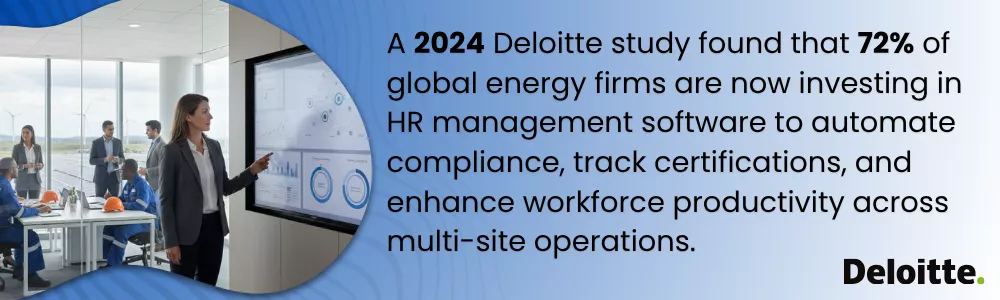
Empowering Energy Firms with HR HUB
This evolution of HR technology finds its strongest expression in HR HUB: a platform built for industries that never pause. HR HUB brings compliance automation, workforce analytics, performance management, payroll intelligence, and learning tools together in one ecosystem.
For energy companies, HR HUB delivers precisely what the industry needs most: precision, transparency, and adaptability. From tracking offshore attendance to generating site-specific payroll reports, every feature is designed to simplify the complex.
Its integrated compliance dashboard helps HR teams effortlessly monitor licenses and certifications. Its analytics engine converts workforce data into actionable insight, guiding smarter decisions on staffing, training, and cost control. And its mobile-first approach ensures that even field workers can access the system securely, no matter where they are deployed.
In a business where uptime defines success, HR HUB ensures your people are always ready: trained, compliant, and performing at their best. Because when your workforce runs like a well-oiled machine, productivity isn’t a target; it’s the natural outcome.