At some time, every expanding company asks the same question: How can we grow without losing control? What initially worked, spreadsheets, dispersed apps, and manual reminders, begins to feel like a juggling act as teams grow and routines become more intricate.
At that point, astute companies understand that accomplishing more with less doesn't entail taking shortcuts. Simplifying is what it means. And that's precisely where HRMS software makes a difference.
Let’s break down how the right HR management software doesn’t just improve HR operations, it transforms your entire business rhythm.
1. Centralized HRMS Software: Ending Fragmentation and Streamlining HR Operations
In many businesses, especially those scaling across geographies, HR operations tend to evolve organically but unevenly. You should start with a simple payroll tool, then bolt on an attendance tracker, an Excel sheet for recruitment, and a shared drive for storing employee files. The result? A tangled web of disjointed systems that don’t speak to each other, and worse, leave too much room for error.
Disjointed tools result in redundant work, inconsistent data, sluggish decision-making, and compliance blind spots. Employees don't know where to look, managers waste time searching for information, and HR teams are forced to reconcile data rather than focus on strategic planning.
This is where a centralized HRMS software steps in as the digital core of your HR operations. By consolidating employee information, workflows, and communication into a single platform, it becomes the command center of your HR function. You’re no longer hopping between tools or relying on manual updates across departments.
With one cohesive dashboard, you gain:
- Real-time data consistency across functions like payroll, attendance, benefits, and performance.
- Faster audits and compliance checks are especially critical in jurisdictions like the US and the Cayman Islands.
- Seamless collaboration between HR, finance, and operations, even if they’re in different time zones.
- Better employee experience, as everyone, from new hires to leadership, navigates the same intuitive interface.
The centralization doesn’t just make HR’s life easier; it elevates the entire organization’s rhythm.
Does Your Business Need an HRMS Upgrade?
- Are you still manually reconciling attendance with payroll?
- Do employees have to email you for their own payslips?
- Is your onboarding still handled via paper or unlinked emails?
- Can you see your real-time turnover rate with one click?
If you’ve answered “yes” to even one of these questions, your business might be outgrowing its current HR setup. The reality is, as organizations expand, even modestly, the cost of relying on manual processes, disconnected spreadsheets, and outdated software adds up quickly. Not just in time, but in errors, compliance risks, and missed opportunities for better decision-making.
Let’s break it down:
- Manual Attendance Reconciliation: Still syncing biometric logs and spreadsheets manually? You’re wasting valuable HR hours and increasing the chances of payroll errors. A modern HRMS automatically integrates attendance with payroll, reducing errors and improving payout accuracy.
- Lack of Employee Self-Service: If employees can’t download their payslips, check leave balances, or update basic details on their own, HR becomes the bottleneck. A good HRMS puts these everyday tasks in the hands of your workforce, saving everyone time.
- Outdated Onboarding Methods: Paper forms and unstructured email threads are not just inefficient; they create data gaps and confusion. With digital onboarding, new hires complete all formalities before Day 1 and enter the organization with a smooth, welcoming experience.
- Limited Visibility Into HR Metrics: Can you access real-time data on attrition, engagement, or payroll costs? Or are you still requesting monthly reports from multiple departments? An HRMS provides dashboards and instant reports that give leadership the insights they need to act fast.
What Happens If You Don’t Upgrade?
Businesses that stick to outdated systems often find themselves dealing with:
- High administrative workload on HR
- Lack of compliance audit trails
- Low employee engagement due to limited transparency
- Delayed decision-making due to lack of timely data
In today’s fast-paced and remote-friendly work environments, not having a scalable HRMS can quietly erode productivity and employee trust.
2. Driving Efficiency with Automated HR Systems
Nearly 40% of an HR team's time is spent on routine administrative tasks. The cost of manual labor mounts, both financially and psychologically, from entering payroll data to sending email reminders for approvals.
These laborious procedures are transformed into intelligent operations that require less oversight through a contemporary HRMS program with robust automation. Consider it your round-the-clock, digital HR assistant.
Tasks that are instantly streamlined include:
- complete payroll processing with instantaneous tax compliance in several jurisdictions.
- processes for leave and attendance that are automatically approved, eliminating email chains and inefficiencies.
- Tracking documents with expiration notifications (perfect for foreign workers or certificates relevant to a specific business).
- Human errors are eliminated through automated statutory computations, such as Cayman pension contributions, ESIC, HRA, and EPF.
Furthermore, it goes beyond simply saving time. Automation standardizes procedures, lessens the need for individual HR executives, and offers a uniform employee experience. For example, using logic you provide once, HR HUB's workflow engine can automatically reset leave balances, send notifications for missing documents, and lock salary sheets.
These tiny savings add up to substantial increases in operational efficiency over months and years.
3. Empower Your Workforce with HRMS Self-Service Tools
The days of employees needing to email HR for every small request are long gone. Why should HR be any different in a world where fast gratification is expected for everything from food delivery to financial apps?
Self-service is now expected rather than a luxury. The proper HRMS software gives workers speed, clarity, and autonomy. Self-service functionality gives users control, whether they are a regional manager assessing performance targets or a frontline employee verifying attendance.
Key benefits include:
- The employee resolves fewer support tickets, routine queries about leave balances, or payslip issues in seconds.
- Improved transparency, employees feel more connected and informed about their own data and HR processes.
- Remote readiness is critical for businesses with distributed teams across India, Canada, or the Caribbean.
Employees in retail, logistics, or hospitality can access HR HUB on the road thanks to its mobile-first design. Even employees who are not tech-savvy can confidently utilize the UI because it is designed to be intuitive.
In addition to lessening HR's workload, this degree of empowerment increases engagement, fosters trust, and demonstrates to staff that the company values their time.
4. Smarter Onboarding with HRMS: Create a Seamless First-Day Experience
Every employee's emotional and operational tone is established throughout their first few days of employment. Confidence might be damaged before day one even starts if the onboarding process is unclear or takes too long.
A well-organized HRMS platform makes the onboarding process seamless rather than requiring countless calls to explain procedures or chase down documentation. Each job, form, policy, and checkpoint is available online and may be customized by department, role, or location.
HR HUB’s onboarding toolkit includes:
- ID uploads and digital forms with instantaneous validation.
- automated welcome scenes with team introductions, company movies, and pre-written remarks.
- Role-based work distribution allows managers to pre-assign training, KPIs, and system access.
- tracking progress to monitor completion and take action if there are any delays.
For businesses that onboard at scale or internationally, this has a huge impact. Whether they work for an IT services company in Bengaluru or a hotel enterprise in the Cayman Islands, employees are always greeted with professionalism and warmth.
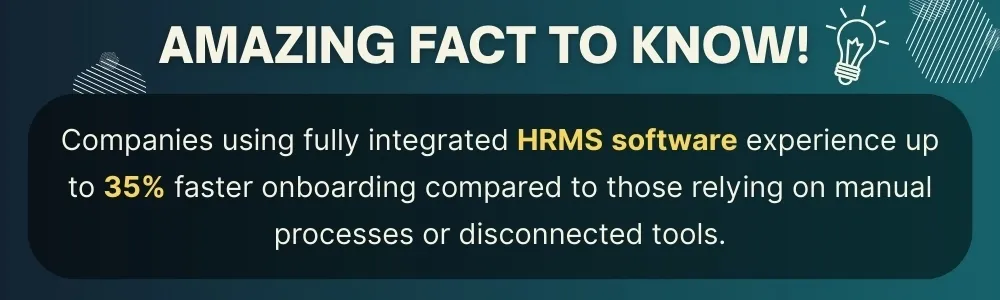
The bonus is that HR departments may cut onboarding times by up to 60%, eliminate duplicate onboarding processes, and reuse templates.
5. Performance Management That Drives Growth Through Your HR Software
Performance is now more than simply yearly evaluations; it's about real-time progress, alignment, and feedback.
Modern HR management software offers dynamic performance capabilities that enable businesses to actively monitor employee contributions and growth, rather than just looking back.
Here’s what dynamic performance management looks like:
- Every quarter, define and realign goals that are visible to management and staff.
- 360-degree feedback gathering that includes clients, managers, and peers.
- automated reminders for developmental input and mid-cycle check-ins.
- dashboards powered by data to uncover underperformance trends early on and highlight great performers.
Employees can see their current situation, expectations, and areas for improvement. Conversely, managers learn who needs training, who is ready for a promotion, and where team capacity is lacking.
This is particularly effective for fast-moving sectors where adaptability is crucial, and KPIs change regularly, such as fintech, digital agencies, or SaaS firms in Canada or India.
Performance management becomes a strategic talent tool when paired with learning modules and pay data.
6. Localized HR Solutions for Businesses: Navigating Global Compliance
Compliance errors are among the areas that seldom surface right away, but when they do, they result in fines, audits, and reputational harm. Each area has its own set of regulations that are constantly changing. Manually managing compliance is like trying to hit a moving target while wearing a blindfold, especially across several countries.
HR departments in India handle professional tax, EPF, ESIC, gratuity thresholds, and constantly shifting tax slabs. Accurate application of overtime regulations, health insurance requirements, and pension contributions is required in the Cayman Islands. Federal, state, and local laws are stacked on top of each other in the US and Canada, creating unique challenges.
This is the point at which an established HRMS program demonstrates its true worth. It integrates regulatory logic directly into payroll, leave, attendance, and reporting workflows, rather than treating compliance as an afterthought.
A compliance-ready HRMS ensures that:
- Employer contributions and regulatory deductions are automatically included in payroll computations.
- Leave policies are in line with accrual regulations and minimum legal entitlements.
- For internal reviews or audits, compliance reports are produced promptly.
- System-wide regulatory updates are implemented without the annual reconfiguration.
The system takes on the role of compliance guardian, rather than having HR teams continuously review circulars, spreadsheets, or consultant communications. In addition to lowering risk, this increases trust among management, investors, and staff that the company does business ethically and openly.
7. Why a Cloud-Based HRMS is Essential for Distributed Teams
Work is no longer done in a single location, at a single desk, during set hours. On the go, decisions are made. Teams work together across countries and locales. Workers don't wait until the next morning to log into a system to anticipate answers.
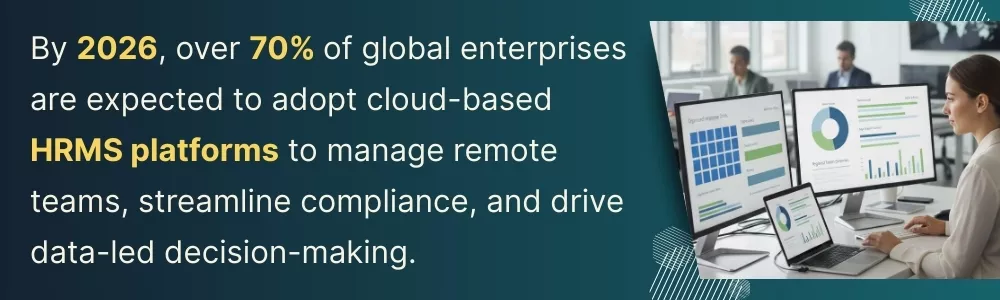
Because of this change, cloud-based HRMS platforms are becoming necessary rather than optional.
HR solutions are no longer restricted to office networks or reliant on local servers, thanks to cloud access. While traveling, managers have the authority to grant leave. During audits, HR personnel can run reports even if they are not physically present. Workers can use their phones to submit requests or download pay stubs.
This kind of accessibility becomes critical for:
- Organizations with multiple branches or locations
- Remote and hybrid teams
- Field staff and frontline workers
- Leadership teams that need real-time visibility
But cloud access isn’t just about convenience. It also enables:
- Quicker feature rollouts and updates
- Enhanced backups and system security
- Improved scalability as the staff expands
- Uniform experience across locations and devices
Role-based access controls allow each user to see precisely what they require, neither more nor less. This harmony between security and accessibility guarantees seamless operations without sacrificing data integrity.
Cloud-based HRMS solutions establish a shared operational layer that keeps everyone connected, informed, and in sync for companies operating in the US, Canada, India, and the Cayman Islands.
8. Optimizing Strategy with HRMS Workforce Management Tools
Although HR data has always existed, it was confined to static reports and spreadsheets for many years. These days, turning that data into insight is the true benefit.
Contemporary HRMS software not only stores data but also interprets it. HR directors have a comprehensive understanding of the relationship between people, performance, and productivity thanks to integrated analytics and dashboards.
With advanced reporting, organizations can analyze:
- Trends in attrition by tenure, function, or department
- Patterns of overtime that indicate understaffing or burnout
- Training efficacy and skill deficiencies
- Time-to-fill metrics and hiring funnel performance
- Comparisons of productivity at the department level
These insights change the way decisions are made. Instead of reacting to problems after they occur, leadership can identify early warning signs and take corrective action.
When paired with intelligent workforce management tools, the system can answer questions that were once impossible to quantify:
- Which teams are consistently overloaded?
- Where are productivity dips linked to absenteeism?
- Which roles have the highest flight risk?
- What training investments actually improve performance?
HR now plays a strategic role rather than an operational one thanks to this data-driven approach. HR directors take on the role of business counselors, armed with data rather than gut feeling. And that change may mean the difference between sustained growth and stagnation in competitive marketplaces.
Future-Ready HR Tools: How HR HUB Transforms Productivity and Scalability
HR efficiency isn't about taking shortcuts. It involves acting wisely, consistently, and purposefully. Your company's digital nervous system is a thorough HRMS program, particularly one like HR HUB.
Whether you're in a fast-growing Indian startup or a Cayman-based wellness business, HR HUB brings everything under one umbrella:
- Centralized records
- Automated payroll & compliance
- Smart performance tracking
- Remote-ready cloud access
- Scalable onboarding and offboarding
- Employee self-service tools
The result? A well-oiled machine where HR is no longer just a support function; it becomes a growth engine.