It begins quietly.
- A calendar invite marked “WFH” that never makes it to HR reports.
- A team agreement that Tuesdays are “deep work days” from home.
- A manager who says, “Let’s focus on output, not location.”
Officially, the company is back in the office. Unofficially, flexibility never left.
Welcome to the era of the Hushed Hybrid policy.
This is not a public protest. There are no town halls demanding change. No dramatic resignations posted online. Instead, what we are witnessing in 2026 is something far more powerful: managers quietly redesigning how work actually happens.
And they are doing it for one reason. Survival.
Below is the expanded and more engaging version of your section. It deepens the narrative, adds nuance, and strengthens the strategic perspective while keeping the tone natural and human.
The Office Is Full Again: Is the Hushed Hybrid Policy Driving RTO Mandate Failure 2026?
Across India, the United States, Canada, and even smaller but globally connected markets like the Cayman Islands, office lights are back on. Desks are occupied. Security badges are active. Cafeterias are busy again. Parking lots are full.
On paper, return-to-office mandates look successful.
However, after a week in these offices, a pattern begins to emerge. Indeed, people are there in person. However, the leadership did not anticipate the level of intensity.
Even when everyone is seated in the same building, important meetings are still conducted via video conferences. The true command centers of productivity remain Slack, Teams, and collaborative dashboards. Workers arrive, put on their headphones, and go about their business as if they were working from home. The commute is now different. The process hasn't.
The office feels alive on certain days. It feels staged on other days.
This disconnect is fueling what many analysts now describe as RTO mandate failure 2026.
The problem is not attendance. It is alignment.
Despite the lack of conclusive evidence that physical presence boosts results, employees who have demonstrated they can deliver remotely are suddenly being asked to commute. Output has never been location-dependent for many positions in digital services, marketing, finance, technology, human resources, and consulting.
Managers, positioned between executive direction and operational reality, feel the strain most intensely. They are expected to enforce policy while protecting performance metrics. They have to defend their attendance while being held responsible for their output.
In situations where performance and policy diverge, managers start to make changes.
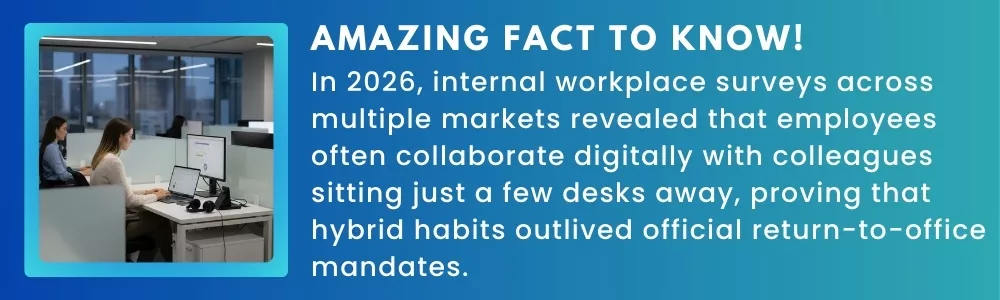
Shadow Hybrid Work and the Rise of the Hushed Hybrid Policy in 2026
The official hybrid framework is one of them. Then there is what truly takes place within teams.
Reality appears to be a mix of Shadow.
Although it deliberately rotates staff to reduce commute fatigue, this department technically meets the statutory in-office quota. When required office weeks reduce the hours available for concentrated work, the project team is the one that discreetly moves deadlines. The manager grants a remote exception "just this once," which becomes a tacit rule.
These adjustments rarely make it into formal documentation. They exist between the lines of policy.
This is not chaos. It is an adaptation to protect results.
Executive dashboards cannot capture what managers observe instantly. Workers are already exhausted from traffic when they arrive at 9 a.m. They see slowdowns during strict office weeks and increases on remote days. Subtle remarks like "I am spending more time commuting than thinking" or "I get more done at home" are heard by them.
They also observe morale, which is more delicate.
Strict attendance requirements can breed discontent, particularly among workers who believe their past performance has already proven their abilities. Surveys don't always reveal that resentment. It manifests itself in involvement, energy levels, and voluntary effort.
Rather than escalating conflict upward, managers recalibrate downward.
That recalibration has become the Hushed Hybrid policy.
Why Manager-Led Flexibility Is Fueling the Hushed Hybrid Policy
Managers are not rebels by design. They function inside a framework. They are aware of responsibility. However, they also have the closest operational ramifications.
They are measured on output, team morale, delivery timelines, and retention. They are compelled to choose between strict compliance and effective leadership when stringent attendance requirements jeopardize either.
It can take more than two hours to commute every day in Indian cities like Delhi, Bengaluru, and Mumbai. There is a noticeable effect on family life and vitality. In both the US and Canada, employment talks now include flexibility. Before asking about pay, candidates now inquire about hybrid arrangements. Losing a single seasoned professional can cause business continuity in the Cayman Islands, where labor markets are competitive, and specialist positions are more difficult to fill.
Manager-led flexibility turns from preference into strategy at this point.
Managers are aware of replacement costs. Onboarding time, lost client continuity, knowledge-transfer gaps, and recruitment costs quickly add up. They are also aware of how brittle engagement can be in a talent-competitive setting.
Often, flexibility is less costly than turnover.
Thus, they employ balance covertly rather than openly question leadership. They modify their timetables. They interpret rules differently. In ways that are not obvious in official reports, they safeguard performance.
Employee Retention India and the Hidden Impact of the Hushed Hybrid Policy
Let us talk openly about retention.
The conversation around employee retention in India has intensified in 2026, but the theme is global. Young professionals expect autonomy. Mid-career professionals expect trust. Senior leaders expect recognition of their time value.
Employees do not always argue when flexibility is taken away without a quantifiable performance rationale. They reassess.
Managers frequently pick up the first indications. Activity on LinkedIn rises, and requests for internal mobility increase. Meeting participation somewhat declines. Feedback stops being enthusiastic and instead becomes neutral.
Rarely do these signs prompt corporate dashboards to sound an alarm immediately. But in day-to-day contacts, supervisors see them.
They are stabilizing their teams by permitting flexibility, even if it is informal.
The purpose of the Hushed Hybrid strategy is not convenience. The goal is to prevent preventable exits that may affect clients, projects, and income.
Retention is not preserved through mandates. It is preserved through trust.
Workplace Transparency Challenges Behind the Hushed Hybrid Policy
Beneath the surface, a deeper tension is developing.
Organizations talk about modern workplace culture, empowerment, and trust. Rigid mandates, however, frequently convey control. A growing lack of transparency in the workplace is revealed when managers covertly modify policies to preserve performance.
According to executives, the mandate is working. Workers are aware that exceptions are frequent. The gray area is where managers work.
This creates three parallel realities:
- The official narrative
- The managerial adaptation
- The employee experience
These worlds diverge with time.
Policies begin to lose credibility because employees see that flexibility is applied unevenly. Narratives about leadership seem to be divorced from operational reality. Because they must balance expectations from both parties, managers endure silent tension.
The stress is structural, but the insurrection is still quiet.
Even well-meaning policies undermine confidence when transparency is absent.
Is RTO Mandate Failure 2026 Accelerating Shadow Hybrid Work and Manager-Led Flexibility?
Labeling this moment as RTO mandate failure 2026 is not about declaring office work obsolete. Many roles absolutely require physical presence. Healthcare, hospitality, manufacturing, retail, and several regulated sectors depend on location-based work.
The failure occurs when mandates ignore context.
A one-size-fits-all directive does not account for role complexity, cultural expectations, infrastructure realities, or talent market pressures. What may suit a regulated environment in Canada may not apply to a digital-first company in India. What works in a dense US corporate district may not align with island economies where commuting logistics differ.
- Managers understand nuance because they deal with operational specifics daily.
- Policies often operate at an abstraction level.
- And performance lives in nuance.
For more insight into how hybrid models compare with traditional office structures and how they impact team performance, check out the detailed guide on hybrid vs office work models.
The Hidden Costs of Shadow Hybrid Work and an Unofficial Hushed Hybrid Policy
Long-term silence involves risk, but the Hushed Hybrid approach might ease tension in the short term.
Uneven flexibility across departments can create perceptions of favoritism. Actual working habits might not be reflected in compliance documents. HR analytics may show office attendance compliance that does not represent real productivity behaviors. Leadership may make strategic real estate or workforce decisions based on incomplete visibility.
The longer Shadow hybrid work remains unofficial, the more complex the structural alignment becomes.
Informal systems eventually collide with formal frameworks.
The solution is not stricter enforcement. It is structured honesty. Clear policies that reflect reality reduce the need for quiet adjustments.
From Manager-Led Flexibility to Structured Workplace Transparency: Ending RTO Mandate Failure 2026
Organizations that double down on strict attendance are not the ones that will prosper after 2026. It is they who recognize operational truth and build their designs around it.
This entails transforming silent adaptability into quantifiable structures.
- It means empowering manager-led flexibility within clearly defined boundaries, supported by transparent reporting.
- It means evaluating productivity by deliverables, not by badge-swipe frequency.
- It means aligning hybrid design with retention goals in India, North America, and emerging global markets.
- It means strengthening workplace transparency so that managers are not forced into gray zones.
Flexibility does not weaken discipline.
It strengthens alignment.
When policy reflects performance reality, there is no need for hushed rebellion. There is only clarity.
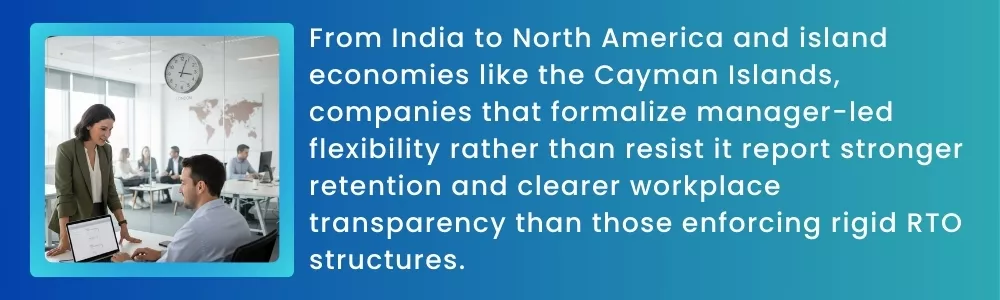
Where the Hushed Hybrid Policy Becomes Reform: Turning Shadow Hybrid Work into Strategic Clarity
It is not disobedience that is causing the silent change we are seeing. It has to do with evolution.
The Hushed Hybrid strategy indicates a lasting shift in the workplace. Managers are not undermining authority. They are reacting to operational realities.
Organizations want technologies that make flexibility visible, quantifiable, and strategically aligned rather than pressuring people into covert workarounds.
This is where technology becomes essential.
HR HUB helps organizations track attendance, hybrid schedules, performance data, and compliance in a structured manner. Rather than guessing how teams are operating, leadership gains clarity. Rather than relying on informal agreements, flexibility becomes documented and aligned with business goals.
When intelligent HR systems support hybrid policies, there is no need for silent rebellion.
Because when reality and policy finally match, the hush disappears.