The First Day Does Not Start on the First Day
Imagine this.
A new employee named Riya has accepted an offer. She is excited. She has told her family, updated her LinkedIn headline in her mind at least five times, and has already started imagining her first day.
Then the waiting begins.
No clear email.
No checklist.
No idea whether she needs to carry documents, upload them, sign forms, or bring passport-size photos, as if it were still 2008.
She wonders, “Should I message HR? Is it too early? Will I look too eager? What if they forgot I am joining?”
Now imagine another version.
Riya accepts the offer and receives a welcome email the same day. It includes her joining date, reporting manager, document checklist, company introduction, policy links, and a simple portal where she can complete her pre-joining tasks. A few days later, her manager sends a short welcome note. Before day one, she already knows what to expect.
Same candidate. Same company. Completely different feeling.
That is the real power of digital onboarding.
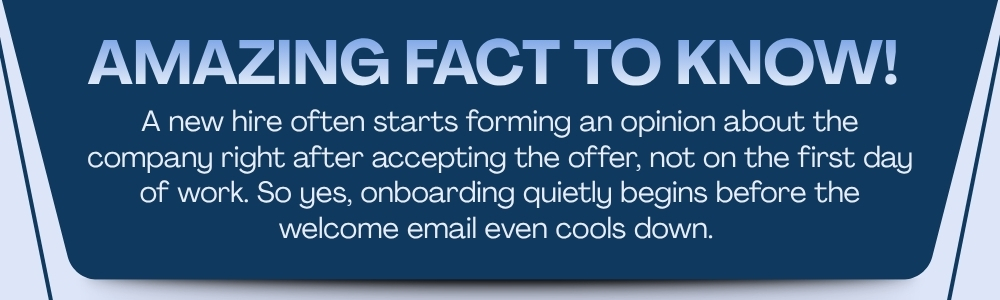
The new hire experience begins long before the employee walks into the office or logs in for the first time. It begins the moment they say yes to the offer. That period between offer acceptance and day one can either build confidence or create confusion.
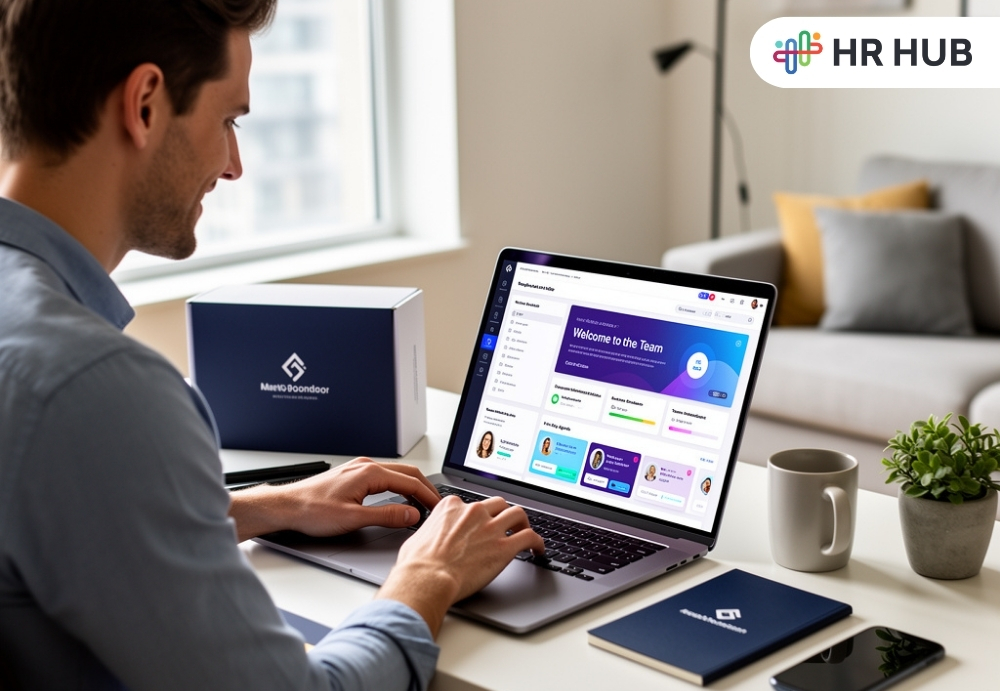
With the right employee onboarding software, companies can turn that waiting period into a warm, organized, and reassuring experience.
Why the Pre-Joining Stage Matters in Digital Onboarding
Many organizations invest significant energy in hiring. They screen resumes, conduct interviews, negotiate offers, and celebrate when the candidate accepts. Then, strangely, the excitement goes quiet.
The candidate hears very little until a few days before joining.
This silence can seem harmless on the company’s part. After all, the person has accepted the offer. What else is needed?
Quite a lot, actually.
For the new hire, this is a sensitive stage. They may still be serving notice at their previous company. They may be comparing opportunities. They may be nervous about the new role. They may have personal questions about timing, documents, policies, payroll, laptop setup, or first-week expectations.
Silence creates space for doubt.
A simple onboarding journey can fix that. Digital onboarding gives new hires small but helpful touchpoints before day one. It tells them, “We are ready for you. You are not entering a mystery room.”
And honestly, no one wants their first day to feel like a treasure hunt with clues hidden across five different email threads.
Digital Onboarding as the New Standard for New Hire Readiness
Digital onboarding is not just about replacing paper forms with online forms. That is only one part of it.
A proper digital onboarding process helps the company guide the new employee from offer acceptance to workplace readiness. It connects HR, managers, IT, admin, finance, and employees through a planned workflow.
It Covers the Journey Before Joining
A strong onboarding management system can manage:
- Offer acceptance follow-up
- Welcome communication
- Pre-joining forms
- Employee personal details
- Document collection
- Bank and tax information
- Policy acknowledgments
- Digital signatures
- Manager introductions
- Buddy assignment
- IT access requests
- Asset allocation
- Training schedules
- First-week plans
- Probation-related instructions
- Department-specific tasks
This gives the employee one clear path instead of scattered instructions.
It Gives Everyone a Clear Role
Onboarding is not only HR’s responsibility. HR may own the process, but many people are involved.
- IT prepares system access.
- Admin may arrange assets, seating, ID cards, or equipment.
- Finance may need payroll information.
- The manager prepares the first-week plan.
- The buddy helps the new hire settle in.
- The employee completes documents and forms.
When all of this happens manually, someone usually forgets something. And somehow, that “something” is usually noticed at 10:15 AM on the employee’s first day.
New hire onboarding software helps prevent that by assigning tasks, tracking progress, and reminding the right people before delays occur.
Traditional Onboarding Gaps That Employee Onboarding Software Can Solve
Traditional onboarding often looks something like this.
- The employee joins.
- HR sends a list of documents.
- The employee sends half of them by email.
- One attachment does not open.
- One document is blurry.
- One file is named “final_final_latest_use_this_one.pdf.”
- HR manually checks everything.
- IT asks if the employee needs access.
- The manager asks, “They are joining today?”
- The employee sits and waits.
This is not a great start.
The old way depends too much on memory, manual effort, and repeated follow-up. It may work when a company hires one person every few months. But once hiring grows, the process starts showing cracks.
Common Problems in Manual Onboarding
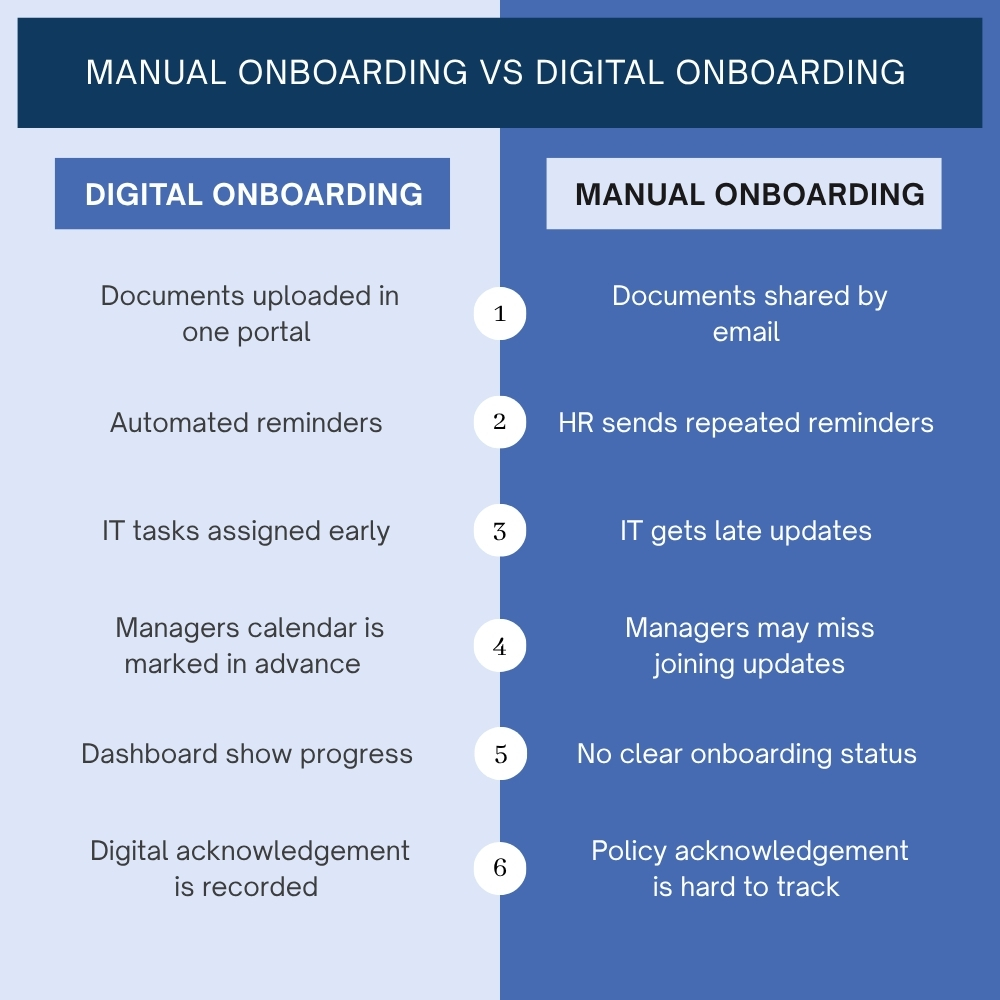
Documents are scattered across emails.
HR has to send repeated reminders.
Managers are not always up to date on joining dates.
IT access may not be ready.
Policy acknowledgement is hard to track.
Employees ask the same questions again and again.
Compliance records may remain incomplete.
There is no single view of onboarding progress.
The employee’s first impression becomes, “I hope the actual work is more organized than this.”
Digital onboarding helps companies avoid this awkward beginning.
Digital Onboarding That Helps New Hires Feel Prepared Before Day One
A new employee does not expect fireworks on day one. They are not looking for a red carpet, a marching band, or a cake with their employee ID printed on it.
They simply want clarity.
They want to know what to do, where to go, whom to contact, what to read, what to submit, and what will happen next.
That sounds simple, but many companies miss it.
It Removes Guesswork
With employee onboarding software, the new hire gets a clear checklist. They can see what is pending, what is completed, and what comes next.
No guessing.
No awkward follow-up messages.
No “Dear HR, just checking...” email drafted three times before sending.
The employee can complete tasks at their own pace before joining. This makes the first day calmer for everyone.
It Builds Confidence Early
When a company communicates well before day one, employees feel valued. They feel the company has planned their arrival.
That feeling matters.
A new hire who enters the company with confidence is more likely to ask better questions, engage with the team, and settle in faster.
Digital onboarding not only organises tasks. It shapes emotions.
A More Personal Welcome Experience Through Digital Onboarding
Some people worry that digital onboarding may make the process feel cold or robotic.
That only happens when companies treat it like a form-filling machine.
The best digital onboarding experiences combine structure with warmth. The system handles the repetitive tasks, while HR and managers focus on the human side.
A Good Welcome Is More Than “Please Find Attached”
Think about the difference between these two messages.
“Please submit documents before joining.”
And:
“Welcome to the team. We are excited to have you with us. To make your first day smooth, we have created a short checklist for you. It will take a few minutes, and we are here if you need help.”
The second one feels better. Same task. Better experience.
New-hire onboarding software allows HR teams to create welcome emails, manager notes, company introductions, and reminders that feel helpful rather than dry.
Small Touches Make a Big Difference
A welcome message from the reporting manager.
A short introduction to the team.
A first-week schedule.
A simple “what to expect on day one” note.
A buddy assignment.
A company culture guide.
These are small things, but for a new employee, they reduce nervousness. They make the person feel included before joining.
Digital onboarding makes sure these small touches happen regularly, not only when someone remembers.
Paperwork Becomes Less Painful
Let us be honest. Nobody joins a company because they are excited to upload ID proof, fill emergency contact details, and sign policy forms.
Paperwork is necessary, but it does not have to feel painful.
A Single Portal Makes Life Easier
With digital onboarding, employees can upload documents through one secure portal. They can see what is required and which documents are approved or pending.
- HR can review everything from one place.
- No email hunting.
- No repeated attachments.
- No document confusion.
An onboarding management system can also help companies create role-, department-, location-, or employee-type-specific document checklists.
For example, employees in India, the Cayman Islands, the US, and Canada may need different forms or details. Digital onboarding helps HR manage these differences without depending on memory or separate spreadsheets.
HR Gets Better Control
For HR teams, document collection is one of the most time-consuming parts of onboarding.
A missing document can delay payroll setup.
An unsigned policy can create a compliance gap.
Wrong bank details can create payment issues.
Digital onboarding reduces these risks by making every requirement visible and trackable.
The employee gets a cleaner experience, and HR gets fewer last-minute surprises.
Early Manager Involvement Through an Onboarding Management System
A new hire’s relationship with the manager is one of the biggest parts of the onboarding experience.
HR may run the process, but the manager shapes the employee’s daily reality.
Still, in many companies, managers enter the onboarding journey too late. Sometimes they get involved only when the employee has already joined.
That is not ideal.
The Manager Sets the Tone
A short message from the manager before a new hire join can help them feel more comfortable.
Something as simple as:
“Hi Riya, welcome to the team. We are looking forward to working with you. On your first day, we will walk you through the team, current projects, and your first-week plan.”
That message takes less than a minute, but it can remove a lot of nervousness.
Employee onboarding software can remind managers to send this message, prepare the first-week plan, assign a buddy, and schedule an introduction call.
It Makes Onboarding a Shared Responsibility
Good onboarding should never sit only on HR’s shoulders.
The manager needs to prepare role expectations.
IT needs to prepare access.
Admin needs to prepare assets.
Finance needs complete payroll details.
The employee needs to complete forms.
The onboarding management system brings these people into one flow, so everyone knows their part.
The result is simple: the new hire does not feel like an unexpected guest.
Better IT and Admin Preparation With New Hire Onboarding Software
Few things are more frustrating for a new employee than joining a company and hearing, “Your laptop is not ready yet.”
That sentence can drain the excitement out of day one faster than weak office coffee.
In today’s workplace, access to systems and work tools is a basic need. If they are delayed, the employee cannot start properly.
Digital Onboarding Helps Teams Plan Ahead
With new-hire onboarding software, IT and admin teams can receive tasks as soon as onboarding begins.
They can prepare:
- Laptop or desktop
- Email account
- Software access
- ID card
- Workspace
- Security permissions
- Communication tools
- Remote work setup
- Equipment shipping
- Access to internal systems
HR can track whether each task is completed before the joining date.
This helps the company avoid the awkward first-day waiting period when the employee is smiling politely with nothing to do.
Remote and Hybrid Employee Support Through Digital Onboarding
Remote onboarding can easily feel lonely if it is not planned well.
An office employee may at least meet people, see the workspace, and naturally understand the environment. A remote employee may only see a calendar invite and a login screen.
Digital onboarding makes remote and hybrid onboarding more structured and personal.
It Creates a Clear Remote Joining Path
Remote employees can complete documents online, receive digital handbooks, attend a virtual orientation, meet their manager via video calls, and access training materials before joining.
They can also receive clear information about:
- Work timings
- Communication channels
- Reporting structure
- Meeting expectations
- Equipment delivery
- Remote work policies
- Security guidelines
- Team introduction
This makes the employee feel connected even if they are not physically present.
It Keeps the Experience Consistent
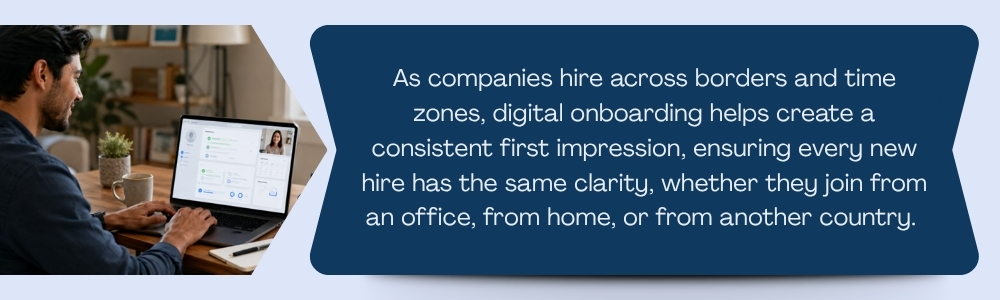
Companies hiring across India, the Cayman Islands, the US, Canada, or multiple locations need consistency. A remote employee should not receive a weaker experience than someone joining from the main office.
An onboarding management system helps companies provide a clear process for every employee, regardless of location.
It Reduces Offer Dropouts
Offer dropouts are painful.
The company spends time hiring, the candidate is accepted, everyone feels relieved, and then the candidate suddenly does not join.
Sometimes the reason is outside the company’s control. But in many cases, poor engagement after offer acceptance plays a role.
If the company goes silent, the candidate may feel less connected. Another employer may communicate better. Doubt may grow.
Preboarding Keeps the Relationship Warm
Digital onboarding keeps the candidate engaged between offer acceptance and joining.
- They receive timely messages.
- They are completely joining tasks.
- They learn about the company.
- They interact with HR or their manager.
- They see that the company is preparing for them.
- This builds commitment.
When a new hire has already completed documents, read about the company, received a welcome message, and seen their first-week plan, they feel more attached to the opportunity.
Employee onboarding software helps HR keep this relationship active without manually following up with every new hire every few days.
For companies managing remote or hybrid teams, this topic connects closely with HR HUB’s guide on automating the remote onboarding process from offer letter to day one, which explains how structured workflows help new hires feel prepared before they officially start.
Company Culture Made Clear Through Digital Onboarding
Company culture is not something employees understand from a poster on the wall.
- They understand it through small experiences.
- How quickly the company responds.
- How clearly it communicates.
- How organized the joining process is.
- How managers speak to them.
- How well is their first day planned?
Digital onboarding gives companies a chance to show their culture early.
Culture Starts With Clarity
If the company says it values people, but the employee’s first experience is confusion, the message does not align with reality.
If the company says it is organized and people-focused, the onboarding journey should reflect that.
Digital onboarding can introduce the employee to the company's values, communication practices, team structure, policies, and workplace behaviour before day one.
This helps the employee understand not just what the company does, but how the company works.
It Speeds Up Time to Productivity
A new hire cannot be productive if they are still trying to find the right form, waiting for login access, or unsure who to ask for help.
Digital onboarding removes avoidable delays.
The First Week Becomes More Useful
When paperwork and basic setup are completed before joining, the first week can focus on learning, team connection, role clarity, and early contribution.
The employee can spend time on:
- Understanding responsibilities
- Meeting team members
- Learning tools
- Reviewing current projects
- Attending training
- Setting short-term goals
- Asking meaningful questions
This does not mean pushing the employee too fast. It means giving them a better start.
New-hire onboarding software helps build readiness before day one, so the employee does not waste the first week resolving basic process confusion.
Easier Compliance Management With an Onboarding Management System
Compliance may not sound exciting, but missing documents, unsigned policies, incomplete employee records, or incorrect details can create real problems later.
The challenge is to manage compliance without making the new hire feel like they are entering a courtroom.
Digital onboarding helps companies collect the required information in a clear, simple way.
Records Stay Organized
With an onboarding management system, HR can maintain:
- Signed offer letters
- Identity documents
- Address details
- Bank information
- Tax details
- Policy acknowledgments
- Employment agreements
- Emergency contacts
- Role-specific declarations
- Location-specific forms
These records can be stored securely and accessed only by authorised users.
This helps HR teams during audits, payroll setup, internal reviews, and employee record checks.
Different Locations Can Have Different Requirements
Companies operating across India, the Cayman Islands, the US, and Canada may need different employee details depending on the location and applicable law.
Digital onboarding helps HR create location-wise checklists so the right information is collected from the right employee.
This reduces errors and gives HR better control.
Better HR Visibility Through Employee Onboarding Software
One of the biggest frustrations in manual onboarding is not knowing the exact status.
- Has the employee submitted all documents?
- Has IT created the email account?
- Has the manager prepared the first-week plan?
- Has the policy been signed?
- Has the admin arranged the asset?
Without a system, HR has to ask everyone manually. That is not a process. That is a full-time detective job.
Dashboards Make Progress Clear
Employee onboarding software provides HR with a dashboard that shows what is completed, pending, delayed, or rejected.
- This visibility helps HR act early.
- If a document is missing, HR can remind the employee.
- If IT access is pending, HR can follow up before the employee joins.
- If the manager has not completed assigned tasks, the system can send reminders.
This helps HR move from reactive follow-up to planned onboarding.
Personalized New Hire Journeys With New Hire Onboarding Software
Not every employee needs the same onboarding journey.
A developer, sales executive, finance manager, HR executive, remote employee, and senior leader will all need different information.
A one-size-fits-all onboarding process often feels boring or irrelevant.
Digital Onboarding Supports Role-Based Journeys
New hire onboarding software can create different workflows based on:
- Department
- Role
- Location
- Seniority
- Employment type
- Remote or office-based work
- Compliance needs
For example:
A sales employee may receive CRM training and product information.
A developer may receive access to the repository and coding guidelines.
A finance employee may receive approval policies and compliance documents.
A remote employee may receive equipment instructions and virtual work guidelines.
A manager may receive team structure and leadership expectations.
This makes onboarding more useful and less like a generic packet of information that nobody wants to read.
Key Features to Look for in Employee Onboarding Software
Choosing employee onboarding software should not be limited to “Can it collect documents?”
The better question is: can it create a better employee experience while helping HR stay organized?
Must-Have Features
A good onboarding system should include:
- Custom onboarding workflows
- Digital document collection
- Employee self-service portal
- Automated reminders
- Role-based onboarding templates
- Manager task assignment
- IT and admin task tracking
- Digital signature support
- Policy acknowledgment
- Secure document storage
- Progress dashboard
- Location-specific onboarding steps
- Training schedule support
- Audit trail
- Mobile-friendly access
- Access control
- Reporting
The system should be easy for HR to manage and simple for employees to use. If the onboarding software needs its own onboarding software, that is a warning sign.
HR HUB and the Future of Digital Onboarding
HR HUB helps companies manage digital onboarding in a structured, organized, and employee-friendly way.
Instead of relying on scattered emails, spreadsheets, manual checklists, and repeated reminders, HR HUB provides HR teams with a central place to manage the new-hire journey.
With HR HUB, companies can support pre-joining activities, document collection, employee details, onboarding tasks, approvals, manager involvement, policy acknowledgement, and progress tracking. This helps HR teams prepare employees before day one rather than trying to fix everything after they join.
For new hires, the experience becomes clearer.
- For HR, the process becomes easier to manage.
- For managers, responsibilities become visible.
- For the company, the first impression becomes stronger.
HR HUB is especially helpful for growing companies that want to create a consistent onboarding experience across teams, locations, and work models. Whether the employee joins from the office, remotely, or in a hybrid setup, the onboarding journey can remain clear and well-planned.
A Better New Hire Experience Before the Welcome Desk
The best onboarding experiences do not begin with a first-day presentation. They begin with a thoughtful message, a clear checklist, a prepared manager, and a process that makes the new hire feel like an expected part of the team.
Digital onboarding helps companies create that experience.
- It removes confusion before day one.
- It reduces HR’s manual work.
- It helps managers get involved earlier.
- It keeps IT and admin teams prepared.
- It improves compliance and record management.
Most of all, it helps new hires feel calm, welcomed, and ready.
That feeling matters because employees remember how they were treated at the beginning. They remember whether the company was prepared. They remember whether they felt lost or supported.
With the right employee onboarding software, businesses can turn onboarding from a paperwork-heavy process into a warm, structured, and memorable start.
And with HR HUB, companies can manage that journey with better clarity, stronger coordination, and a smoother experience from the moment a new hire says yes.