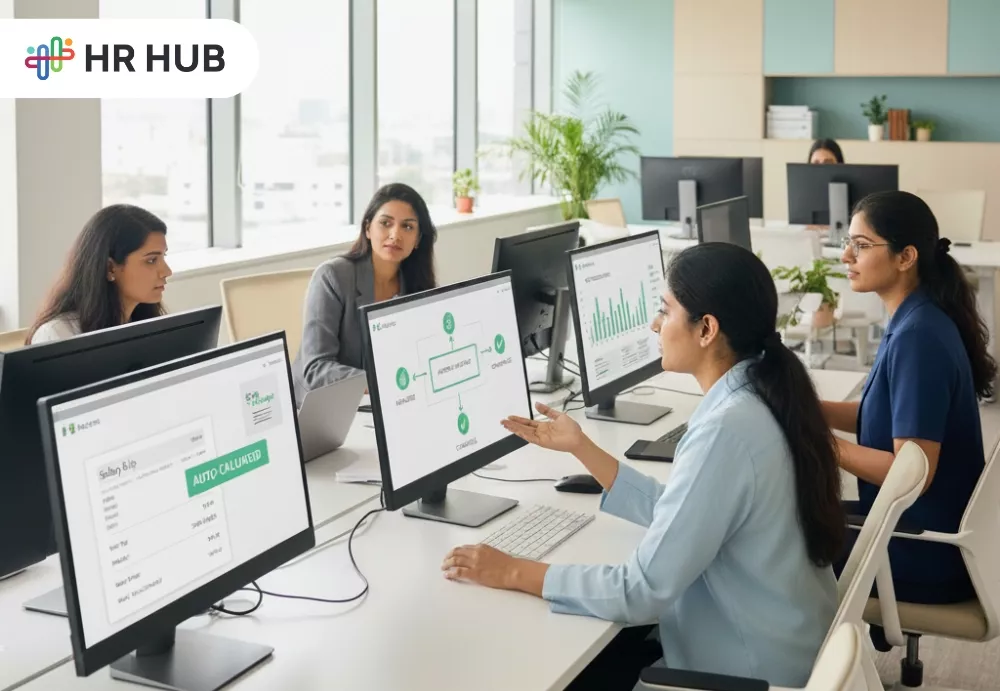
Managing payroll in India involves more than just crediting salaries; it also entails navigating a monthly maze of forms, deductions, and constantly evolving government directives.
Before you know it, your HR team is overburdened with spreadsheets and legal deadlines due to PF, ESI, and an impending new labor code.
However, another late-night compliance panic need not be the conclusion of this tale.
Enter modern HR technology, the quiet hero that turns the chaos of payroll compliance into a calm, automated rhythm.
Let’s uncover how.
The Indian Payroll Landscape: More Than Just Numbers
Indian payroll isn’t a “calculate and pay” function. It’s a legal, operational, and ethical responsibility rolled into one. Every business, from a 20-employee startup in Pune to a 2,000-person enterprise in Delhi, must comply with dozens of state and central laws governing wages, social security, and employee welfare.
The challenge? Each of these laws operates on different parameters, thresholds, and deadlines.
For example, under the Employees' Provident Fund Act, government notifications may alter remittance deadlines, wage caps, and contribution rates. Maharashtra and Karnataka have different professional taxes. The Payment of Bonus Act determines who is eligible for additional compensation, while the Payment of Wages Act specifies how and when workers must be paid.
Even the most seasoned HR teams can become overwhelmed by HR payroll compliance in India, given multiple branches, diverse job types, and frequent rule changes.
Manual systems simply can’t keep up with this pace. But automation can.

Automation: Turning Chaos into Control
One of the most significant transformations modern HR tech brings is the ability to translate compliance rules into system logic.
Every salary component, from basic pay to allowances and deductions, is mapped to the relevant laws. The system automatically calculates PF, ESI, LWF, gratuity, and TDS using the latest government-defined formulas.
Let’s say the PF wage ceiling changes overnight or a new circular adjusts ESI contribution limits. The platform updates itself instantly, silently, and accurately.
That’s the beauty of compliance automation: it doesn’t ask HR to remember; it reminds HR what’s already changed.
For growing organizations, this is more than convenience; it’s protection. One missed filing or incorrect deduction can lead to financial penalties and reputation risks. Automated HR systems guard against both, turning payroll compliance into a seamless back-end process rather than a fire drill.
When Geography Stops Being a Compliance Obstacle
A Bengaluru office might follow one Professional Tax structure, while a Mumbai branch follows another. In traditional setups, this meant maintaining multiple salary sheets, each with its own compliance logic; a nightmare for consistency and audits.
Modern HR platforms handle multi-state compliance effortlessly. Each employee’s profile is tagged to their work location, and the system automatically applies the corresponding tax, wage, and leave laws.
- Need to generate state-wise reports? Done.
- Need to change minimum wage structures due to new notifications? The software does it in a single update.
This geographic adaptability has redefined human resources compliance, making national expansion no longer synonymous with compliance complexity.
Staying Ahead of Labour Code Reforms
India's employment ecosystem is changing as a result of the four labor codes on wages, social security, industrial relations, and occupational safety. They consolidate more than 40 laws into a unified framework, introduce new reporting requirements, and redefine wage definitions.
For HR teams, this means yet another wave of recalibration: new payslip formats, new contribution rules, and new inspection norms.
Modern HR systems don’t wait for HR to catch up. They are continuously updated to reflect legal changes, ensuring compliance remains proactive rather than reactive.
The best part? This shift doesn’t disrupt payroll cycles. The system’s backend logic evolves while HR continues business as usual, uninterrupted and confident that compliance never lags behind regulation.
Integrating with the System That Governs You
Government portals like EPFO, ESIC, NSDL, and Shram Suvidha are the heart of digital compliance in India. But manually uploading files, verifying formats, and reconciling data can eat away hours of productive time.
HR tech platforms are altering that story. They create files that are ready for upload, automate reconciliations, and even set up reminders for submissions. There is much less chance of missing a deadline or turning in figures that don't match.
For companies handling thousands of employees, this integration turns compliance from a manual burden into a structured, transparent, auditable, and stress-free workflow.
Real-Time Watchdogs: Compliance Dashboards and Alerts
Imagine knowing in advance that your PF filing is due tomorrow, one employee’s ESI number is missing, and a new tax rate has been introduced in your operating state, all in a single dashboard.
That’s the level of control modern systems offer through compliance dashboards. These dashboards act like a personal risk radar for HR, flashing early warnings whenever something needs attention before it becomes a violation.
This real-time oversight is what separates reactive compliance from intelligent compliance. It’s not about waiting for a government notice; it’s about ensuring you never receive one in the first place.
Compliance Beyond Payroll: The Invisible Layer
Most organizations think compliance ends with paying salaries correctly. In reality, it starts there.
Under the Factories Act, the Shops and Establishments Acts, and the Maternity Benefit Act, organizations must maintain proper records of attendance, leave, and working hours.
Modern HR systems integrate attendance, leave, and shift management to automatically validate if an employee’s working hours comply with statutory limits. They even factor in mandatory breaks, overtime eligibility, and holiday pay, ensuring every operational detail supports hr payroll compliance.
The result? Compliance isn’t a document you prepare; it’s a process you live daily.
Digital Registers, Paperless Audits
The era of dusty files and manual registers is over. Today, digital recordkeeping fulfills the legal requirement to maintain registers such as Form D (Bonus), Form F (Muster Roll), and Form XXV (Wages) by instantly, accurately, and securely maintaining them.
Auditors and inspectors can access them in minutes instead of days. And because the data is timestamped and traceable, it eliminates suspicion of tampering or inconsistencies.
Compliance documentation has officially gone from paperwork to proofwork.
Data Privacy Joins the Compliance Table
In the modern world, human resources compliance isn’t limited to labour laws. Employee data privacy is protected by the Digital Personal Data Protection Act (DPDPA 2023).
Payroll data is inherently sensitive, and violations may result in severe consequences. Modern HR software is protected by role-based access control, two-factor authentication, and encryption. For accountability, every action, from reviewing pay stubs to authorizing reimbursements, is recorded.
Payroll accuracy and data security come together to guarantee that compliance is about respecting people, not just obeying the law.
The Learning Layer: Keeping HR Teams Informed
Even with automation, compliance awareness remains key. Leading HR platforms integrate micro-learning modules that explain regulatory changes, summarize new notifications, and even quiz HR staff on updates.
Instead of outsourcing compliance training, organizations are now embedding it into daily operations, ensuring every HR executive understands both the “what” and the “why” behind compliance rules. Knowledge plus automation; that’s the real formula for sustainable compliance success.
Predictive Payroll Compliance: The Road Ahead
HR systems will soon be able to anticipate risks rather than just identify them.
Anomalies such as abrupt changes in PF deductions or unusual overtime hours that may violate labor laws can already be identified by AI-driven analytics.
In the near future, HR technology will suggest remedial measures before an error occurs. The shift from doing to anticipating is the next frontier in payroll compliance.
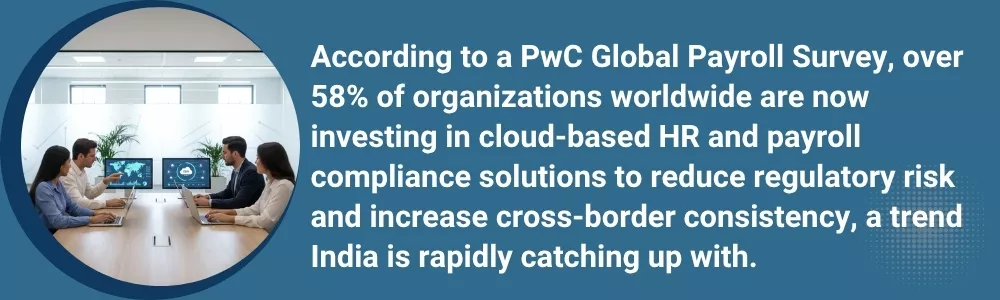
Where Compliance Meets Clarity: The HR HUB Advantage
When compliance is automated, HR transforms. Instead of firefighting, teams can focus on strategy, culture, and people development; the things that truly build an organization.
That’s precisely what HR HUB empowers companies to do.
Built with India’s complex regulatory environment in mind, HR HUB automates every aspect of payroll and statutory compliance, from PF, ESI, and TDS to gratuity, bonus, and audit reports. It dynamically adapts to state-specific laws, generates ready-to-file documents, and maintains digital acknowledgements for every policy shared with employees.
With its real-time dashboards, data security frameworks, and AI-powered compliance updates, HR HUB ensures your organization remains compliant without the constant manual grind.
For HR professionals, it’s not just software; it’s peace of mind wrapped in automation.
Simplifying the Law, Empowering the People
In the end, compliance isn’t about forms or filings; it’s about fairness and trust.
When employees are paid correctly, contributions are timely, and policies are transparent, compliance becomes part of the culture.
Modern HR technology makes that transformation possible. It bridges the gap between the fine print of labour law and the everyday reality of running a business.
With solutions like HR HUB, companies no longer have to chase compliance; they can live it confidently, seamlessly, and intelligently.
Because when technology simplifies the law, HR finally gets to do what it was meant to do: focus on people, not paperwork.