Imagine this: your HR team is racing against time, managing spreadsheets, juggling employee requests, switching between five different platforms, and still missing payroll deadlines.
It’s not about working harder anymore. It’s about working smarter. That’s where integrated HR software enters, not as a fancy upgrade, but as the digital spine that holds your entire organization together.
Let’s uncover how connecting your HR systems can do more than save time; it can reshape how your business runs.
Why Disconnected HR Systems Drain Your Time and Energy
You’ve seen it before. A new employee is hired, and you onboard them manually by creating their profile in your HRMS, setting them up in payroll, sending a separate email to IT for access credentials, and another to finance for reimbursements.
The entire process takes hours. Mistakes are inevitable. Data inconsistencies become a regular issue. And worst of all, every department ends up doing the same work in silos.
This kind of inefficiency results from fragmented systems in which recruitment, payroll, performance, and communication tools operate in isolation from one another. Without integration, your organization becomes reactive rather than proactive.
That’s why leading companies are shifting to connected HR technology ecosystems, where tools don’t just automate, they collaborate.
What Integrated HR Software Means: Beyond Simple API Connections
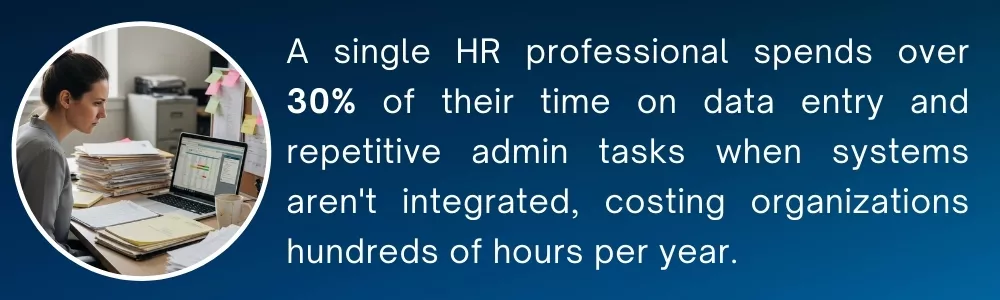
The term “integration” often gets thrown around casually in tech conversations. But in the HR world, integration isn’t just about connecting two systems via an API. It’s about aligning workflows, syncing data across platforms, and eliminating repetitive tasks.
When your HR tech integrates properly:
- A new hire added in your recruitment system instantly appears in your payroll and benefits systems
- Approved leaves automatically adjust project timelines and resource allocations.
- Employee performance insights trigger relevant training paths and succession plans.
- Exit processes update asset recovery, access revocation, and final settlements in a single flow.
That’s the kind of interconnected intelligence modern businesses need to remain agile, compliant, and people-centric.
The Four Pillars Where HR Tech Integration Makes a Game-Changing Impact
Let’s dive deep into the specific areas where HR tech integrations truly unlock operational efficiency.
1. Recruitment, Onboarding & Employee Data Management: Build Once, Use Everywhere
Recruitment is the entry point of every employee journey. When disconnected, this process becomes chaotic. After hiring, HR manually enters candidate data into the HRMS (Human Resource Management System), creates employee codes separately, and emails IT to prepare hardware. This is time-consuming and error-prone.
With integrated HR technology:
- Once a candidate is marked as “hired” in your ATS (Applicant Tracking System), their information flows directly into the HRMS
- Their employee profile is automatically created, along with ID generation and onboarding tasks.
- Access rights, welcome emails, and asset allocations are triggered across IT and admin departments.
- E-signature platforms integrate with document management, ensuring compliance from day one.
This eliminates redundant data entry and creates a seamless bridge between pre-hire and post-hire processes. It also ensures new employees feel welcomed, not delayed by inefficiencies.
2. Time, Attendance & Payroll: Real-Time Sync That Pays Off
One of the most critical functions in HR is payroll, and one of the easiest to mess up when systems aren’t in sync.
Let’s say your employees clock in using a biometric system, but your payroll team works on a completely separate platform. Every month, HR has to manually download attendance reports, verify hours, reconcile overtime, and enter data into payroll.
This not only increases workload, but also leads to:
- Incorrect salary disbursements
- Missed tax deductions or compliance flags
- Employee dissatisfaction and loss of trust
With integrated systems:
- Attendance data flows directly into the payroll engine
- Over time, shift differentials, deductions, and leaves are factored in automatically.
- Salaries are processed with zero manual intervention.
- Payslips are auto-generated and accessible in employee portals.
And when you're working across borders, a global HRMS with country-specific payroll compliance (such as Indian PF/ESIC, US FICA/FUTA, or Cayman pension/gratuity) ensures your operations stay compliant without extra effort.
This turns payroll from a stressful bottleneck into a predictable, efficient function.
3. Performance, Learning & Growth: Build a Feedback Loop That Works
Most companies treat performance reviews and training as two separate initiatives. Managers conduct reviews, and HR decides on learning paths months later. There's no link between performance gaps and development actions.
Integrated HR Tech changes this:
- Appraisal scores are directly tied to development plans
- Low ratings on “client communication” automatically assign a relevant course from your LMS
- Completed training is added to employee skill profiles and is visible during the following review.
- Managers can track learning progress and re-evaluate goals accordingly.
This builds a continuous growth cycle where performance drives learning, and learning fuels performance, without HR having to chase people for updates.
It also shows employees that their development is not just a checkbox; it’s a part of the company’s culture.
4. Analytics & Forecasting: Real-Time Insights for Smarter Decisions
Every HR team wants to be data-driven. But if your data lives in silos, it’s impossible to see the whole picture.
When systems are integrated:
- Employee churn data combines with engagement scores and exit feedback to reveal patterns
- Attendance, absenteeism, and productivity data come together to flag burnout risks.
- Compensation, appraisal scores, and promotion cycles can be analyzed for equity and fairness.
- Headcount trends, training hours, and hiring pipelines feed into workforce planning.
And you don’t need a data science team to do this. Integrated HR technology platforms now come with drag-and-drop dashboards, visual charts, and filters to give decision-makers instant clarity.
It’s no longer about “what happened.” It’s about “what’s happening right now,” and “what should we do next?”
Beyond HR: A Ripple Effect Across the Organization
The magic of HR Tech integrations lies in their impact on departments outside HR, too.
- Finance teams get real-time payroll, expense, and benefits data for monthly closings.
- It knows precisely when to activate or deactivate access based on join/exit workflows.
- Operations can align shift schedules, project resourcing, and availability with real-time headcounts.
- Managers gain unified visibility into team performance, leaves, training, and engagement.
- Employees enjoy a self-service experience, from checking payslips to applying leave, without emailing HR every week.
When HR systems are integrated into your organizational fabric, every team becomes more informed, more efficient, and more aligned with business goals.
Smart Efficiency Starts With Smart Connections
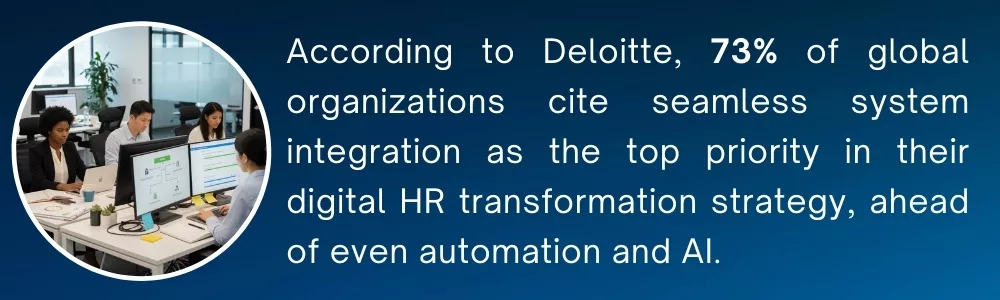
You don’t need 20 different tools to manage your workforce. You need smartly connected tools that talk to each other.
That’s the real value of modern HR Tech, it’s not just digital, it’s dynamic. It doesn’t just automate, it adapts. It doesn’t replace people, it empowers them with better systems and fewer bottlenecks.
And as companies scale, integration becomes non-negotiable. It’s the difference between managing HR reactively and designing people processes that scale with your business vision.
Where HR HUB Fits In: One Ecosystem. Infinite Possibilities.
At its heart, HR HUB was built to simplify and synchronize the complex world of HR operations landscape. It’s not just a tool. It’s an ecosystem designed to:
- Eliminate data silos
- Align payroll, performance, recruitment, and compliance.
- Support region-specific rules for global teams.
- Provide intelligent workflows and automation.
- Enable real-time dashboards for every user role.
Whether you’re a startup looking to automate onboarding or an enterprise needing to unify attendance, payroll, and tax compliance across countries, HR HUB is your integrated solution.
It’s time to replace the patchwork with a platform built for scale, speed, and success.