The Day That Everything Shifts (And HR Receives an Email)
Usually, it begins with a straightforward email.
"Hello, I wanted to let you know that I am expecting..."
There is no dramatic background music. Not a single firework. A single sentence that subtly changes everything.
It is the start of a journey that will change the employee's life.
It frequently sets off a different kind of journey for HR.
Policy documentation, eligibility verifications, leave computations, payroll management, and the sporadic "Wait, how many weeks is it again?"
Additionally, the human element of the story often gets lost amid spreadsheets and compliance regulations.
Maternity Leave in India: It’s Not Just About Weeks and Numbers
On paper, the Maternity Benefit Act, 1961, reads like a neatly written rulebook.
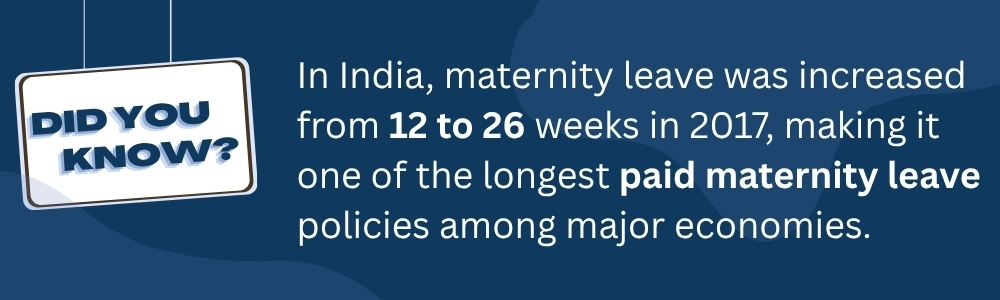
- 26 weeks for the first two children.
- 12 weeks for subsequent ones.
- A clear split between pre- and post-delivery leave.
If policies behaved exactly like documents, HR would have one of the easiest jobs.
But policies don’t operate in isolation. People do.
And people bring situations that no document fully prepares you for.
Picture this.
An employee joins your organization and, within a few months, shares the news. Now HR pauses.
- Is she eligible?
- How many days count toward eligibility?
- What about probation?
Then another case.
An employee is working remotely from another state where leave rules and holidays differ slightly. Now HR has to consider regional compliance nuances.
And then comes the classic:
"What happens if the deadline is altered?"
All of a sudden, the tidy "26 weeks" begins to expand, change, and adapt to actual occurrences.
Include payroll in the equation.
Rarely do pay cycles and leave start dates coincide exactly. Thus, HR is currently computing:
- Partial month salaries
- Adjustments for leave starting mid-cycle
- Ensuring no overpayment or underpayment
At this point, maternity leave is no longer a policy.
It becomes a moving timeline that needs constant recalibration.
The Hidden Complexity of Statutory Leaves in India and Workplace Reality
This is where things become even more intriguing.
Maternity leave is not a stand-alone course. It coexists with India's extensive system of statutory leaves, each with its own rationale, boundaries, and surprises.
Think of it like managing multiple calendars at once:
- Earned leave quietly builds up in the background, sometimes overlapping with maternity timelines
- Sick leave stepping in before maternity leave officially begins
- Public holidays appear right in between, raising questions like
“Do they count or not?”
And then comes the tricky part.
Leave transitions.
An employee might:
- Take sick leave before maternity leave
- Move into maternity leave
- Then extend with earned leave
HR must now make sure that every transition is legitimate, compliant, and accurately documented.
Here, manual tracking is like trying to solve a puzzle with constantly shifting pieces.
And one small mistake can lead to:
- Incorrect leave balances
- Payroll discrepancies
- Employee dissatisfaction
So yes, maternity leave is one policy.
But in reality, it behaves like a combination of multiple moving parts that need to stay perfectly aligned.
Inside the HR Team: Managing Maternity Leave Without a Leave Management System in India
Let’s slow down and actually walk through what happens behind the scenes.
An employee sends that email.
HR acknowledges it, congratulates her, and then quietly opens multiple tabs.
- One Excel sheet for leave balance.
- Another for attendance.
- A payroll file somewhere in a shared folder.
- Maybe an email thread from last year to check how a similar case was handled.
Now begins the real work.
- Verify eligibility based on tenure and policy
- Calculate total leave duration
- Split pre- and post-delivery leave
- Adjust for holidays or overlaps
- Inform payroll about upcoming changes
- Update internal records
- Respond to employee queries like
- “How much leave do I have left?”
- “Will my salary remain the same?”
And then comes the most human step of all.
Double-check everything.
Because no one wants to explain later why something went wrong during such an important phase of someone’s life.
Now multiply this process across:
- Multiple employees
- Different departments
- Different locations
- Different policy interpretations
This is where cracks start to appear.
Not because HR lacks expertise
But because the system they rely on is fragmented
Why a Leave Management System in India Changes the Game for Modern HR Teams
Now imagine the same situation, but this time, the system does the heavy lifting.
The employee logs into a portal and applies for maternity leave.
No emails. No follow-ups. No confusion.
Behind the scenes, the leave management system in India:
- Checks eligibility instantly based on tenure and company policy
- Calculates exact leave duration, including pre- and post-delivery splits
- Adjusts for holidays and overlapping leaves
- Syncs data directly with payroll
- Maintains a complete record for compliance
HR is no longer chasing information across files.
Everything is already connected.
And something subtle but powerful happens here.
HR shifts from being an information processor to being a support system.
Instead of answering “How many days do I have left?”, HR can focus on
“How can we support you better during this time?”
HR Compliance Tracking in India: Why “We Think It’s Right” Is Never Enough
This moment is familiar to all HR teams.
There's an audit notice.
All the decisions made over the past few months now require evidence.
Not justifications. not presumptions. Evidence.
At this point, monitoring HR compliance might mean the difference between calm and pandemonium.
Because now you need to show:
- The exact date the leave request was submitted
- Approval timelines and authority
- Salary calculations during the leave period
- Supporting documents like medical certificates
And here’s the reality.
If this information is scattered across:
- Emails
- Shared folders
- Excel sheets
You are not just preparing for an audit. You are reconstructing history.
But when everything is tracked in a system:
- Every action is time-stamped
- Every change is recorded
- Every document is accessible
It removes panic from the process.
You are not searching for data. You already have it.
Automated Leave Policies: Simplifying Statutory Leaves in India Without the Confusion
Policies look calm on paper.
But in real scenarios, they behave more like “what if” machines.
- What if leave overlaps with a national holiday?
- What if the employee joins mid-year?
- What if maternity leave extends due to medical reasons?
- What if two types of leave collide?
Every "what if" becomes a conversation when it is handled manually.
And conversations take time. Too much time at times.
Automated leave rules silently resolve this.
They:
- Apply rules instantly
- Prevent invalid leave applications
- Handle overlaps without confusion
- Ensure consistency across all employees
No debates. No interpretations.
Just decisions that follow the defined rules every single time.
And the best part?
No one notices them when they work well.
Which is exactly the point.
Managing maternity leave effectively often has a direct impact on payroll accuracy, especially when calculating paid leave and statutory deductions. You can explore this deeper in our guide on payroll mistakes HR teams should avoid.
The Employee Perspective: Why Leave Management System India Matters More Than You Think
While HR is navigating policies and systems, the employee is navigating something far more personal.
She is preparing for a major life change.
Her concerns are not about:
- Leave calculations
- Compliance rules
- Payroll entries
She is thinking about:
- Health and recovery
- Preparing for a new member in the family
- Financial stability during the leave period
Now imagine adding uncertainty to that.
- Delayed salary.
- Confusing leave balances.
- Unclear communication.
It does not feel like a system issue.
It feels like a lack of support.
On the other hand, when everything works smoothly:
- Leave is approved without friction
- Salary is credited on time
- Information is clear and accessible
The organization sends a powerful message without saying much.
“You don’t need to worry about this part. We’ve handled it.”
A Small Shift with Big Impact: How Automated Leave Policies Improve HR Compliance Tracking
Many organizations chase big ideas to improve employee experience.
New initiatives. New policies. New programs.
But sometimes, the real impact comes from fixing something fundamental.
Maternity leave is one of those moments.
Because it touches everything:
- Compliance
- Payroll
- Employee well-being
- Organizational trust
When managed properly:
- Employees return with a stronger sense of belonging
- Teams experience fewer disruptions
- HR spends less time resolving issues
- Compliance becomes a routine, not a concern
It is not about doing something extraordinary.
It is about making sure that when it truly matters, everything works as it should.

Where Everything Comes Together: Leave Management System India for Seamless Statutory Leaves and Compliance
Think about this for a moment.
Maternity leave is one of the few HR processes that touches:
- Legal compliance
- Payroll
- Employee well-being
- Workplace culture
Handling it casually creates friction across all these areas.
Handling it properly creates alignment.
This is where tools like HR HUB come into the picture.
Instead of managing maternity leave as a separate activity, HR HUB connects everything:
- Leave management system India for accurate tracking
- HR compliance tracking for audit readiness
- Automated leave policies for consistent execution
So when that email arrives
“Hi, I wanted to inform you that I am expecting…”
The response is no longer uncertain.
It is clarity, confidence, and a process that simply works.