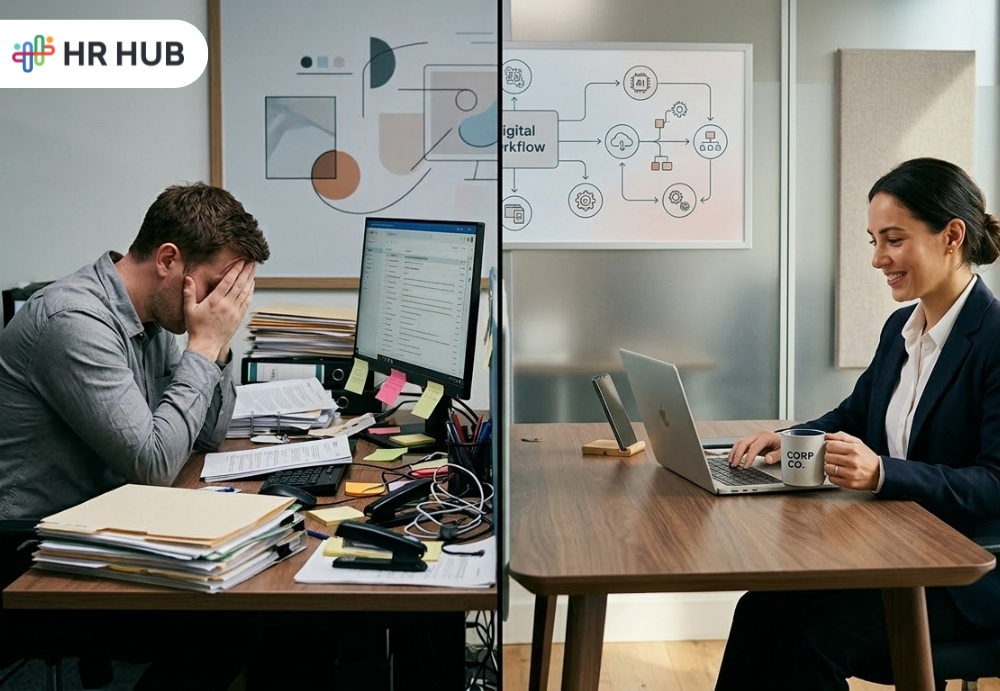
For decades, middle management has been the operational backbone of organizations. Managers in this layer coordinated teams, tracked performance, handled approvals, and ensured policies were followed. Their role was often defined by reporting structures, documentation, and oversight.
But a powerful shift is underway.
Artificial intelligence is rapidly changing how businesses operate. Intelligent systems now handle tasks that once required hours of manual supervision in seconds. Reporting dashboards update automatically. Workflow approvals are digital. Attendance, payroll, and employee performance data are tracked in real time.
This transformation has triggered what many analysts now describe as the Middle Management Crisis.
Organizations across industries are questioning whether traditional middle management roles still make sense in a highly automated environment. Some roles are evolving into strategic leadership positions. Others are quietly disappearing.
By 2027, the definition of middle management will look very different from what it was just a decade ago.
Understanding why this shift is happening is essential for managers who want to remain relevant in the modern workplace.
Understanding the Rising Middle Management Crisis in the Age of AI Displacement
For many years, middle managers acted as the bridge between senior leadership and operational teams. Their responsibilities included monitoring performance, preparing reports, communicating policies, and managing daily tasks.
In traditional business structures, this role was essential. Information flowed slowly. Data needed to be collected manually. Managers were responsible for ensuring that updates reached executives and that instructions reached employees.
Today, most of that information flow is automated.
Modern HR systems, project management platforms, and analytics dashboards generate real-time reports. Real-time performance metrics are available to both executives and employees without manual consolidation.
As a result, companies are beginning to question the value of roles that focus primarily on coordination and reporting.
This is the heart of the Middle Management Crisis. Organizations are realizing that administrative supervision alone is no longer enough justification for a managerial layer.
Instead, companies are searching for leaders who can guide teams, develop talent, interpret data, and drive meaningful change.
Managers who continue to operate as administrative intermediaries may find their roles shrinking or disappearing.
How AI Displacement Is Accelerating Workforce Transformation and the Middle Management Crisis
Artificial intelligence is not just improving efficiency. It is fundamentally changing how work is structured.
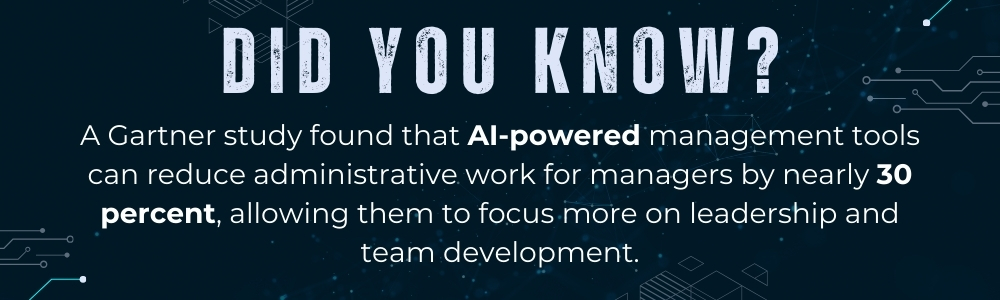
AI systems can now automate many of the tasks traditionally handled by middle managers. These include scheduling, workflow approvals, task allocation, and performance monitoring.
For example, workforce management platforms can automatically assign shifts based on employee availability, skills, and compliance rules. Performance analytics tools can identify productivity trends without requiring managers to manually prepare reports.
Recruitment platforms use intelligent algorithms to shortlist candidates, reducing the amount of manual screening required.
In HR departments, AI systems can track employee attendance, calculate payroll, generate compliance reports, and provide real-time workforce insights.
This shift is often described as AI Displacement, in which technology replaces routine decision-making and administrative supervision.
However, AI displacement does not mean that leadership itself is disappearing.
What is disappearing is the traditional form of managerial work that revolves around documentation, coordination, and oversight without strategic contribution.
Managers who focus only on operational control are the most vulnerable.
Managers who develop leadership capabilities, strategic thinking, and people development skills are becoming more valuable than ever.
Leadership Evolution: How AI Is Transforming Traditional Middle Management Roles
The role of a manager used to revolve around control. Monitoring employee activity, approving requests, and ensuring compliance were seen as the primary responsibilities.
Modern organizations now expect something very different.
The future of management lies in what can be described as Leadership Evolution.
Instead of supervising routine tasks, managers are expected to guide teams through complex challenges. They must help employees adapt to changing technologies, support innovation, and build collaborative cultures.
This shift means that managers must move away from controlling work and begin enabling it.
Effective leaders focus on developing talent, improving team engagement, and helping employees navigate professional growth. They spend more time mentoring and less time reviewing spreadsheets.
They also rely heavily on data-driven insights rather than manual observation.
In this new environment, managers who can interpret workforce analytics and convert insights into strategic decisions become extremely valuable.
Leadership evolution is not simply about acquiring technical knowledge. It requires emotional intelligence, communication skills, and the ability to inspire teams during periods of change.
These qualities cannot be easily automated, making them the most important capabilities for the next generation of leaders.
Career Reskilling for Managers: The Best Response to AI Displacement and the Middle Management Crisis
The biggest challenge facing middle managers today is adaptation.
Many professionals entered management roles during a time when reporting, coordination, and supervision were central responsibilities. As automation replaces these functions, managers must develop new capabilities.
This is where Career Reskilling becomes critical.
Managers who want to remain relevant must invest in developing skills that technology cannot easily replicate.
These include strategic thinking, workforce development, organizational design, and change management. Understanding how to interpret data and turn insights into action is becoming an essential skill.
Digital literacy is also increasingly important. Managers must understand how modern business systems work and how automation affects workflows.
Career reskilling also involves developing stronger people leadership skills. Coaching employees, resolving conflicts, encouraging collaboration, and building team morale are becoming the defining responsibilities of management.
Organizations are increasingly supporting reskilling initiatives through leadership development programs, digital learning platforms, and mentorship structures.
Managers who embrace reskilling are not only protecting their careers but also positioning themselves for more senior leadership opportunities.
Those who resist change risk becoming obsolete in an environment driven by technological transformation.
Why Organizations Are Redesigning Structures During the Middle Management Crisis
Businesses are under constant pressure to improve efficiency and reduce unnecessary layers of hierarchy.
Traditional management structures often create bottlenecks where decisions must pass through multiple levels before action can be taken.
Artificial intelligence and digital workflow systems allow organizations to operate with fewer hierarchical barriers.
As a result, many companies are redesigning management structures to become flatter and more agile.
In these modern structures, managers are responsible for leading teams rather than simply overseeing processes.
This transformation directly relates to the ongoing Middle Management Crisis, where organizations are reassessing the necessity of traditional supervisory roles.
Instead of maintaining layers dedicated to reporting and monitoring, companies are investing in leadership roles that drive collaboration, innovation, and strategic alignment.
Managers who can connect business objectives with employee performance are becoming key contributors to organizational success.
How HR HUB and Modern HR Technology Are Changing the Role of Managers
Human resource technology is one of the biggest drivers of management transformation.
Modern HR platforms provide real-time insights into workforce productivity, engagement levels, attendance patterns, and performance trends.
Managers no longer need to gather information from different departments or spreadsheets manually.
Instead, data is available instantly through intelligent dashboards and analytics tools.
This allows managers to spend less time managing administrative tasks and more time focusing on people development.
Solutions like HR HUB are designed to support this transition.
By automating routine HR processes such as attendance tracking, payroll processing, leave management, and performance monitoring, HR HUB helps organizations reduce manual administrative workload.
Managers gain immediate access to workforce insights to make informed decisions about team productivity and employee engagement.
Instead of acting as intermediaries between employees and HR departments, managers become strategic leaders who use technology to guide team performance and growth.
This shift highlights how digital HR systems are reshaping the nature of leadership within organizations.
For a deeper understanding of how AI is reshaping HR leadership and workplace strategy, explore this detailed guide on how HR is evolving in the age of artificial intelligence.
Leadership Evolution in the AI Era: New Skills Managers Must Develop
To remain relevant in an AI-driven workplace, managers must build a new set of capabilities.
First, they must develop strong analytical thinking. Understanding workforce data, performance trends, and operational metrics is becoming essential for effective leadership.
Second, communication skills are more important than ever. Managers must explain organizational changes clearly and help teams adapt to new technologies and workflows.
Third, managers must become skilled at leading diverse and distributed teams. Remote and hybrid work environments require leaders who can maintain engagement without relying on physical supervision.
Fourth, emotional intelligence plays a crucial role in managing change. Employees often experience uncertainty during technological transitions, and managers must support them through these shifts.
Finally, adaptability itself is a leadership skill. The pace of technological change means that management practices must evolve continuously.
These capabilities embody the true meaning of Leadership Evolution, in which leadership focuses on empowerment rather than control.
Preparing for the Future of Work Through Career Reskilling and Leadership Evolution
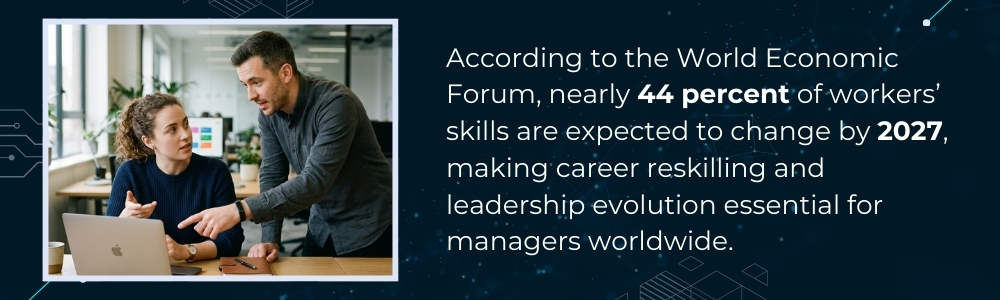
The next few years will define the future of management.
Artificial intelligence will continue expanding into more areas of business operations. Routine administrative work will become increasingly automated.
This will intensify the effects of AI Displacement, especially for roles that depend heavily on manual coordination and reporting.
Managers who view AI as a threat may struggle to adapt.
Managers who view AI as a tool for improving leadership will find new opportunities emerging.
Technology can eliminate repetitive work, allowing managers to focus on strategic leadership, innovation, and employee development.
The challenge is not technology itself. The challenge is whether managers are willing to evolve.
Adaptive Leadership: Overcoming the Middle Management Crisis in an AI-Driven Workplace
The age of the traditional paper-pushing manager is coming to an end.
Automation, artificial intelligence, and digital business systems are transforming how organizations operate. The Middle Management Crisis is not simply about job loss. It is about redefining what leadership means in the modern workplace.
Managers who commit to Career Reskilling, embrace Leadership Evolution, and learn to work alongside intelligent systems will thrive in the future.
Managers who continue relying on outdated administrative roles may find themselves replaced by automation.
Platforms like HR HUB demonstrate how technology can reduce operational complexity while empowering managers with meaningful workforce insights.
The future of management will not be defined by control or supervision.
It will be defined by leadership, adaptability, and the ability to guide people through continuous change.
By 2027, the question will not be whether artificial intelligence has changed management.
The real question will be which managers choose to evolve with it.