At 6:45 a.m., before most people have had their first cup of coffee, someone in HR at a hospital is already solving a crisis.
- A nurse called in sick.
- A replacement is available… but wait, is her certification still valid?
- Another department is short-staffed because two employees swapped shifts without informing HR.
- And somewhere in the inbox, there is an email titled: “URGENT: Compliance Audit Today.”
Greetings from the real world of healthcare HR administration.
This is not the type of HR where you merely schedule team outings and approve leave. This is the type where a single incorrect choice can simultaneously impact patient treatment, legal status, and operational stability.
The Myth of Regular HR vs Real HR Management in Healthcare
Let's clarify.
Ask someone to work a full shift in a hospital if they claim that HR is the same everywhere. Not a tour. Not a gathering. a whole change.
Because the illusion dissolves at that point.
A delayed hire typically results in a missed deadline. In healthcare, a delayed hire can mean a nurse handling more patients than is safe, a technician skipping breaks, or a doctor stretching beyond reasonable limits.
And no, there is no “we’ll manage for today” in healthcare. Today is always critical.
That is why HR management in healthcare is not just about managing people. It is about managing pressure, unpredictability, and responsibility all at once.
Think about what HR is actually dealing with every single day:
- Shifts that run 24 hours, but energy levels that do not
- Roles that cannot stay vacant even for a few hours without consequences
- Certifications that must always be valid, not “almost valid.”
- Compliance rules that vary not just by country, but sometimes by department
And somewhere in between all this, HR is also expected to ensure employee well-being, retention, and performance.
It is like being the air traffic controller of a system where every flight is urgent.
Using spreadsheets to handle all of this is like trying to do surgery with a butter knife. In the long run, you would never trust it, even though you might make it through a few circumstances.
Healthcare Staffing Software: Solving the Daily Staffing Puzzle in Hospitals
Imagine this.
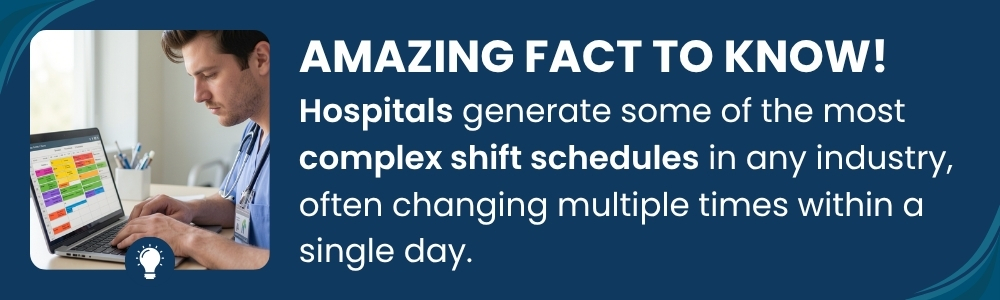
At last, you make what appears to be the ideal schedule. Every shift is occupied. It covers every department. You even check everything again.
You think you've cracked it for a split second.
Then, without knocking, reality enters.
- A nurse calls in sick at 7:10 a.m.
- A technician requests emergency leave.
- An unexpected patient surge fills up beds faster than planned.
Your perfect schedule? It lasted exactly 20 minutes.
This is the aspect of healthcare HR that nobody discusses. Making a schedule is not a chore. It is an ongoing negotiation with reality.
Additionally, the cost of making a mistake goes beyond simple operational discomfort. It may result in:
- Staff burnout from repeated overload
- Reduced quality of patient care
- Frustration among teams who feel overused or overlooked
This is where healthcare staffing software starts to feel less like a tool and more like a lifeline.
Instead of scrambling through calls and messages, HR teams can:
- Instantly identify who is available, qualified, and not already overworked
- Assign roles based on certifications, not assumptions
- Adjust schedules without creating a ripple effect of confusion
- Maintain fairness so the same people are not always filling the gaps
Think of it as moving from guesswork to visibility.
Because in healthcare, “let’s see what happens” is not a plan anyone is comfortable with.
Hospital HRMS and Certification Tracking: Managing the Silent Risks in Healthcare
Here is something interesting.
Most HR problems are noisy. People grumble. Emails accumulate. Issues become apparent.
Problems with certification? They remain silent.
Everything appears to be in order. Workers are at work. Patients are receiving medical care. Everything appears to be running smoothly.
Until one straightforward question is posed during an audit.
"Can you present this employee's most recent certification?"
Abruptly, there was quiet.
One ignored expiration or missed renewal could result in:
- Legal complications
- Financial penalties
- Questions around credibility and trust
And what's annoying? It may have been prevented.
The problem is not that HR departments don't give a damn. The problem is that in settings with hundreds of certificates and different expiration dates, manual tracking does not scale well.
Rather than treating certifications as static documents, a well-designed hospital HRMS treats them as live data.
It helps HR teams:
- Track expiry dates without relying on memory or manual reminders
- Set automated alerts well before deadlines
- Map certifications to roles so unqualified assignments never happen
- Maintain records that are ready the moment an audit begins
It changes the entire mindset from “Did we miss something?” to “We already have this covered.”
And in healthcare, that shift alone can prevent major problems.
HR Management in Healthcare: Simplifying Compliance Across Regions and Roles
If healthcare HR had a personality, compliance would be that strict teacher who updates the syllabus mid-semester and still expects everyone to pass.
Every region brings its own complexity.
- India has its labor laws and healthcare norms.
- The US and Canada come with layered regulations and reporting requirements.
- The Cayman Islands introduce their own compliance structures.
Imagine now that you have to manage all of this across several staff types, shifts, and positions.
It goes beyond simply being aware of the rules. It involves using them appropriately every day.
Without structured systems, compliance becomes reactive. You fix things when something goes wrong.
With the right approach to HR management in healthcare, compliance becomes part of everyday operations.
Modern systems support this by:
- Keeping every record structured, updated, and audit-ready
- Applying policy rules automatically instead of relying on manual checks
- Ensuring employees meet all requirements before they are assigned critical roles
- Reducing the last-minute rush that usually comes with inspections
Because let’s be honest, the phrase “surprise audit” has never made anyone smile.
Employee Lifecycle Management in Healthcare: Beyond Hiring and Exit
Employees in the healthcare industry don't just sign up, work, and then quit. Their path is challenging, hard, and closely related to practical implications.
Hiring in Healthcare HR Management: Finding the Right Talent at the Right Time
You are not just hiring someone to fill a role. You are trusting them with the responsibility that directly affects lives.
Every detail matters. Qualifications, background checks, certifications, experience. There is no room for shortcuts.
Onboarding in Hospital HRMS: Ensuring Compliance from Day One
In many industries, onboarding focuses on introductions and culture.
In healthcare, onboarding is also about readiness.
- Are they compliant?
- Are they trained?
- Are they prepared to handle real situations from day one?
Because there is no slow ramp-up while patients wait.
Growth and Performance in Healthcare: Strengthening Employee Lifecycle Management
Healthcare does not stand still. Neither can its professionals.
Doctors learn new procedures. Nurses adapt to new protocols. Technicians handle evolving equipment.
A strong employee lifecycle management approach ensures:
- Training is continuous, not occasional
- Performance is tracked with context, not just numbers
- Skill gaps are identified before they become risks
Retention Strategies in HR Management in Healthcare: Reducing Burnout and Turnover
Things start to become serious at this point.
Burnout in the healthcare industry is not a theory. HR departments deal with it daily.
Long hours. Emotional strain. Physical exhaustion.
There is a breaking point for even the most committed professionals.
HR teams need visibility into:
- Workload distribution
- Overtime patterns
- Employee engagement levels
Because keeping a healthcare professional requires more than simply pay, it also needs balance, support, and acknowledgment.
It's also never as easy as advertising a job to replace one.
Hospital HRMS and Data Insights: How Healthcare HR Teams Make Smarter Decisions
There is a turning point in every HR team’s journey.
The moment when they stop reacting to problems… and start understanding them.
That moment usually begins with data.
Instead of asking, “Why are people leaving?” They start to see trends across departments, roles, or shifts.
Instead of wondering, “Are we understaffed?” They can check staffing levels in real time.
Instead of hoping, “We should be compliant…” They can confirm it with confidence.
This is where systems like hospital HRMS truly stand out.
They take scattered pieces of information and turn them into something useful.
Clarity.
- And once HR teams have clarity, decisions improve.
- When decisions improve, operations stabilize.
- And when operations stabilize, both employees and patients feel the difference.
Understanding how workforce data connects every stage of the employee journey is key to improving healthcare HR outcomes. Explore how lifecycle insights drive smarter decisions in this detailed guide.
The Future of HR Management in Healthcare: Technology, Staffing, and Compliance Trends
Healthcare is not slowing down. If anything, it is becoming more demanding.
- Patient expectations are rising.
- Regulations are becoming stricter.
- Workforces are becoming more dynamic and mobile.
HR departments can't keep working like firefighters all the time.
They require systems that support them rather than oppose them.
Businesses using healthcare staffing software are already observing the change:
- Staffing gaps are identified before they become problems
- Compliance issues are reduced significantly
- Employee management becomes more structured
- Daily operations feel less chaotic
And perhaps most importantly, HR teams get back something they rarely have.
Breathing space.
HR Management in Healthcare: Connecting Staffing, Compliance, and Workforce Efficiency
Healthcare HR is more than just another department if you step back and look closely.
When things start to become uncertain, it is the system that subtly keeps everything together.
In a way that directly affects patient care, it links individuals, procedures, and regulations.
That is why HR management in healthcare is no longer about maintaining records or approving requests.
It is about managing reality in real time.
And when the right systems support that reality, the chaos does not disappear… but it becomes controllable.
And in healthcare, that is more than enough.
Healthcare Staffing Software and HRMS: The Backbone of Modern Healthcare Operations
Behind every smooth hospital operation, there is an HR system quietly doing its job right.
That is where solutions like HR HUB come into the picture.
HR HUB brings together staffing, certification tracking, compliance management, and employee lifecycle management into one structured platform. Instead of juggling multiple tools or relying on manual processes, healthcare organizations get a clear, connected system that helps them stay in control.
From handling complex shift planning to ensuring certifications never slip through the cracks, HR HUB supports HR teams in doing what they do best, keeping healthcare operations stable, compliant, and efficient.
Because in healthcare, when HR works better, everything works better.