It usually starts with a small doubt.
An employee asks, “Why is my PF different this month?”
Finance notices a mismatch during TDS reconciliation.
Or worse, a notice arrives asking for clarification on past filings.
That’s when payroll shifts from a routine process to something far more serious.
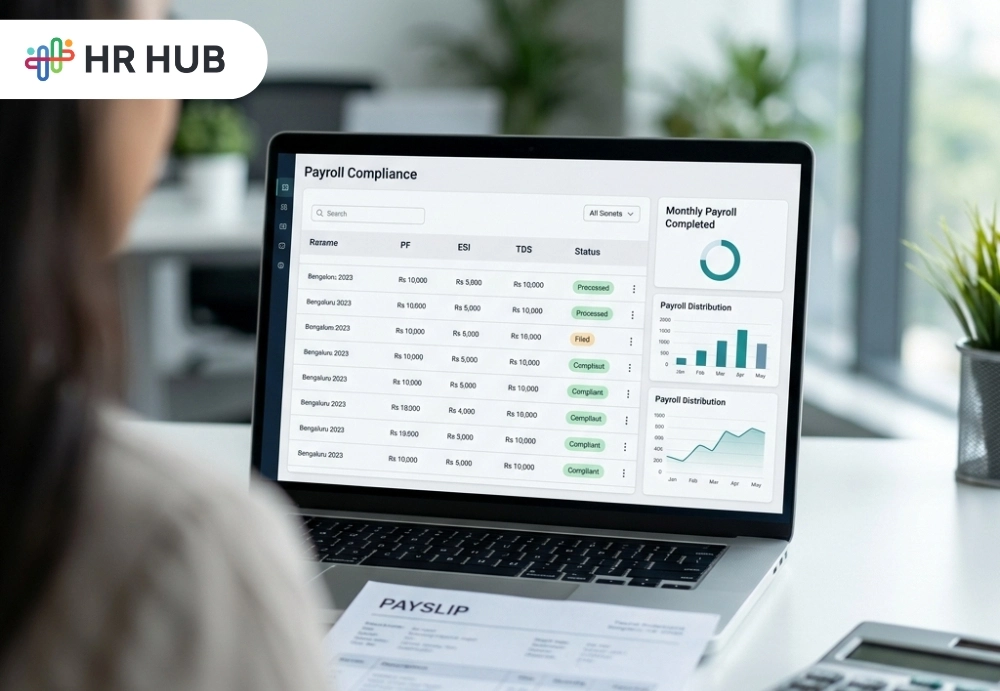
In India, payroll compliance involves more than just deductions. It concerns precision, punctuality, and uniformity for each worker, each month, and each year. And the ripple effect starts as soon as one piece is misplaced.
Payroll Compliance in India: Why It Is Not One System but Three Connected Processes
The majority of teams treat PF, ESI, and TDS as distinct checklists. One is managed by finance, one by payroll, and one by HR. That's where the confusion subtly starts.
Since these are not separate computations in the actual payroll. Their actions resemble a chain reaction.
When one input is changed, the others react.
- PF directly shapes how your salary is structured
- ESI depends on eligibility windows and continuity rules
- TDS sits on top, adjusting itself based on everything below
Consider it this way. Payroll is more like a network of interconnected pipes than a calculator. The flow throughout the entire system changes if pressure changes in one area.
For example:
- Increase basic salary → PF increases → taxable income reduces → TDS changes
- Incorrectly exclude an allowance → PF reduces → taxable income increases → TDS increases
- Misapply ESI eligibility → net salary shifts → reporting mismatches
You are not calculating three separate values. You are maintaining balance within a single moving system.
Once you start seeing payroll compliance in India as a connected flow rather than a set of isolated rules, decisions become clearer, and errors are easier to trace.
PF in Payroll Compliance in India: The Deduction Employees Notice the Most
PF is not just a backend deduction. It is visible, trackable, and often questioned.
Employees look at their PF as a form of forced savings. They compare it across job offers. They check if it is consistent. The employer contributes 12%. If it fluctuates, it raises concern.
What Happens Behind the Scenes
- 12% of the basic salary is deducted from the employee's
- 12% is contributed by the employer
- Employer contribution is further split into EPF and EPS
- Mandatory coverage applies based on eligibility rules
On paper, this looks predictable. In practice, it rarely is.
Where the Real Complexity Lies
PF is not just about applying 12%. It is about deciding what to minimize and what that 12% applies to.
- Should PF be calculated on full basic or capped wages?
- Are allowances being structured to legally minimize PF, or aggressively?
- Are new joiners being onboarded with correct PF eligibility?
- Are international workers or high earners being treated correctly?
These are not calculation issues. These are policy and structuring decisions.
A Small Change, A Big Impact
Let’s say a company restructures salaries:
- Reduces basic
- Increases special allowance
PF reduces instantly. That may look like a cost-saving move, but it also changes:
- Employee savings
- Employer liability
- Taxable income
One decision, multiple consequences.
What Most Teams Realize Too Late
PF errors don’t usually show up immediately.
They sit quietly in the background until:
- An employee raises a query
- A PF inspection happens
- Or the records are reconciled after months
At that point, corrections are not just operational. They are financial and reputational.
ESI in India Payroll Tax: Why Eligibility and Continuity Matter More Than You Think
Because ESI appears straightforward at first glance, it is frequently misinterpreted.
Qualifications under ₹21,000. a set percentage of contributions. Simple.
until pay adjustments are made.
Most teams make mistakes at that point.
The Key Reality
Once an employee becomes eligible for ESI, they remain covered until the end of the contribution period, even if their salary exceeds ₹21,000 during that period.
This single rule changes how ESI should be handled entirely.
Understanding Contribution Cycles
ESI works in fixed cycles, not rolling monthly checks.
That means:
- Eligibility is locked at the start of the cycle
- Contributions continue throughout the cycle
- Salary changes do not immediately stop deductions
What This Means in Practice
- You cannot remove ESI just because the salary has increased
- You need to track which cycle the employee falls into
- Payroll systems must remember past eligibility, not just current salary
Where Mistakes Commonly Happen
- Stopping ESI the moment the salary crosses the threshold
- Including or excluding wrong salary components
- Missing filing timelines due to incorrect tracking
The Deeper Insight
ESI is not about percentage calculation. It is about time-based eligibility.
If your payroll system does not understand continuity, it will keep making the same mistake repeatedly.
If you want to go deeper into building a structured system, this guide on HR HUB explains how to design a legally compliant payroll setup in India from the ground up.
TDS in Payroll Compliance in India: The Most Dynamic and Evolving Component
Payroll becomes unpredictable at TDS.
TDS acts like a moving target, in contrast to PF and ESI, which adhere to set principles.
It's not just about policies; it's about people.
What Drives TDS Changes
- Employee-selected tax regime
- Investment declarations
- Proof submissions
- Salary revisions
- Bonuses and incentives
Every one of these factors can change during the year.
Why It Feels Unstable
Because it is.
What you calculate in April is based on projections. By December, those projections rarely hold.
Employees may:
- Switch tax regimes
- Update declarations
- Submit proofs that differ from initial claims
And each change forces recalculation.
Where Most Teams Struggle
- Treating TDS as a fixed deduction
- Not recalculating after salary changes
- Ignoring declaration updates
- Trying to fix everything in the last quarter
This leads to sudden spikes in deductions, frustrated employees, and compliance mismatches.
The Real Nature of TDS
TDS is not a one-time calculation. It is a continuous adjustment process.
It requires:
- Regular recalculations
- Updated data inputs
- Forward-looking projections
Without this, accuracy is almost impossible.
Payroll Compliance in India: What Happens When PF, ESI, and TDS Don’t Align
Now imagine all three running slightly off.
- An employee’s salary is structured incorrectly.
- PF is calculated on a reduced basis.
- ESI is skipped, assuming ineligibility.
- TDS is calculated on outdated projections.
Individually, each issue is not minor.
Together, they create:
- Incorrect statutory payments
- Wrong tax deductions
- Inconsistent net salaries
- Audit risks
This is how payroll breaks. Not through one big mistake, but through multiple small misalignments.
That’s why payroll compliance in India cannot be managed in silos. Every component feeds into the next.
The Hidden Risks of Manual Payroll Compliance in India Using Spreadsheets
Spreadsheets give a sense of control.
You can edit anything. Adjust anything. Override anything.
That flexibility is exactly what makes them risky for payroll.
What Actually Happens Over Time
- Multiple versions of files exist
- Different teams use different formulas
- Manual edits override logic
- No one knows which version is final
And most importantly, there is no history.
No way to track:
- Who changed what
- When it was changed
- Why was it changed
The Hidden Risk
Two employees with identical salaries can end up with different deductions.
Not because of policy differences.
Because of process inconsistencies.
And these errors are hard to detect until they become visible problems.
Why Automated Payroll Software Is Essential for Payroll Compliance in India
As compliance requirements grow, manual systems start showing cracks.
Automated payroll software does more than speed things up. It brings consistency.
What Changes With Automation
- PF, ESI, and TDS rules are applied uniformly
- Salary changes trigger automatic recalculations
- Compliance deadlines are tracked
- Reports are generated with traceable data
What It Solves
- Reduces dependency on individual expertise
- Eliminates version confusion
- Ensures consistency across employees
- Provides audit-ready records
Most importantly, it catches issues early.
Not after months. Not during audits. But during the process itself.
How HR HUB Pay Simplifies Payroll Compliance in India
When the technology comprehends compliance reasoning rather than just statistics, payroll becomes manageable.
The structure of HR HUB Pay is based on how payroll functions in India, not merely how it is computed.
What It Brings to the Table
- Built-in compliance logic for PF, ESI, and TDS
- Dynamic tax regime handling based on employee choice
- Declaration and proof management at the employee level
- Real-time salary breakdown visibility
- Clean, structured reports for audits and filings
The Real Difference
Teams stop reacting to issues.
They start operating with clarity.
Instead of fixing errors at the end of the month, they prevent them at the start.
Payroll Compliance in India: What to Fix Before You Fix Your Payroll System
Many organizations jump straight into tools without fixing the foundation.
That leads to the same issues repeating, just in a different system.
Building a Strong Foundation for Payroll Compliance in India: Where to Start
Salary Structure: Define components clearly. Avoid ambiguity.
Eligibility Rules: Set clear rules for PF and ESI coverage.
Policy Clarity: Remove case-by-case handling. Standardize decisions.
Ownership: Define who is responsible for payroll accuracy across teams.
When these are clear, everything else becomes easier to manage.
Payroll Compliance in India: A Quick Reality Check for Your Current Process
Pause for a moment and look at your current payroll process.
If it includes:
- Manual adjustments every month
- Repeated employee queries on deductions
- Last-minute tax corrections
- Heavy reliance on specific individuals
Then the payroll is not yet under control.
It is being handled.
But not mastered.

Mastering Payroll Compliance in India with Automated Payroll Software and Smart Systems
Payroll compliance in India is not about knowing rules.
It is about building a system where:
- Every deduction is predictable
- Every change is traceable
- Every employee sees consistency
TDS, ESI, and PF are not distinct problems. They belong to the same structure.
Compliance becomes more about design and less about work after that structure is established.
Additionally, that design is easier to grow, maintain, and trust throughout the company with platforms like HR HUB.