Payroll is often seen as a backend operation, a routine administrative task where numbers go in, and payslips come out. But anyone who has ever managed payroll knows that it's far from routine. It’s a high-stakes, high-precision function that touches every employee, every department, and every regulation.
And when it goes wrong? People don’t get paid. Laws get broken. Trust gets lost.
Whether you’re managing a local team or a global workforce, understanding the real challenges of payroll processing is not optional; it’s essential. Let's dive into the core issues businesses face and how they can turn payroll chaos into payroll confidence.
1. Managing Payroll Processing and Compliance in a Changing Landscape
Payroll processing is deeply rooted in compliance, and compliance is a moving target. Tax codes, labor laws, social security rules, gratuity regulations, and insurance requirements are updated frequently across different regions.
In India, for instance, EPF, ESI, and TDS rates can change mid-year, and any lapse in applying these could result in financial penalties or regulatory heat. Ensure your provider follows international security standards like SOC2 compliance or GDPR, especially if you handle data across European or North American borders.
In the Cayman Islands, the law mandates contributions to pension and health insurance schemes, and errors in deductions could affect your business's legal standing. In the US and Canada, variations between states or provinces make payroll a minefield of localized rules.
Why It Matters: Ignoring or missing a regulation doesn't just result in fines; it undermines the trust your employees and stakeholders have in your organization.
How to Solve It:
- Use a payroll processing system that automatically updates with statutory changes for each region.
- Don’t rely solely on HR personnel to track laws; supplement with alerts from government agencies.
- Partner with compliance advisors who specialize in labor regulations across your operational geographies.
Payroll compliance is not just a checkbox; it’s a layered responsibility that demands precision and up-to-date insight.
2. Managing Payroll for Remote and Multi‑Location Teams Without Errors
Remote work, global expansion, and cross-border teams are now the norm. But with this flexibility comes the challenge of managing payroll for employees across multiple locations, currencies, time zones, and benefit structures.
Let’s say you have developers in Bangalore, sales staff in Toronto, and a marketing team in the Cayman Islands. Each one comes with its own public holidays, overtime policies, and statutory deductions. Trying to apply a one-size-fits-all approach leads to frustration, delays, and legal risks.
How to Fix This:
- Choose a payroll processing system that allows you to create location-specific payroll rules.
- Integrate time-tracking and attendance data across branches.
- Create localized workflows while maintaining central oversight.
Handling diverse teams means having the flexibility to customize payroll while ensuring a unified view across the organization.
3. How to Eliminate Manual Payroll Issues and Costly System Errors
One wrong decimal. One missed deduction. One outdated Excel formula. That’s all it takes to create a payroll disaster. Most payroll system errors originate from manual payroll issues, and these errors often go unnoticed until employees start complaining or audits are triggered.
Imagine paying someone twice by mistake or omitting their insurance deduction. Now multiply that across departments.
The Risk:
- Underpaying employees lowers morale and can lead to labor disputes.
- Overpaying or tax misreporting leads to financial losses and legal consequences.
Your Strategy:
- Shift to automated, rule-based payroll systems.
- Integrate with your HR database to sync salary, attendance, and leave updates in real time.
- Establish a maker-checker process where data entered by one person is verified by another.
Removing manual processes not only reduces errors but also saves time and protects your brand from embarrassment.
4. Why Lack of Payroll Visibility and Reporting Hurts Business Decisions
Do you know how much your business paid in overtime last quarter? Or the tax obligations due next month? Many companies process payroll but have no insight into what it reveals. Payroll data is a goldmine if you can access and analyze it.
Without Reporting, You’re Operating Blindly Business decisions, whether it's hiring, expansion, or budgeting, rely on accurate payroll data. Without clear reports, leadership is left guessing.
What to Do:
- Choose payroll systems with rich reporting and dashboard tools.
- Monitor trends like overtime costs, attrition-linked payout spikes, and bonus liabilities.
- Share monthly payroll reports with senior management and finance teams.
Good payroll isn't just about payment; it’s about insight.
5. The Benefit of Integrating Payroll Management Services with HR
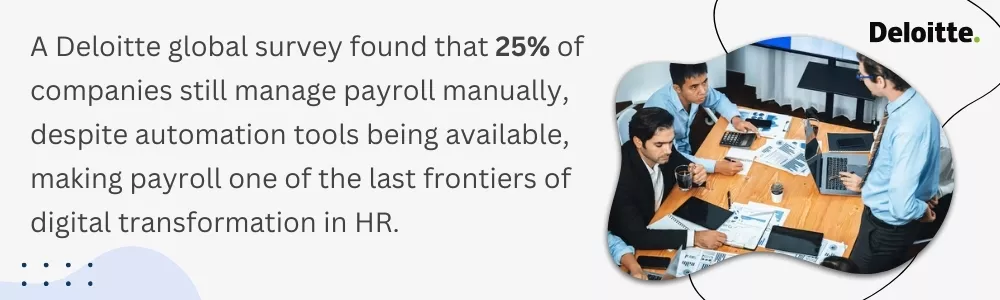
This is a silent killer of efficiency: your payroll system doesn’t integrate with your attendance software, HRMS, or accounting platform. The result? Duplicated work, mismatched data, and longer processing cycles. Likewise, Data silos are a silent killer of efficiency; when your HR and payroll systems don't talk, your business speaks in contradictions.
For example, an employee applies for leave in one system, but that data isn’t reflected in payroll calculations. Now you’ve either overpaid or underpaid.
Solution:
- Opt for payroll management services that offer full integration or API support.
- Create a single source of truth by syncing HR, finance, and operations platforms.
- Conduct periodic system audits to ensure consistent data flow.
Integration with HR and Payroll isn’t a luxury; it’s the backbone of efficient, accurate payroll.
6. Switching to Automated Payroll Solutions to Prevent Missed Paydays
Every payroll team knows the drill: the end of the month is crunch time. But when approvals are delayed, data is incomplete, or systems are slow, employees suffer. Missed salaries erode trust and signal poor operational planning.
The Impact: Late salaries lead to high attrition, employee disengagement, and PR nightmares.
How to Prevent This:
- Set automated alerts and reminders for timesheet approvals and manager inputs.
- Implement automated payroll solutions that reduce manual dependencies.
- Establish internal deadlines at least 2–3 days ahead of the actual payout date.
Speed, when paired with accuracy, is payroll’s greatest strength.
7. Protecting Sensitive Payroll Data in an Increasingly Digital Workplace
Payroll systems house sensitive personal information, employee bank details, social security numbers, salary breakdowns, and tax IDs. This makes them a top target for cyberattacks.
What’s at Stake: A data breach doesn’t just violate privacy; it opens you up to lawsuits, damages your reputation, and undermines employee confidence.
Steps to Secure Payroll Data:
- Use payroll platforms that support encryption, secure hosting, and access controls.
- Restrict sensitive data to authorized personnel only.
- Enable password protection for payslips and key reports.
- Conduct routine vulnerability assessments.
Security isn’t a postscript. It must be embedded into every layer of your payroll operations.
Building a Reliable and Future‑Ready Payroll Processing System
If reading through these challenges felt familiar, you’re not alone. Businesses across the world, from fast-scaling startups to enterprise giants, struggle with the complexities of payroll. The difference lies in how they respond.
Do they continue to juggle spreadsheets, fire-fight issues, and hope for the best?
Or do they invest in systems that offer structure, automation, compliance, and visibility?
This is where HR HUB changes the game.
Built for multi-region businesses, HR HUB offers a smart, compliant, and scalable payroll processing system that aligns with your actual needs. It helps you:
- Stay on top of tax and labor law changes.
- Eliminate manual payroll issues and system errors.
- Automate approvals, calculations, and payouts.
- Protect sensitive data with enterprise-grade security.
- Generate real-time payroll analytics for smarter decisions.
Whether you're in Mumbai or Miami, George Town or Toronto, HR HUB simplifies the most complex payroll environments, letting your team focus on strategy instead of stress.
Because payroll isn’t just about paying people, it’s about earning their trust, every single month.