Somewhere in an office, around appraisal season, two very different things are happening at once.
An employee is opening a blank document titled.
“Self Evaluation Final Final V3”
And a manager is thinking
“Wait… what exactly did this person do in March?”
Welcome to the annual performance review.
A ritual where everyone pretends to remember everything, writes like they’re applying for an award, and hopes the final rating feels “fair enough.”
Now here’s the twist.
In 2026, this entire scene is quietly disappearing.
Performance Management Software Still Can’t Fix This Night Before the Appraisal Problem
Let’s go back to Rahul.
It’s late. Not just late. The kind of late where your brain stops cooperating and your coffee has gone from hot to questionable.
His laptop screen is open. A blank document stares back at him, its title already renamed three times.
“Self Evaluation Final Final V3”
He leans back and tries to remember his year.
Not last week. Not yesterday. The entire year.
His mind jumps around.
- July. That big project. Yes, that went well.
- March… something about a client call? Maybe.
- February? Blank.
- April? Completely gone.
It’s not that he didn’t work. He worked every single day.
But memory doesn’t store effort. It stores highlights.
So Rahul does what most people do.
He writes what sounds impressive.
When he can, he adds numerals. uses terms like "led," "initiated," and "delivered." He rewrites little work to sound like significant accomplishments. He avoids the messy portions. the errors. the times of learning.
Not because he is a liar.
Because he is taught in silence to do this by the system.
What about his manager?
In between meetings, they open the document. Go through it quickly. Nod at well-known terms. Include a couple of lines. Perhaps think of something that happened recently. Perhaps not.
There is a rating.
Completed.
One year of effort. Hundreds of emails. Dozens of meetings. Wins, mistakes, learning curves.
All compressed into a 30-minute conversation that both sides secretly know is incomplete.
If that doesn’t feel slightly ridiculous, it’s probably because we’ve all accepted it for too long.
Why Traditional Appraisal Software Fails Without Continuous Employee Feedback
The truth is, the annual review was never designed to fail.
It was created with good intentions.
Structure. Accountability. Fairness.
On paper, it sounds perfect.
In reality, it struggles to keep up with how work actually happens.
Because work is not a yearly event.
It is daily. Messy. Continuous.
And when feedback is delayed, it doesn’t just lose relevance. It loses impact.
Imagine telling a cricketer in December.
. “You should have played that shot differently in May.”
At that point, it’s no longer feedback. It’s a commentary.
It's too late to make any changes.
It's too late to make changes.
Invisible biases are another.
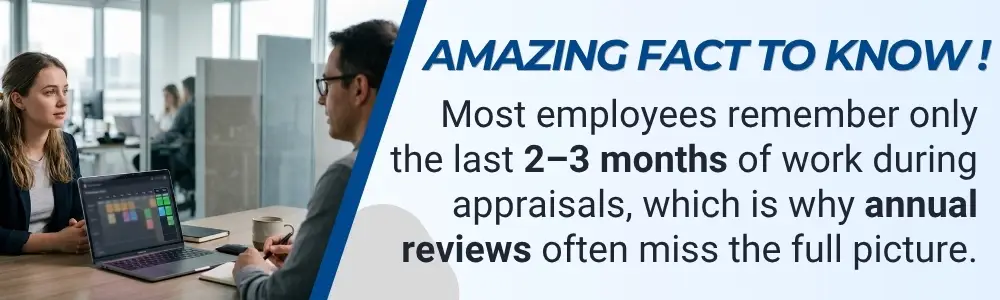
Supervisors often recall recent events. A mediocre year might be overshadowed by a good final quarter. A single error toward the end might ruin months of hard work.
Conversely, workers provide their best effort.
They draw attention to victories. Minimize difficulties. Everything should be framed according to the situation.
So what happens in that meeting is not a clear picture of performance.
It’s a curated version from both sides.
And somewhere in between, real growth gets lost.
What you’re left with is not development.
It’s a performance theatre.
Continuous Employee Feedback Is Redefining Real-Time Performance Management in 2026
Now let’s shift the scene.
Same Rahul. Different year.
He wraps up a client presentation on Tuesday. It wasn’t perfect, but it worked.
On Wednesday morning, he gets a message.
“Great work on the presentation. The flow was strong. Next time, tighten the data section a bit.”
That’s it.
No formal template. No rating scale. No long document.
Just a small, timely nudge.
And here’s what makes it powerful.
He can use it immediately.
Not months later. Not next year.
Right now.
This is what continuous employee feedback actually looks like in practice.
It’s not overwhelming. It’s not formal. It doesn’t feel like an HR exercise.
It feels like work… working.
Small moments of clarity.
Quick corrections before mistakes become habits.
Recognition when it actually matters, not when it’s scheduled.
And over time, these small moments add up to something far more meaningful than a yearly review ever could.
How Performance Management Software Is Shifting Reviews into Continuous Conversations
There’s a quiet change happening in how performance is viewed.
Earlier, managers showed up like judges.
Once a year. With a decision.
Now, they’re expected to show up more often, not with answers, but with guidance.
Think of the difference.
A judge tells you what went wrong.
A coach helps you get better before it goes wrong again.
That shift changes everything.
It turns performance discussions into ongoing conversations instead of high-pressure events.
It allows space for questions like:
- “What could I have done better here?”
- “Am I focusing on the right priorities?”
- “Where should I push myself next?”
And suddenly, performance becomes a shared responsibility.
Not a one-sided evaluation.
This is where performance management software plays a quiet but important role.
It doesn’t replace conversations.
It remembers them.
It captures quick feedback, progress updates, and small wins that would otherwise disappear.
Because let’s be honest.
No one remembers everything.
But systems can.
From Guesswork to Clarity: How OKR Tracking Improves Employee Performance Tracking
Let’s talk about goals, because this is where things used to get… confusing.
Earlier, goals sounded good in meetings but didn’t help much in practice.
- “Be more proactive.”
- “Improve collaboration”
- “Add more value to the team.”
They sound positive. Motivating even.
But ask anyone to measure them, and things quickly become unclear.
What does “more proactive” look like on a Wednesday afternoon?
How do you know if you’ve improved collaboration?
Now, enter OKR tracking.
Objective: Improve customer onboarding
Key Result: Reduce onboarding time from 5 days to 2 days
Simple. Clear. Trackable.
Now Rahul doesn’t need to wait for feedback to know if he’s doing well.
He can see his progress.
He can adjust his approach.
He can have better conversations with his manager because both are looking at the same reality.
And this is where performance management software becomes more than just a tracking tool.
It becomes a mirror.
Showing what’s working. What’s not? And what needs attention?
Modern Appraisal Software Supports Real-Time Performance Management All Year Round
There was a time when appraisal software felt like an annual visitor.
You knew it was coming. You prepared for it. You dealt with it. Then it disappeared.
Now, it’s always there. Quietly doing its job.
Modern appraisal software doesn’t wait for appraisal season.
It builds the story as work happens.
- Every piece of feedback.
- Every goal update.
- Every collaboration.
It connects the dots.
So when the time comes to review performance, there’s no pressure to reconstruct the past.
No last-minute storytelling.
No guesswork.
Just a clear, evolving record of what actually happened.
And for once, the appraisal feels less like a task… and more like a reflection.
Why Employee Performance Tracking Matters More Than Ratings in Modern Workplaces
Here’s a small truth that often surprises companies.
Most employees don’t wake up thinking. “I hope I get a 5 out of 5 this year.”
They think:
- Am I getting better?
- Does my work matter?
- Am I moving forward or standing still?
A rating might answer none of these.
It gives a number.
But not direction.
A conversation, on the other hand, does something different.
It gives clarity.
And when employees feel heard, understood, and guided, something shifts.
They stop working just to “perform well” during reviews.
They start working to improve.
And that’s where real engagement comes from.
Not from being evaluated more often.
But from being understood more often.
If you want to explore how modern tools directly impact team output and engagement, this detailed guide on improving productivity through HR systems connects perfectly with the shift toward continuous performance management.
How HR Teams Use Performance Management Software to Drive Continuous Employee Feedback
If you walk into an HR team today, you’ll notice something.
Their job looks very different from what it used to be.
Earlier, it was about processes.
Sending reminders. Tracking completion. Closing cycles.
Now, it’s about experience.
- How does performance feel to an employee?
- Does feedback come naturally or feel forced?
- Are managers actually helping people grow?
HR teams are no longer just managing systems.
They’re shaping behavior.
- Helping managers have better conversations.
- Designing processes that feel less like processes.
- Using data not just to report, but to guide decisions.
It’s a different kind of responsibility.
Less about control.
More about clarity and trust.
Why Companies Are Replacing Annual Reviews with Continuous Employee Feedback and OKR Tracking
This change is not just about making things feel better.
It’s about making them work better.
Companies that move toward continuous employee feedback and OKR tracking are seeing real differences.
- People improve faster because feedback is timely.
- Teams stay aligned because goals are visible.
- Reviews become smoother because nothing is a surprise.
And perhaps most importantly.
Employees stay.
Because when people feel lost, they leave.
When they feel guided, they grow.
How Real-Time Performance Management Captures What Annual Reviews Miss
Let’s visit Rahul one last time.
But this time, there’s no late night. No cold coffee. No blank document.
He opens his performance dashboard.
Not to prepare.
Just to check.
He sees feedback from different points in the year. Notes from his manager. Recognition from teammates. Progress on his goals.
It’s not perfect.
But it’s real.
And for the first time, he doesn’t feel like he has to prove his work.
It’s already there.
He smiles.
Because clarity feels a lot better than guessing.
The Future of Performance Management Software and Real-Time Performance Management
Performance is no longer about looking back and judging.
It’s about moving forward with clarity.
Less about events.
More about everyday progress.
Less about ratings.
More about growth.
And while performance management software supports this shift, the real change is in how companies think about performance itself.
Not as something to measure once a year.
But as something to build, every single day.
How HR HUB Combines Continuous Employee Feedback, OKR Tracking, and Appraisal Software for Real Growth
If there’s one thing clear in 2026, it’s this:
Performance is no longer something you evaluate once a year.
It’s something you build every day.
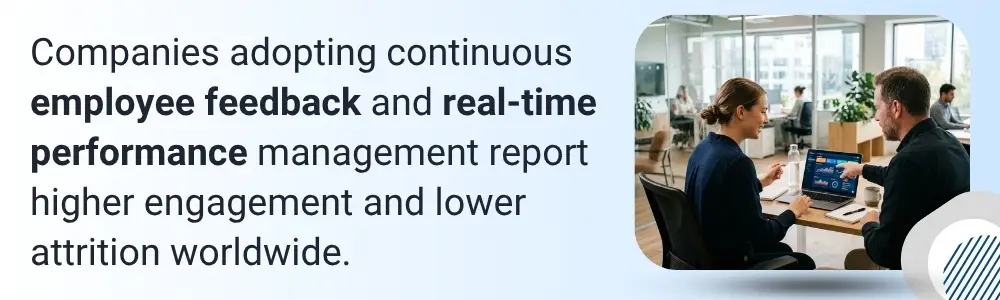
With the right mix of continuous employee feedback, smart appraisal software, and clear OKR tracking, companies are creating workplaces where people don’t just wait for feedback.
They grow with it.
And this is where solutions like HR HUB step in.
By bringing feedback, goal tracking, and performance insights into one place, HR HUB helps organizations move away from outdated appraisal cycles and toward something far more meaningful.
Not just better reviews.
Better people.