Benefits for employees used to have a set formula. The majority of corporate packages consisted of a health insurance plan, a retirement contribution, and a few set allowances. Efficiency was a key consideration in the design of these programs. Regardless of individual preferences or living circumstances, everyone benefited equally.
But workplaces today are far more diverse than they were a decade ago. Employees now bring different expectations, lifestyles, and personal responsibilities into their professional lives. A young graduate starting their career does not necessarily need the same support as a working parent, and a mid-career professional may value benefits very differently from someone approaching retirement.
The way businesses view employee benefits is changing as a result. Organizations are shifting away from uniform benefit packages and toward customized benefit plans that let workers select the things that are most important to them. This change is centered on Flexible Rewards programs and Flexible lifestyle accounts.
The result is a powerful shift in how companies design their Total Rewards Strategy, strengthen Employee Engagement, and respond to emerging HR Trends 2026.
Why Traditional Employee Benefits Models Are Losing Their Impact in Modern Workplaces
For years, standardized Employee Benefits programs were considered practical and manageable. Employers could maintain a single structure that applied to the entire workforce, making administration straightforward and predictable.
Yet the reality inside modern workplaces tells a different story.
Today's workers demand more than just basic pay. They expect businesses to comprehend their personal struggles, goals, and way of life. Employees frequently feel disconnected from the value of their employer's offerings when benefit packages don't account for these factors.
Consider two workers who are employed by the same company. While one may place a higher priority on professional credentials or childcare assistance, the other may be enthusiastic about fitness and health initiatives. A single benefits package cannot adequately meet both needs.
This is where traditional systems begin to fall short. When benefits feel irrelevant, employees may overlook their value entirely. Over time, this disconnect can reduce satisfaction and weaken Employee Engagement.
Forward-thinking organizations are responding by redesigning benefits to prioritize flexibility and personalization.
The Rise of Flexible Lifestyle Accounts in Modern Employee Benefits and Flexible Rewards Programs
One of the most exciting developments in modern HR strategy is the introduction of flexible lifestyle accounts. These programs allow employees to access a benefit allowance they can allocate to services or programs that support their personal well-being.
Employees can choose advantages from a carefully curated list rather than being given a set bundle. Wellness initiatives, financial planning services, childcare support, professional growth, travel opportunities, and educational subscriptions are a few examples of these choices.
Modern Flexible Rewards systems are built on this methodology.
For instance, a worker may decide to use their allowance for online courses or leadership development. Another employee might better use the same stipend for family support, exercise memberships, or mental health services.
The key advantage is choice. Employees are no longer limited to a single predefined structure. Instead, they can shape their benefits around the realities of their lives.
How Personalized Employee Benefits Improve Employee Engagement in Today’s Workforce
Personalization does more than improve benefits utilization. It fundamentally reshapes the relationship between employees and their organizations.
When employees feel that their company understands their individual needs, trust naturally grows. This trust strengthens Employee Engagement because workers begin to see their employer as a partner in their wellbeing rather than simply a provider of salary.
Flexible benefits also support employees throughout different stages of life.
Professionals in their early careers could place a higher priority on networking opportunities and educational allowances. Mid-career workers frequently prioritize health benefits, childcare services, and family assistance. Experienced professionals nearing retirement could benefit from investment advice and financial planning tools.
By allowing employees to adapt their benefits over time, companies create a system that evolves alongside their workforce.
This adaptability is one of the main reasons personalized benefits are gaining momentum across industries worldwide.
Redefining Total Rewards Strategy with Flexible Rewards and Modern Employee Benefits
Organizations that want to remain competitive are now rethinking how they design their Total Rewards Strategy.
Historically, total rewards focused mainly on salary and a few standardized benefits. Today, the concept has expanded dramatically. Companies now consider well-being, career development, workplace flexibility, recognition programs, and personalized benefits critical components of their reward ecosystem.
In this new model, Flexible Rewards become a central pillar of the overall strategy.
By integrating flexible benefit options, organizations can create a reward structure that feels more meaningful to employees. Workers feel empowered to tailor their benefits according to their personal circumstances rather than accepting a predefined package.
This shift also helps companies compete in the global talent market. Skilled professionals increasingly evaluate employers based on how well their benefits align with their lifestyle priorities.
A thoughtful Total Rewards Strategy built around flexibility can make a significant difference in attracting and retaining top talent.
Examples of Personalized Employee Benefits Shaping Employee Engagement and Workplace Culture
Companies around the world are experimenting with innovative benefit options that reflect evolving employee expectations.
Wellness benefits have become particularly popular. Many organizations now provide allowances for mental health services, meditation programs, fitness memberships, and nutrition coaching.
Learning and development programs are another major category. Employees may use flexible benefits to enroll in certification courses, leadership programs, or technical skill training.
Family-related benefits are also expanding. Some companies offer childcare assistance, parental coaching, eldercare support, or flexible work arrangements designed to help employees manage family responsibilities.
Financial well-being programs are also gaining attention. These benefits may include investment advisory services, debt management support, or retirement planning workshops.
These programs reflect the growing importance of personalization in Employee Benefits and demonstrate how organizations are responding to evolving HR Trends 2026.
How HR Technology Is Powering the Shift Toward Flexible Rewards and Modern Employee Benefits
Managing personalized benefits across a large workforce requires strong technological support. Digital HR platforms now enable companies to manage flexible benefits efficiently.
Through these platforms, employees can access benefit catalogs, review available allowances, and select the programs that suit their needs. Many systems provide dashboards where employees can track their selections and monitor remaining balances.
For HR teams, these platforms provide valuable data insights. Organizations can analyze which benefits employees use most frequently and adjust their programs accordingly.
Technology also simplifies compliance and reporting processes, making flexible benefit systems easier to manage across multiple regions and regulatory environments.
As HR technology continues to evolve, flexible benefits will become even more accessible for organizations of all sizes.
Organizations exploring modern approaches to employee experience can also learn how HR technology is reshaping the workplace in this guide on revolutionizing the employee journey with HR technology.
Challenges Organizations Face When Introducing Flexible Rewards and Personalized Employee Benefits
While personalized benefits offer tremendous value, organizations must design these programs carefully.
One important consideration is fairness. Companies need to ensure that benefit allowances are distributed in a way that feels equitable across different employee groups.
Clear communication is equally important. Employees should understand how flexible benefits work, what options are available, and how they can maximize the value of their allowances.
Organizations operating in multiple countries must also consider the regulatory and tax implications of certain benefits.
Despite these challenges, the long-term benefits of flexible programs often outweigh the complexity of implementation. Companies that invest in well-designed benefit systems typically see stronger engagement and improved retention.
Why Flexible Rewards Are Emerging as One of the Biggest HR Trends 2026
The workplace is evolving faster than ever before. Hybrid work models, global teams, and changing employee expectations are reshaping how organizations design their HR strategies.
Within this transformation, flexible benefits have emerged as one of the most influential HR Trends 2026.
Employees now expect their workplace to support not only their professional growth but also their overall well-being and lifestyle goals. Personalized benefits enable companies to deliver this support in meaningful ways.
Organizations that embrace Flexible Rewards demonstrate that they value employees as individuals rather than simply as members of a workforce.
This approach strengthens company culture, builds loyalty, and creates workplaces where employees feel genuinely supported.
The Future of Employee Benefits: Building a Personalized Total Rewards Strategy for Modern Workplaces
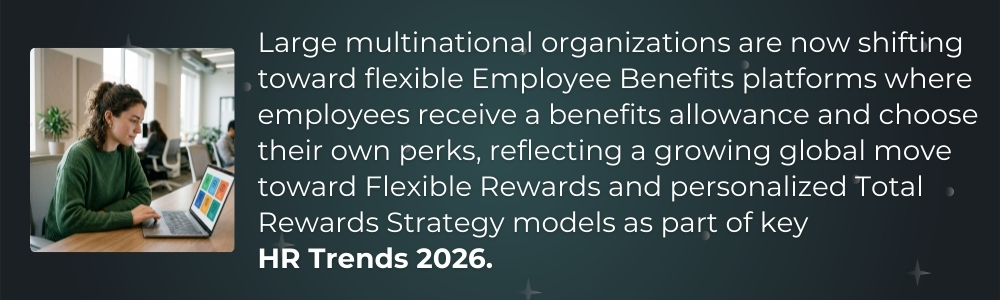
The era of standardized benefit packages is gradually fading. In its place, organizations are building personalized ecosystems where employees can choose the benefits that truly enhance their lives.
Flexible lifestyle accounts allow businesses to design smarter Employee Benefits programs while giving employees the freedom to prioritize what matters most. When integrated into a thoughtful Total Rewards Strategy, these programs drive stronger Employee Engagement and position organizations at the forefront of evolving HR Trends 2026.
Technology plays an important role in making this transformation possible. Modern HR platforms enable organizations to manage flexible benefits efficiently while delivering a seamless experience for employees.
Solutions like HR HUB are helping organizations bring this vision to life. With integrated HR tools that support employee management, engagement initiatives, and benefits administration, HR HUB enables companies to create modern workplaces where flexibility and personalization are built into everyday operations.
As businesses continue to adapt to changing workforce expectations, the move toward personalized perks will shape the future of work. Companies that embrace this shift today will build stronger teams, healthier workplace cultures, and more meaningful employee experiences tomorrow.