There was a time when office walls were silent. Desks were assigned once and rarely moved. Meeting rooms were booked through endless email threads. Attendance was either manual or isolated inside a software system that had no idea what was happening in the building itself.
In 2026, the office has a voice.
It knows when employees enter. It senses when collaboration peaks. It adjusts temperature based on occupancy. It learns traffic flow patterns. It predicts space demand. It communicates with HR systems.
This is the era of the Phygital Workplace.
And for HR leaders across India, the Cayman Islands, the US, and Canada, this is no longer a facilities conversation. It is a strategic performance conversation. Because the workplace is now measurable. And what is measurable becomes a KPI.
Phygital Workplace Strategy: How Digital Intelligence Is Transforming Physical Office Spaces
A Phygital Workplace is more than just a fancy dashboard-equipped smart workplace. It is an interconnected ecosystem where digital and physical systems function as one cohesive whole.
Consider this change:
HR used a single method to monitor attendance in the past. Energy use was measured differently by facilities. IT kept a separate eye on the network load. These realizations didn't relate to one another.
Now they do.
When physical spaces communicate with HR software, something powerful happens. HR can see how people actually use the workplace, not just how policies say they should.
The office stops being a cost center and becomes a performance indicator.
And that is where the transformation truly begins.
Below is the expanded and more engaging version of your requested sections. The tone is immersive, insight-driven, and layered with strategic depth while maintaining clarity and flow.
IoT in Workplace: Turning Real-Time Movement Data Into Actionable Workforce Insights
The emergence of IoT in the workplace has subtly changed the way offices react, think, and breathe.
Intelligent infrastructure has replaced static infrastructure.
Sensitive information about how people move and interact with their environment is continuously collected by sensors built into desks, ceilings, access points, lighting systems, elevators, and HVAC networks. They keep track of:
- Desk utilization
- Meeting room occupancy
- Peak entry and exit hours
- Environmental comfort levels
- Collaboration density
- Traffic flow between departments
- Idle zones versus high-intensity zones
At first glance, this looks operational. It feels like facilities management.
But look deeper.
Patterns begin to emerge.
You observe that Mondays are calm, whereas collaboration zones are at their busiest in the middle of the week. Employees seem to prefer specific temperature ranges and avoid locations that differ even slightly. You can tell which departments are drawn to enclosed pods and which groups are grouped near natural light.
This behavior is not arbitrary. It's behavioral intelligence.
HR needs to reevaluate its assumptions about workplace design if collaboration spaces are regularly packed while individual focus pods remain empty.
The hybrid approach needs to be adjusted if some teams avoid office anchor days.
If employee comfort dips at specific hours due to temperature or lighting inconsistencies, engagement may decline subtly but consistently.
The power of IoT in workplace technology lies in its ability to convert physical movement into insight. It reveals the hidden story of how employees actually use the workplace, not how policies expect them to.
The office is no longer a fixed location.
It becomes a living dataset that explains productivity, collaboration, and engagement patterns.
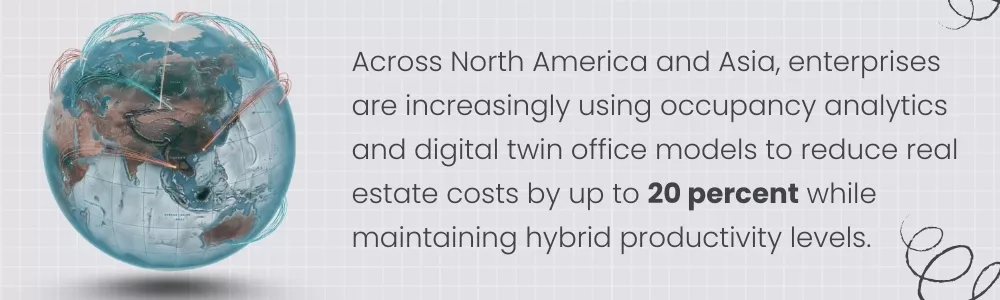
Digital Twin Office Explained: How a Phygital Workplace Predicts and Plans Future Space Needs
One of the most compelling innovations in smart infrastructure is the digital twin office.
A digital twin office is a dynamic virtual replica of the physical workspace. It mirrors occupancy levels, movement patterns, environmental conditions, and space performance in real time.
But its true value is not visualization. It is a simulation.
With a digital twin, HR leaders can explore strategic decisions before making expensive physical changes.
They can test:
- The impact of shifting from two to three anchor days
- The effect of converting fixed desks into shared seating
- The implications of downsizing a floor
- The space required for projected team expansion
- How collaboration zones influence productivity distribution
Instead of relying solely on surveys, HR can model real-world outcomes using behavioral data.
In high-cost markets such as Toronto, New York, Bangalore, or compact business hubs in the Cayman Islands, real estate commitments represent major financial exposure.
A digital twin reduces uncertainty.
It allows HR to validate strategy using predictive insight rather than assumptions.
It transforms space planning from reactive to proactive.
Smart Building HRMS Integration: Connecting Infrastructure Intelligence With Workforce Management
An interconnected building is remarkable.
It is revolutionary to have a linked building that directly interfaces with HR systems.
This is where organizational intelligence is reshaped by Smart Building HRMS integration.
Imagine attendance records and access control logs automatically synchronizing. Imagine dashboards for hybrid scheduling that display occupancy data instantaneously. Consider how environmental comfort measurements influence employee wellness initiatives
With Smart Building HRMS integration, HR leaders gain:
- Accurate presence validation
- Real-time hybrid compliance visibility
- Team-specific space utilization insights
- Correlation between office attendance and performance metrics
- Alignment between workforce planning and actual physical capacity
Instead of tracking attendance in isolation, HR can validate it against building data.
Instead of unthinkingly planning team growth, HR can assess whether the infrastructure supports expansion.
Instead of debating hybrid alignment emotionally, leaders can evaluate participation trends objectively.
When building intelligence that integrates with HR systems, infrastructure becomes part of workforce analytics.
And that is when space transforms into a strategic asset.
Occupancy Analytics in the Phygital Workplace: Eliminating Space Waste With Data-Driven Decisions
Hybrid work introduced flexibility. It also introduced ambiguity.
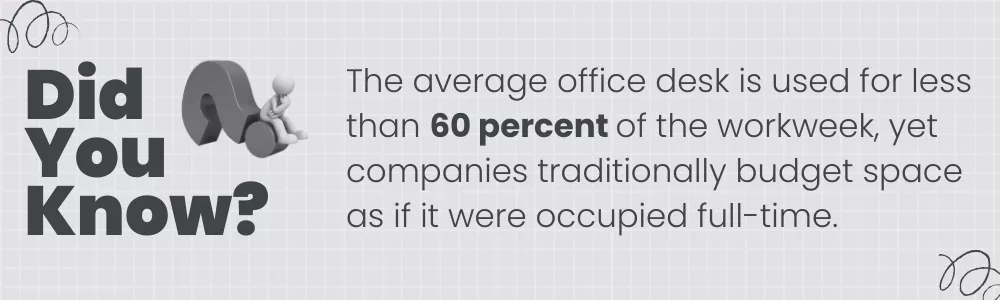
Many organizations operate offices without a clear understanding of how often they are used, which teams use them, or whether the space aligns with actual demand.
This is where occupancy analytics becomes indispensable.
Occupancy analytics measures how space performs across days, departments, and time blocks. It uncovers patterns that traditional reporting cannot capture.
It answers difficult but necessary questions:
- Are we leasing more square footage than we require?
- Do collaboration days truly increase cross-team interaction?
- Which floors sit underutilized for most of the week?
- Are meeting rooms consistently overbooked while desks remain vacant?
- Is seating allocation proportional to departmental attendance trends?
Without occupancy analytics, decisions are based on perception.
With occupancy analytics, decisions are backed by evidence.
Enterprises across North America are using verified utilization rates to restructure leasing agreements. Companies in India are pursuing operational efficiency through hybrid recalibration. Accurate measuring has a direct impact on cost control in small economies with limited commercial space, such as the Cayman Islands.
Space planning is transformed from a discussion to a discipline via occupancy analytics.
Square footage is reframed as a financial metric.
To explore how comprehensive HR technology further enhances employee experience and workplace transformation, see this HR HUB insight: Revolutionizing the Employee Journey With HR Technology.
Hybrid Office ROI: Measuring Financial Performance Through Occupancy Analytics and Smart Infrastructure
Flexibility and culture have dominated conversations about hybrid work for years.
Numbers are the main topic of discussion in 2026.
What is the real hybrid office ROI?
- Does flexible work reduce attrition?
- Does it decrease real estate expenditure?
- Does it improve productivity metrics?
- Does it lower utility costs?
- Does it increase employee satisfaction scores?
Calculating hybrid office ROI requires merging infrastructure intelligence with HR performance data.
- Energy savings from reduced occupancy.
- Cost reduction from space consolidation.
- Retention improvements linked to flexibility.
- Productivity metrics aligned with collaboration days.
- Commuting pattern reductions influencing employee well-being.
The hybrid policy becomes quantifiable as HR links these data streams.
Theory gives way to the performance score.
The ROI of a hybrid office shows whether flexibility yields operational benefits or merely convenience.
And for that same reason, HR's strategic purview now includes smart infrastructure.
Because where people and space meet, ROI exists.
Enhancing Employee Experience in a Phygital Workplace With IoT in Workplace Technology
Employees rarely discuss infrastructure openly.
But they experience it constantly.
- They notice when desks are unavailable despite bookings.
- They notice when meeting rooms feel overcrowded.
- They notice when the WiFi slows during peak hours.
- They notice when shifts in temperature disrupt concentration.
These moments may seem minor. But repeated friction accumulates.
In a Phygital Workplace, intelligent systems anticipate these issues.
- Smart booking platforms prevent double allocation.
- Real-time occupancy displays guide employees to available spaces.
- Predictive capacity tools redistribute usage before congestion occurs.
- Environmental controls adapt dynamically based on presence levels.
The result is a workplace that feels smooth.
In competitive talent markets across India, Canada, the US, and evolving hubs like the Cayman Islands, a seamless experience strengthens employer perception.
Infrastructure is no longer a background function.
It influences culture, satisfaction, and retention.
Data Governance in a Phygital Workplace: Managing Privacy in Smart Building HRMS Integration
Accountability is unavoidable as offices grow more sophisticated.
Sensitive information is produced by tracking occupancy and behavioral movement. Although insights are useful, misapplication can damage confidence.
Organizations must ensure:
- Transparent communication about data collection
- Clear explanation of how insights are used
- Role-based access controls
- Alignment with local privacy frameworks
- Strict separation between behavioral insight and personal surveillance
To create governance frameworks that maintain employee dignity, HR directors must collaborate with IT and compliance departments.
India's changing data protection laws necessitate close monitoring. Privacy laws are strict in regions of the US and Canada. Compliance requirements are nonetheless strict in offshore jurisdictions such as the Cayman Islands.
Intelligence should never take precedence over trust in a physical workplace.
Because performance cannot be sustained without trust.
Insight is provided by smart infrastructure.
Insight enhances culture rather than undermines it, thanks to responsible leadership.
The success of the modern workplace depends on that balance.
The Future of the Phygital Workplace: Where Digital Twin Office Intelligence Drives Hybrid Office ROI
The office of 2026 is no longer just square footage and furniture. It is an intelligent system. And in that system, HR is no longer just managing people.
HR is managing how people interact with space.
The Phygital Workplace is redefining how we measure productivity, engagement, and cost efficiency. Through IoT in workplace systems, organizations turn movement into measurable patterns. With a digital twin office, planning becomes predictive. Through Smart Building HRMS integration, systems align. With occupancy analytics, waste becomes visible. And by calculating hybrid office ROI, flexibility becomes financially accountable.
Smart infrastructure is not a facilities upgrade.
It is a strategic performance lever.
For organizations ready to lead this transformation, the right HR technology partner becomes critical.
HR HUB empowers companies to align workforce management with modern infrastructure intelligence. From advanced attendance tracking and hybrid workforce planning to analytics-driven insights that integrate seamlessly with smart systems, HR HUB helps organizations move confidently into the era of the Phygital Workplace.
Because in 2026, the smartest office is not the one with the most technology.
It is the one where technology, people, and performance operate as one connected ecosystem.