There is a discernible change in the hiring environment. Resumes were a major tool used by organizations to find qualified applicants. Company names, degrees, and titles were viewed as indicators of possible success. However, hiring teams in the US, Canada, India, and the Cayman Islands are recognizing that resumes hardly present the whole picture.
A résumé can provide an overview of a person's experience, but it cannot show how they work with others in hectic settings, think on their feet, or tackle real difficulties. Employers frequently make hiring errors when they rely too much on candidates' claims rather than their real abilities.
For this reason, proof-of-work recruiting approaches are becoming more popular in contemporary recruitment strategies. Companies are pushing candidates to demonstrate their competence through real tasks, standardized evaluations, and quantifiable performance indicators, rather than relying solely on interviews and paperwork.
HR departments can now evaluate candidate performance more precisely thanks to technologies like AI Talent Assessment 2026. Recruiters can assess candidates' performance in real job simulations rather than speculating about their potential for success.
At the same time, organizations are refining their Candidate Experience Design to keep the hiring process engaging rather than exhausting. A well-designed hiring journey helps attract top performers while filtering out mismatches.
With structured Skill-Validation Workflows, supported by platforms such as the HR HUB Talent Suite, and enhanced through Recruitment Automation, organizations are discovering more reliable ways to identify genuine high performers.
Let us explore five powerful strategies that are transforming talent evaluation in 2026.
Why Resumes Alone Fail in 2026: The Rise of AI Talent Assessment 2026
Imagine sifting through hundreds of resumes for a position that requires flexibility, ingenuity, and problem-solving skills. Each applicant claims to have comparable abilities. The majority of resumes have well-curated experiences, streamlined wording, and polished explanations of accomplishments.
However, the true test starts when the individual starts working.
Hiring managers often discover that some candidates who appeared impressive on paper struggle with practical tasks, while others with modest resumes outperform expectations. This gap between written experience and actual capability is what drives organizations to rethink hiring methods.
In 2026, recruitment leaders are focusing on capability signals rather than resume signals. Through AI Talent Assessment 2026, organizations can evaluate how candidates approach tasks, solve problems, and make decisions.
The goal is simple. Move beyond static documents and evaluate real performance.
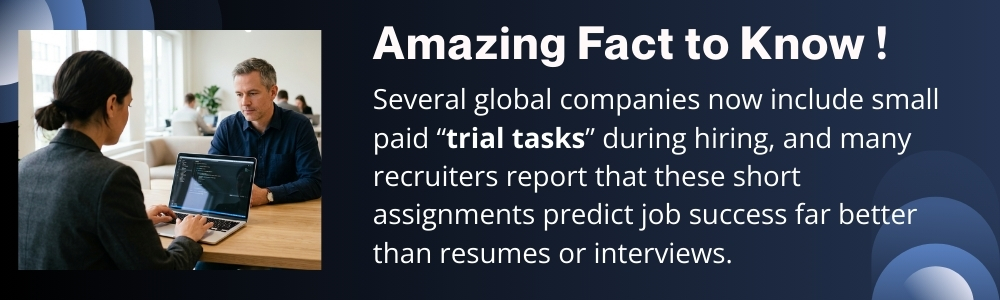
Strategy 1: Real Work Simulations and Skill-Validation Workflows to Evaluate Actual Job Performance
One of the most reliable ways to identify high performers is to place candidates in situations that closely resemble real work.
Real work simulations present candidates with practical scenarios similar to the challenges they will face after joining the organization. Instead of asking theoretical questions during interviews, recruiters can observe how candidates analyze problems, organize information, and produce results.
These simulations form an essential part of modern Skill-Validation Workflows.
Consider a few examples.
- A marketing strategist may be asked to develop a campaign idea for a new product launch.
- A data analyst might receive raw data and be asked to extract meaningful insights.
- A customer success manager may be presented with a difficult client scenario and asked to resolve it.
These exercises provide a realistic view of how candidates perform under conditions similar to their future role.
Platforms like the HR HUB Talent Suite, which allow recruiting managers to develop standardized assessments, specify evaluation criteria, and collect feedback consistently across several hiring teams, are widely used by businesses to manage these simulations.
Combined with AI Talent Assessment 2026, these simulations can reveal deeper insights about candidate performance, including how efficiently tasks are completed, how logical their approach is, and how well they communicate solutions.
This approach transforms hiring from speculation into observation.
Strategy 2: Project-Based Hiring Assessments Powered by Recruitment Automation
While brief interview tasks might yield valuable indications, project-based hiring assessments frequently yield deeper insights.
Candidates complete structured mini-projects that mimic actual responsibilities rather than short exercises. Hiring teams can assess candidates' work planning, information organization, and long-term output through these initiatives.
For example, a product manager candidate might be asked to analyze a market scenario and prepare a product improvement strategy. A developer might be asked to build a small application module. A financial analyst may be asked to evaluate a budget scenario and present recommendations.
These exercises reveal far more than traditional interviews ever could.
Organizations may guarantee that all candidates receive uniform instructions, deadlines, and evaluation criteria by implementing recruitment automation. Recruiters can effectively handle submissions and monitor progress using automated procedures.
Platforms like the HR HUB Talent Suite help structure these project assessments with scoring frameworks, enabling hiring teams to evaluate candidates objectively.
When these projects are analyzed using AI Talent Assessment 2026, organizations gain additional insights into problem-solving patterns, attention to detail, and solution quality.
The result is a hiring decision based on tangible work rather than assumptions.
Strategy 3: Collaborative Problem Solving and Candidate Experience Design for Better Talent Evaluation
High performers are not solely defined by technical proficiency. Success in most firms depends primarily on teamwork, communication, and flexibility.
This is why many companies now include collaborative problem-solving sessions in their hiring process.
During these sessions, candidates work with hiring managers or other participants to solve a complex problem. The goal is not simply to produce the correct answer but to observe how candidates think and interact with others.
- Do they listen carefully to different perspectives?
- Do they explain ideas clearly?
- Do they adapt when new information appears?
These meetings provide insightful information about candidates' behavior.
Organizations can ensure candidates are assessed uniformly throughout the hiring process by incorporating collaborative sessions into Skill-Validation Workflows.
Meanwhile, Recruitment Automation tools can document session outcomes, collect feedback from multiple evaluators, and store evaluation records within a centralized hiring platform.
When managed through the HR HUB Talent Suite, hiring teams gain a clear view of candidates' performance across technical ability, communication style, and teamwork.
These insights help organizations identify candidates who not only perform well individually but also elevate team performance.
Strategy 4: Using AI Talent Assessment 2026 to Analyze Candidate Performance Patterns
Traditionally, hiring decisions have been based on intuition. Interview impressions, communication style, and personal judgments often influenced the final decision.
However, modern recruitment strategies are increasingly data-driven.
Through AI Talent Assessment 2026, organizations can analyze candidates' behavior across multiple stages of the hiring process. This includes task performance, problem-solving patterns, response accuracy, and communication effectiveness.
AI systems, for instance, can assess coding tasks by examining the logic, efficiency, and structure. Written answers can be evaluated for coherence, clarity, and the quality of their argument.
Hiring teams can use thisinformation to identify trends associated with high performance.
Recruitment automation, which automatically guides candidates through evaluation phases, tracks results, and emphasizes candidates with strong potential, is extremely advantageous for large firms processing thousands of applications.
When this data is integrated into platforms like the HR HUB Talent Suite, hiring teams gain a complete picture of candidate performance across every stage of the recruitment process.
This structured approach makes hiring decisions more reliable and transparent.
Many organizations are already combining proof-of-work hiring with AI-driven recruitment platforms. If you want to explore how intelligent hiring systems are transforming candidate shortlisting and bias reduction, you can read this detailed guide on AI recruitment software transforming hiring in 2026.
Strategy 5: Candidate Experience Design That Attracts High-Performer Talent
Even the most advanced hiring assessments will fail if the process frustrates candidates.
Top performers often have multiple job opportunities. If the hiring journey feels confusing, slow, or poorly organized, they may simply move on.
This is why Candidate Experience Design has become a major focus for recruitment teams.
A well-designed hiring journey communicates professionalism and respect. Clear instructions, transparent timelines, and thoughtful communication create a positive impression on candidates.
Organizations that prioritize Candidate Experience Design ensure candidates always know what to expect at each stage of the hiring process.
These experiences are supported by contemporary tools such as the HR HUB Talent Suite, which automates communication, provides regular information, and manages assessment procedures.
In the meantime, hiring teams may concentrate on meaningful encounters rather than administrative duties thanks to Recruitment Automation's assistance with scheduling, reminders, and evaluation procedures.
When organizations combine engaging candidate journeys with strong Skill-Validation Workflows, they create hiring systems that both evaluate talent effectively and attract high-quality applicants.
The Shift Toward Evidence-Based Hiring with Skill-Validation Workflows
A fresh hiring philosophy is required in the modern workforce. Resumes and interviews are no longer the exclusive methods organizations use to find qualified applicants.
Instead of relying on presumptions, evidence-based hiring focuses on how candidates perform. Structured projects, real-world work simulations, cooperative problem-solving, and data-driven evaluations provide clearer insights into applicant potential.
With the support of AI Talent Assessment 2026, organizations can analyze performance signals that were previously impossible to measure. These insights allow hiring teams to identify individuals who consistently demonstrate strong capability and professional maturity.
Platforms like the HR HUB Talent Suite bring these strategies together by connecting assessments, evaluation frameworks, and Recruitment Automation in a single centralized environment.
The result is a hiring process that is structured, transparent, and far more reliable than traditional methods.
Building High-Performance Teams with HR HUB Talent Suite and Recruitment Automation
Organizations that adopt proof-of-work hiring strategies gain a significant advantage. Instead of relying solely on resumes, they identify candidates who can actually deliver results.
By combining practical assessments, intelligent analytics, and thoughtful Candidate Experience Design, companies can build hiring processes that reveal true potential.
Modern hiring is no longer about who writes the best resume. It is about who demonstrates the strongest capability.
Solutions such as the HR HUB help organizations implement these advanced hiring approaches through integrated Skill-Validation Workflows, AI Talent Assessment 2026, and scalable Recruitment Automation tools.