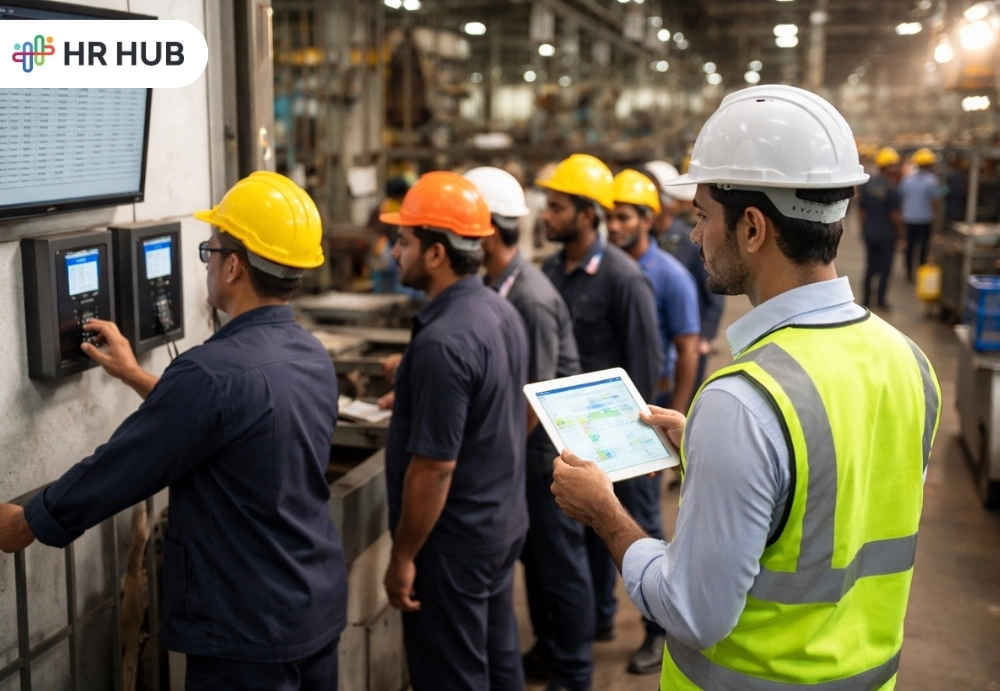
6:02 a.m. The sound of the siren. And the first issue arises.
Half-awake, Ramesh swipes his card while the tea continues to work slowly. Five more employees line up behind him. Already, one machine has begun to hum. Another is awaiting the "almost here" operator.
The shift officially starts at 6:15 AM.
But here’s the real situation:
- One worker forgot to punch in
- One came early but is assigned to the next shift
- One swapped shifts with a colleague without informing HR
- And one supervisor is already doing mental math about overtime before breakfast
Welcome to the daily puzzle inside India’s manufacturing sector.
This is not chaos. This is normal.
And this is exactly why HR software for the manufacturing industry is no longer just a “nice-to-have tool.” It has quietly become the only way to keep things from falling apart.
Why Attendance Isn’t Simple in Manufacturing: A Reality Check for HR Software for the Manufacturing Industry
Ask anyone outside manufacturing how attendance works, and you’ll get a confident answer:
“People come in. They mark attendance. They leave.”
Simple.
If you ask someone at a factory, they may chuckle before responding.
Because attendance here is more about scheduling, coordination, exceptions, and ongoing modifications than it is about physical presence.
- A worker clocks in early. Does that count as overtime?
- Someone leaves mid-shift due to machine downtime. Half-day or full-day?
- A night shift crosses midnight. Which day does it belong to?
- A public holiday falls between rotating shifts. Who gets paid what?
Suddenly, that “simple attendance” looks like a puzzle with moving pieces.
And if you are still managing this through registers or scattered spreadsheets, you are basically playing chess blindfolded.
Why Shift Management Software Is Essential for Handling Dynamic Factory Shifts
Let’s talk about shifts. Or more accurately, shifting shifts.
In theory, shifts are fixed blocks of time.
In reality, they behave more like suggestions.
- A morning shift stretches because production targets aren’t met
- A night shift starts early because a machine is finally operational
- A worker swaps shifts with a colleague solely for social reasons.
- Contract workers come in at different times altogether
And somewhere along the line, HR is supposed to keep flawless records.
Here's where shift management software makes a big difference.
Not by dictating to others, but by making movement easier to understand.
- Assign shifts clearly
- Allow structured swaps
- Track deviations without confusion
- Keep supervisors and HR on the same page
Because let’s be honest, “Who worked which shift?” should never turn into a detective story.
Overtime Tracking in Manufacturing: Where Small Errors Turn Into Big Problems
Overtime is emotional if attendance is unclear.
People will say something like, "Sir, I stayed two extra hours."
Suddenly, trust begins to erode.
Money is not the only factor in overtime. It has to do with justice.
Things get ugly if overtime is not properly tracked:
- Extra hours go unnoticed
- Some employees get overpaid, others underpaid
- Supervisors rely on memory instead of data
- Payroll becomes a battlefield
Now imagine a system that quietly tracks everything:
- When the shift ended
- When the employee actually left
- Whether those extra hours qualify as overtime
- How they should be paid
No arguments. No guesswork. Just clarity.
And suddenly, HR doesn’t have to play referee every month.
How an Attendance Management System Turns Workforce Data Into Real Insights
For a moment, let's change the viewpoint.
What if attendance served as a storyteller as well as a record?
"Present" and "absent" are not the only options available in a contemporary attendance management system.
It tells you:
- Why is one department always short-staffed on Mondays
- Which shift consistently runs overtime
- Who is regularly late, and who is silently overworking
- Where production inefficiencies are actually people inefficiencies
This is where things get interesting.
Because now attendance is not just HR data. It becomes operational insight.
And decisions stop being reactive.
How HR Software for the Manufacturing Industry Connects Attendance, Overtime Tracking, and Payroll
Here’s where things usually go wrong in many factories:
- Shift planning happens in one place
- Attendance is recorded somewhere else
- Overtime is tracked manually
- Payroll is calculated separately
It’s like four different people trying to cook the same dish without talking to each other.
The result? Confusion with a side of frustration.
Now bring in HR software for the manufacturing industry that connects everything.
Suddenly:
- Shifts feed directly into attendance
- Attendance feeds into overtime
- Overtime feeds into payroll
- Payroll reflects reality, not assumptions
And HR? Finally gets to breathe.
From Manual Tracking to HR Software for Manufacturing Industry: A Simple Shift That Changes Everything
Let’s go back to Ramesh.
Same factory. Same 6:02 AM shift.
But this time:
- He clocks in through a biometric system
- His shift is already assigned in the system
- If he stays longer, overtime is auto-calculated
- His supervisor doesn’t need to track anything manually
- HR doesn’t need to verify five different sheets
Nothing dramatic has changed on the surface.
But everything underneath is smoother.
And sometimes, that’s all it takes.
If you're exploring how attendance systems have evolved beyond manual tracking, this detailed read on the journey from registers to intelligent systems offers valuable context.
Why Compliance Becomes Easier with an Attendance Management System and Overtime Tracking
Let's be honest. It's not exciting to comply.
Nobody thinks, "Today I want to calculate legal overtime limits," when they wake up.
But disregarding it? That becomes costly.
Manufacturing units deal with:
- Maximum working hour limits
- Overtime rules
- State-specific labor laws
- Audit requirements
Doing this manually is like trying to remember everyone’s birthday without a calendar.
A system ensures:
- Rules are applied automatically
- Limits are not crossed unknowingly
- Records are always ready when needed
Less stress. Fewer surprises.
Choosing the Right HR Software for the Manufacturing Industry: What Really Matters on the Ground
Forget the fancy dashboards for a moment.
What really matters on the ground is simple:
- Can it handle messy, real-life shifts?
- Can it track attendance without constant supervision?
- Can it calculate overtime without arguments?
- Can it connect everything to payroll without errors?
If the answer is yes, you are not just buying software.
You are removing daily friction.
The Future of Manufacturing Workforce Management with Shift Management Software and Smart Attendance Systems
Manufacturing has always been about movement.
Machines move. Materials move. People move.
But now, the way we manage that movement is changing.
The shift is not just in timing.
It is in the mindset.
- From manual tracking to intelligent systems.
- From reactive corrections to proactive clarity.
- From confusion to confidence.
How HR HUB Simplifies Attendance, Shift Management Software, and Overtime Tracking for Manufacturing
If all of this sounds familiar, it’s because these challenges are not rare. They are part of everyday factory life.
This is exactly where HR HUB steps in.
HR HUB is designed to handle the realities of manufacturing environments:
- Complex shift structures
- Accurate attendance tracking
- Seamless overtime calculation
- Direct integration with payroll
- Compliance-ready records
It does not try to simplify your operations artificially. It adapts to how your factory actually works.
And that makes all the difference.
Because in manufacturing, every hour matters.
And knowing exactly what happened in that hour? That’s where control begins.