For years, the resume has been treated like a passport. If it carried the right stamps, such as prestigious degrees, big brand employers, and polished job titles, the door opened. If not, it quietly closed.
But in 2026, that passport will lose power.
Companies across India, the Cayman Islands, the US, and Canada are discovering something uncomfortable yet undeniable. The resume was built for a slower economy. Today’s growth cycles move too fast for credentials to keep up. Businesses scaling in technology, healthcare, finance, hospitality, and services cannot afford to guess talent quality based on formatted summaries.
The real question is no longer “Where did you work?” It is “What can you do right now?”
That shift is why skills-based hiring software is no longer optional. It is becoming the foundation of modern workforce strategy.
Why Traditional Resumes Fail in Modern Hiring and the Need for Skills-Based Hiring Software
A resume was designed for a different era. It was built when careers were linear, industries were stable, and skill requirements did not change every 18 months.
Today, that reality no longer exists.
A resume provides information about a person's past. Seldom does it convey their level of performance. Job titles are displayed, but not the level of detail. Tools are listed, but the depth of mastery is not. While obligations are mentioned, impact is not.
Two candidates can have engineering degrees from reputable universities. You taught younger peers, independently developed scalable systems, and resolved production issues under pressure. The other might have played a limited role without exposure to actual decision-making, following predetermined orders.
They appear similar on paper. They aren't in execution.
There is structural friction in hiring due to the discrepancy between documented experience and actual capability. Because resumes contain a lot of content, recruiters rely on keyword matching. Formatting takes precedence over performance proof in applicant tracking systems. Simply because their resumes do not follow conventional patterns, high-potential experts who gained their knowledge through actual projects, startups, freelancing, or self-driven learning are eliminated.
After that, hiring managers spend weeks interviewing applicants who meet the qualifications but struggle with real-world situations.
This inefficiency hinders innovation in India's constantly growing technology sector, where product cycles are swift. Hiring misalignment can halt entire initiatives in the US and Canada, where specialized knowledge in AI, cybersecurity, healthcare, and finance is crucial. A single poor hiring decision can impede departmental operations in the Cayman Islands, where teams are often small, and each appointment has a significant impact.
The CV was never designed to forecast performance under the demands of contemporary business. It was created to compile a history of employment. That distinction is important.
The Rise of Skills-First Recruitment and the Shift Driven by Skills-Based Hiring Software
The global hiring conversation has shifted from pedigree to proficiency.
Across industries, organizations are asking sharper questions.
- Can this candidate execute the task?
- Can they adapt to change?
- Can they solve the problems we are actually facing?
This is the essence of skills-first hiring.
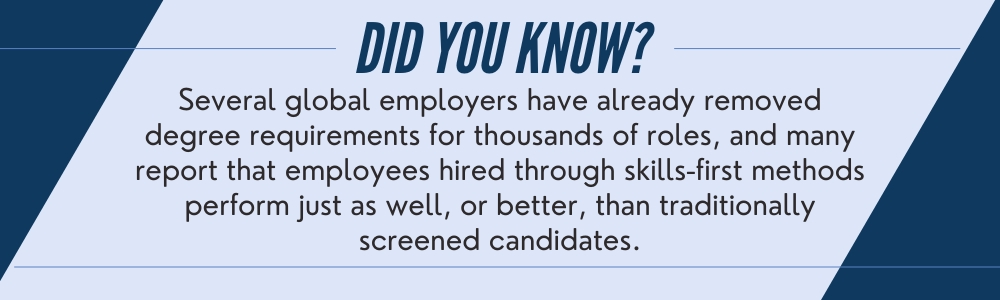
Organizations are rethinking recruitment strategies around digital exams, competency benchmarking, and quantifiable job frameworks, demonstrating the momentum behind this shift. Companies are evaluating applicants based on their practical definition of success rather than just their degree.
Deliverables and technical competencies are increasingly important in job descriptions in the US and Canada. Employing leaders is upending long-held beliefs about required academic programs. Employers are placing greater value on adaptability and cross-functional skills in smaller markets like the Cayman Islands, where flexibility is becoming crucial.
The hiring equation is evolving into something far more pragmatic.
Capability plus contextual relevance equals sustainable performance.
At the center of this transformation is skills-based hiring software. Rather than scanning resumes for familiar brand names, it aligns candidate profiles with validated skill frameworks. It integrates assessments, structured scoring, and measurable competency tracking.
It reduces subjectivity. It increases clarity. It converts hiring from interpretation into a structured evaluation.
How Talent Intelligence Platforms and Skills-Based Hiring Software Are Transforming Recruitment Strategy
Recruitment served as a reaction mechanism for many years. There was a vacancy. There was a job posting. Applications came in. The screening process started.
However, growing businesses can't afford to wait for gaps to show up.
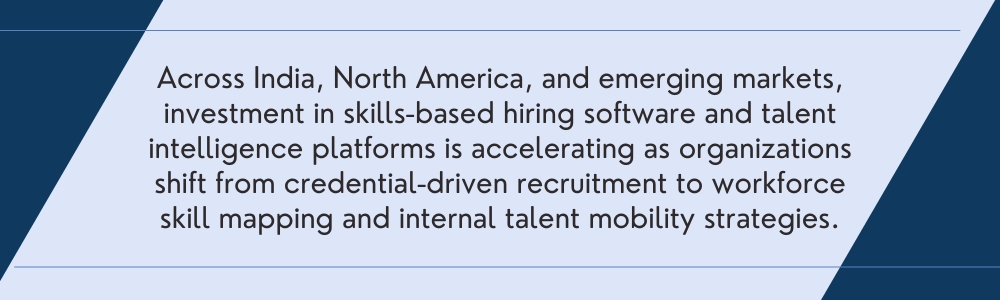
By focusing on the future, talent intelligence platforms are revolutionizing the recruitment process. They compile information about the internal workforce, market trends, performance indicators, and skill development. Leadership teams are starting to examine whose qualities will determine our competitiveness next year, rather than who applied.
Think about an Indian tech company that intends to go into the data analytics market. Talent intelligence tools identify skill shortages months before demand increases, saving time and effort. After that, the company can start internal redeployment, upskilling, or targeted hiring.
These platforms provide information on new skill clusters and competitive pay standards in North America, where there is high workforce mobility and deep specialization. Predictive visibility is even more important in the Cayman Islands, where specialized talents could be hard to come by.
Recruitment shifts from reactive staffing to strategic workforce planning.
Workforce Skill Mapping: The Foundation of Skills-Based Hiring Software for Smarter Scaling
Growth is often associated with external expansion. New clients. New products. New hires.
But many organizations underestimate the depth of capability already inside their walls.
Workforce skill mapping creates visibility into this hidden potential. It goes beyond job titles and captures the specific competencies employees possess, including technical skills, certifications, soft skills, and experiential expertise.
A finance executive may have advanced knowledge of automation. A customer service representative may have project coordination experience from previous roles. A marketing professional may have coding proficiency gained independently.
Without structured workforce skill mapping, these capabilities remain undocumented and underutilized.
When organizations connect workforce skill mapping with skills-based hiring software, they create a dynamic ecosystem. External hiring decisions are aligned with internal capability analysis. Skill gaps are identified precisely rather than assumed.
Promotions are backed by evidence. Data support lateral moves. Scaling becomes intentional instead of reactive.
Internal Talent Mobility Powered by Skills-Based Hiring Software for Sustainable Growth
While hiring from outside is crucial, doing so exclusively is expensive and time-consuming.
Because internal talent mobility fosters stability while permitting evolution, modern firms are investing in it. Employee retention increases when they perceive clear growth paths. Redeployment is feasible when leadership is aware of skill adjacencies.
An operations analyst can go into business strategy through internal talent mobility. With the right training, a software tester can move into product management. Instead of beginning over with new hiring cycles, it enables firms to redeploy capability.
In India, where digital transformation is accelerating across sectors, internal mobility reduces pressure on the external talent market. In the US and Canada, where employee expectations around career progression are high, it strengthens engagement. In the Cayman Islands, where hiring externally can be constrained by market size, it maximizes existing workforce potential.
With skills-based hiring software, internal mobility becomes more structured. Employees are evaluated for new opportunities based on verified competencies rather than informal recommendations.
Scaling becomes disciplined and sustainable.
Removing Degree Requirements: Expanding Talent Access Through Skills-Based Hiring Software
One of the boldest shifts in modern recruitment is the removal of degree requirements from job descriptions.
This maneuver is frequently misinterpreted. Standards are not lowered by it. They are recalibrated by it.
Relevant skills for rapidly changing industries can be developed through online courses, project experience, certifications, or practical problem-solving. Organizations increase access to competent professionals who might not have pursued standard academic courses by eliminating degree requirements.
In India, where alternative learning environments are growing quickly, this strategy is very effective. Employers in the US and Canada are increasingly investigating inclusive employment practices, so it resonates there. Flexibility greatly expands the pool of candidates in smaller markets.
However, a thorough talent assessment is necessary to remove degree filters. Skills-based hiring software, which ensures that capability evaluation replaces certification assumptions, provides that rigor.
For a deeper look at how modern talent acquisition is evolving and what it means for skills-focused hiring, explore the insightful article on Redefining Modern Talent Acquisition.
What 2026 Recruitment Trends India Reveal About the Future of Skills-Based Hiring Software
The shift in India's hiring patterns for 2026 is not a test. It's structural.
Organizations are immediately including digital tests in their employment procedures. They are creating performance-metric-connected competency libraries. To build ongoing talent pipelines, they are combining learning and recruitment platforms.
A deeper realization is reflected in this integration. Transparent workforce planning, ongoing reskilling, and quantifiable ability are essential for future success.
In the US and Canada, the same structural change is taking place. Applicant tracking is no longer the exclusive use of recruitment technology. These days, it interacts with internal mobility, workforce analytics, and performance management.
The resume is gradually becoming a supplemental reference document rather than the main decision-making tool.
The Real Business Impact of Skills-Based Hiring Software on Performance and Scalability
This evolution is not theoretical. It delivers measurable outcomes.
Organizations implementing skills-based hiring software report improvements in quality of hire because candidates are selected based on validated competencies. Time to hire decreases because screening becomes structured and automated. Early attrition declines when employees are placed in roles aligned withtheirr strengths.
Performance consistency improves. Teams become more adaptable. Workforce planning becomes data-driven.
In high-growth environments across India, North America, and smaller strategic markets, this alignment creates operational stability. Projects move faster because the right people are in the right roles from the beginning.
Scaling stops feeling unpredictable. It becomes measurable, repeatable, and strategically aligned.
Beyond the Resume: Building a Future-Ready Workforce with Skills-Based Hiring Software and HR HUB
The resume may not disappear tomorrow, but its dominance is fading. Growth in 2026 requires clarity about capability, not confidence in credentials.
Forward-thinking organizations are adopting:
- Skills-based hiring software
- Talent intelligence platforms
- Workforce skill mapping frameworks
- Structured internal talent mobility programs
- Strategic removal of degree requirements
To execute this effectively, businesses need a system that integrates recruitment, performance, internal mobility, and workforce analytics into a single, cohesive platform.
This is where HR HUB plays a powerful role.
HR HUB enables organizations to move beyond traditional hiring models by supporting structured recruitment workflows, competency-based evaluations, internal mobility tracking, and workforce data visibility. It helps businesses align hiring with performance management, learning initiatives, and long-term workforce planning.
Instead of treating recruitment as an isolated process, HR HUB integrates it into the broader employee lifecycle. That integration ensures that scaling is sustainable, measurable, and aligned with business goals.
The future of hiring belongs to capability. Companies that shift early will not just fill positions. They will build adaptable, high-performing teams ready for 2026 and beyond.
The resume had its era. Skills define the next one.