It usually starts quietly.
No one announces it. No alert pops up. There is no sudden drop in performance. Meetings still happen. Tasks still get completed. Deadlines are still met.
But something feels… off.
A message gets a one-word reply. A joke in a meeting lands flat. Cameras stay off, even when they don’t have to be. Conversations end the moment the agenda does.
This is not a productivity issue.
This is what loneliness in remote work looks like.
And most teams do not realize it until it has already settled in.
How Remote Work Culture Changed Everyday Employee Connection
Think back to a typical office day.
Not the meetings. Not the tasks. The in-between moments.
- That two-minute conversation while grabbing coffee.
- The spontaneous debate about a movie that somehow involved half the team.
- The shared frustration during a busy day slowly turned into laughter.
- The quick “Are you free for a minute?” that led to a completely unrelated conversation.
There was a rhythm to it. Unplanned, unscripted, and often unnoticed.
These moments were never part of any KPI. No manager tracked them. No system measured them. Yet they quietly shaped how people felt at work.
They helped new employees settle in faster. They made difficult days easier to get through. They turned colleagues into familiar faces, and familiar faces into trusted teammates.
Over time, these small interactions created something powerful. A sense of ease. A sense of comfort. A sense that you were not working alone, even when your work was individual.
Now remove all of that.
Strip the day down to scheduled calls, structured updates, and task-based communication.
What remains is efficient. It is organized. It works.
But it feels… distant.
That is the shift many virtual teams are experiencing today. Not a loss of productivity, but a loss of presence.
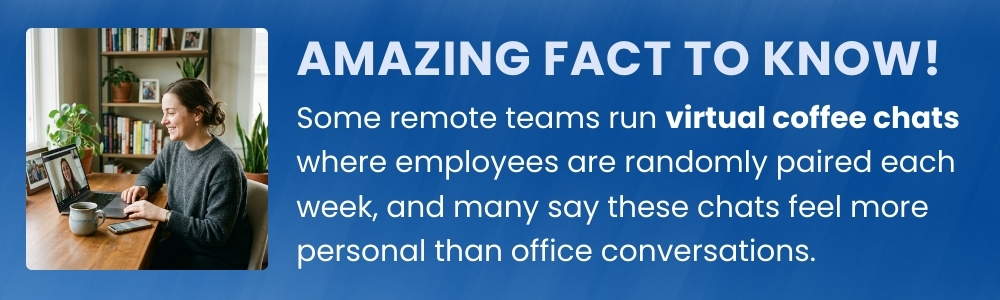
How Poor Remote Work Culture Impacts Employee Connection in Virtual Teams
In most remote setups, communication does not disappear. It becomes sharper, faster, and more focused.
But it also becomes narrower.
- “Please check this.”
- “Update me on this.”
- “Deadline is tomorrow.”
Every message serves a purpose. Every interaction is tied to output.
At first, this feels like progress. Less distraction. More clarity. Faster execution.
But slowly, something begins to change.
Conversations lose their warmth. Messages become shorter. Responses become functional. The space for personality, humor, or casual exchange starts shrinking.
Employees begin to think twice before speaking unless it is necessary. They avoid starting conversations that are not work-related. They hesitate to share thoughts that are not directly tied to a task.
And without realizing it, they start working in silos.
Even in active virtual teams, individuals can feel like they are operating alone. Present in meetings, but not part of the environment.
This is how a remote work culture starts to weaken, not through lack of communication, but through lack of meaningful interaction.
The Hidden Impact of Weak Employee Connection in Virtual Teams
Loneliness in a remote setup is not loud. It does not interrupt workflows. It does not trigger alerts.
It settles in quietly.
You start noticing small changes.
- Fewer people unmute themselves in meetings.
- Energy levels feel lower, even when everyone is present.
- Discussions end quickly, without natural continuation.
- Collaboration happens only when assigned, not organically.
- People log in, complete their work, and disappear.
There is no obvious breakdown. Everything still functions.
But the sense of team slowly fades.
And then comes the deeper impact.
- Employees stop sharing ideas unless asked.
- They feel less comfortable reaching out for help.
- They disconnect emotionally from the team, even if they remain professionally committed.
This affects creativity because people stop contributing beyond expectations. It affects collaboration because interactions become limited to necessity. It affects retention because people do not leave environments they are engaged in; they leave the ones they feel disconnected from.
For organizations managing virtual teams, this is not something to ignore. It directly shapes the long-term health of the workplace.
The Virtual Watercooler Concept: Transforming Remote Work Culture
Now imagine a different kind of digital workspace.
Not one where every conversation has a clear outcome. Not one where every interaction needs justification.
But one where people can simply exist as part of a team.
- A place where someone shares a small personal win.
- Where another person drops a random thought that sparks a conversation.
- Where someone casually says, “Today was a bit hectic,” and others respond, not as colleagues, but as people.
That is the virtual watercooler.
It is not just another feature added to a platform. It is a shift in how communication is allowed to happen.
It creates a space where conversations do not need permission, where interaction is not limited to tasks, and where employees can show up as themselves, not just as their roles.
In a strong remote work culture, this space becomes more than just a channel or a feed.
It becomes the place where the team feels like a team.
Why Employee Connection Must Be Intentionally Built in Virtual Teams
In a physical office, connection is a byproduct of proximity.
People sit together. They overhear conversations. They naturally interact without effort.
In remote teams, that layer disappears completely.
And in its place, silence becomes the default.
If no one initiates a conversation, nothing happens. If no space is created for interaction, it simply does not exist.
This is why connection in virtual teams cannot be left to chance.
It needs to be thoughtfully built into the way people work.
Designing employee connection means creating an environment where interaction feels easy, not forced.
It means:
- Creating spaces where conversations can happen without a defined purpose
- Encouraging moments of interaction that are not tied to deadlines
- Making participation feel optional, but inviting
- Allowing employees to engage in ways that suit their personality
When done right, these efforts do not feel like initiatives or programs.
They feel natural.
And when connection feels natural, it becomes sustainable.
Practical Ways to Improve Employee Connection in Remote Work Culture
A real virtual watercooler does not rely on scheduled activities or constant planning.
It blends into the everyday experience of work.
You begin to see it in small, consistent ways.
Conversations That Are Not About Work
A “Good morning” message that turns into a thread. A casual question about weekend plans. A random post that suddenly gets multiple responses. These moments create familiarity, which slowly builds comfort.
Recognition That Feels Personal
Not just structured awards, but simple acknowledgments. A quick “Thanks for helping with this.” A public appreciation from a teammate. These small gestures carry more emotional value than formal recognition alone.
Spaces That Reflect People, Not Just Roles
When employees share interests, opinions, or experiences, they become more than just job titles. This makes collaboration easier because people connect on a human level.
Leaders Who Show Up as Humans
When leaders participate in conversations without formality, it changes how the entire team interacts. It makes the environment feel open, approachable, and safe for expression.
This is where connection becomes real.
Not because it is planned, but because it is allowed.
Employee connection is not limited to a single moment; it evolves throughout the entire journey. To understand how every stage shapes employee experience, explore how modern HR management software streamlines the entire employee lifecycle.
Why HR HUB Intranet Is Essential for a Strong Remote Work Culture
Even with the right intent, many organizations struggle to sustain this kind of interaction.
The reason is simple.
Everything is scattered.
One platform for chats. Another for recognition. Another for announcements. Yet another for updates.
Employees are expected to engage across multiple spaces, and over time, it becomes overwhelming.
So they choose the simplest path.
They stick to what is necessary and ignore the rest.
This is where the connection starts fading again.
A centralized platform changes this completely.
With a system like HR HUB Intranet, interaction is not spread across tools. It exists in one connected space.
Conversations, updates, recognition, and engagement all happen in the same environment.
Employees do not have to look for where to engage. It is already part of their daily workflow.
This reduces friction. It increases participation. It makes interaction feel effortless.
And when something becomes effortless, people actually do it.
How Employee Connection Strengthens Engagement in Virtual Teams
The purpose of a virtual watercooler is not to recreate the office exactly as it was.
It is to recreate the feeling that people had within it.
The feeling of being part of something.
When employees feel connected:
- They contribute more freely
- They collaborate more naturally
- They support each other without being asked
- They stay engaged because they feel included
This is what shifts a group of individuals into a team that actually works together.
Restoring Employee Connection in Modern Remote Work Culture
Remote work gave organizations many advantages.
Flexibility. Speed. Access to talent across locations.
But in the process, it quietly removed something that was always there, holding everything together.
Human connection.
The answer is not to go backward.
It is to move forward with awareness.
- To recognize that connection does not happen automatically in a remote setup.
- To create spaces where interaction feels comfortable, not forced.
- To design a work environment where people feel present, even when they are not physically together.
Because at the end of the day, work is not just about what gets done.
It is about how people feel while doing it.
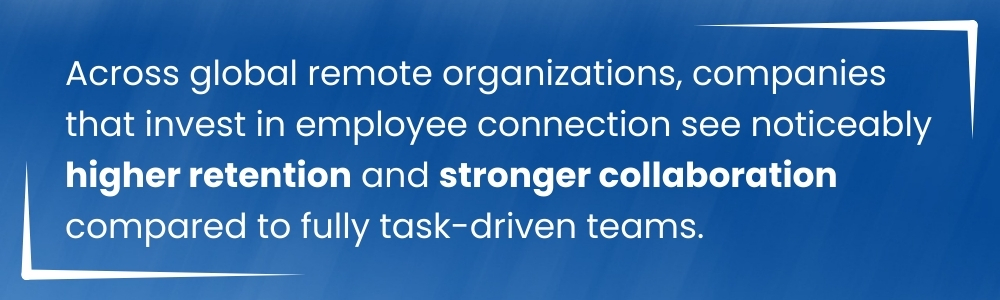
Building a Connected Remote Work Culture with HR HUB Intranet
The future of remote work will not be defined by tools alone.
It will be defined by how connected people feel while using them.
This is where platforms like HR HUB step in, not just as systems, but as enablers of real workplace interaction. With features like intranet feeds, employee engagement tools, and centralized communication, HR HUB helps organizations rebuild what remote work often weakens.
Not by forcing interaction, but by creating the right environment for it.
Because at the end of the day, people do not stay connected out of obligation.
They stay connected because they want to.
And sometimes, all it takes is bringing back a simple thing we never thought we would miss.
A place to just… talk.