Artificial intelligence is no longer limited to tools that simply respond to commands. A new category of systems is emerging: AI agents that can plan tasks, execute workflows, and interact with business systems autonomously. These systems are often called Agentic AI because they operate with a level of autonomy.
In many organizations, these agents already assist with tasks such as writing code, handling customer support queries, monitoring infrastructure, analyzing data, and coordinating internal processes. The shift from “AI as a tool” to “AI as a worker” creates a major governance question.
If software can act like an employee, should it follow rules similar to employees?
Forward-thinking companies are beginning to answer that question with something new: an Autonomous Worker Handbook.
This handbook defines how AI agents operate inside the organization, what they are allowed to do, how their decisions are monitored, and who remains accountable when automation makes mistakes.
Let’s explore how organizations can draft their first policies for AI workers.
Why Businesses Need Policies for Agentic AI
In the early stages of AI adoption, companies focused on productivity benefits. AI helped teams summarize documents, generate code snippets, or automate repetitive tasks.
Agentic AI goes a step further. Instead of assisting humans step by step, these systems can plan multi-step workflows and execute them across different systems.
For example, an AI agent could:
- Monitor customer support queues
- Generate a response draft
- Update the CRM system
- Trigger follow-up actions
All without human input.
While this automation unlocks enormous productivity gains, it also introduces risks. If an autonomous system accesses sensitive data, makes an incorrect decision, or performs an unintended action, the impact can be serious.
This is why organizations are beginning to formalize AI governance frameworks, often inspired by global standards such as GDPR and emerging guidelines like the EU AI Act.
A clear internal policy ensures that companies benefit from AI autonomy while maintaining control.
What Is an “Autonomous Worker” in the Workplace?
Before writing policies, organizations must clearly define what qualifies as an autonomous AI worker.
In most businesses, AI systems fall into three operational categories.
Assistive AI
These tools provide suggestions but do not take action independently. Humans remain responsible for every step.
Examples include writing assistants or document summarization tools.
Semi-Autonomous AI
These systems can execute tasks but require human approval for critical decisions.
Examples include AI agents that prepare payroll reports or analyze business data.
Fully Autonomous Agents
These systems can perform workflows with minimal supervision, interacting with multiple systems and triggering actions automatically.
An Autonomous Worker Handbook usually focuses on the second and third categories.
Step 1: Define Access and System Permissions
AI agents should never operate with unlimited system access. Just like human employees receive role-based permissions, autonomous systems must operate within clearly defined boundaries.
Imagine a company deploying an AI agent that prepares weekly sales performance reports. The agent is allowed to access dashboards inside tools like Salesforce or HubSpot to analyze pipeline data and generate summaries.
However, the same AI agent should not be able to edit customer records, modify deals, or access payroll data.
Real Example: Microsoft Copilot Access Controls
When Microsoft 365 Copilot was introduced, one of the biggest concerns was data access.
Copilot works inside tools like Word, Excel, and Teams, but it cannot access documents that a user does not already have permission to see.
For example, if an employee asks Copilot to summarize financial reports stored in SharePoint but lacks permission to access those files, Copilot will not retrieve them.
This rule follows a strict principle:
AI inherits the same access permissions as the user.
Microsoft implemented this to prevent AI systems from accidentally exposing confidential company data.
Step 2: Assign Human Ownership and Accountability
Even when AI systems operate independently, a human must always remain accountable for the outcomes.
A useful way to understand this is to treat AI agents like digital employees. Every employee has a manager, and every AI system should have one as well.
Real Example: JPMorgan’s AI Governance Teams
JPMorgan Chase uses hundreds of AI models across fraud detection, trading analysis, and internal operations.
To manage these systems, the bank requires every AI model to have a designated business owner and model supervisor.
Each AI system must be registered in the company’s Model Risk Management framework, where teams monitor:
- Model performance
- Bias risk
- Regulatory compliance
- Operational impact
Even if an AI model generates insights automatically, a human team remains accountable for its use.
This structure is widely considered a best practice in financial institutions.
Step 3: Define Approved Use Cases for AI Agents
One of the most common mistakes organizations make is allowing AI systems to expand into tasks they were never intended for.
A well-written AI policy clearly defines where automation is appropriate and where human judgment remains essential.
Real Example: Shopify AI Customer Support Automation
Shopify introduced AI tools to help merchants manage support requests.
AI agents can:
- Categorize support tickets
- Suggest responses
- Route customers to the correct department
However, Shopify does not allow automated systems to make financial decisions, such as issuing refunds or modifying merchant payouts.
Those actions require human review.
This separation ensures that AI improves support efficiency without creating financial or legal risks.
Step 4: Create Transparent Logging and Audit Trails
When an AI agent performs actions across company systems, every step must be recorded.
Think of it as maintaining a digital paper trail.
Real Example: Google AI Logging for Responsible AI
Google maintains detailed logging for AI systems used in its cloud products.
For example, when businesses use AI through Google Cloud AI, the system logs:
- API requests
- Input prompts
- Model outputs
- Processing timestamps
This logging helps organizations investigate incidents and audit how AI systems are being used.
It is also critical for companies that must meet compliance standards in regulated industries.
Step 5: Establish Escalation Rules for Uncertain Situations
Autonomous systems should not attempt to solve every problem independently. Sometimes the safest decision is to stop and ask for help.
Real Example: Autonomous Vehicles Safety Escalation
Companies developing autonomous vehicles, such as Waymo, use strict escalation protocols.
If the system encounters a situation it cannot confidently interpret, such as unusual road behavior or construction patterns, the system may:
- Slow down
- Pull over safely
- Request remote human assistance
The vehicle does not attempt to guess in uncertain scenarios.
This concept is directly applicable to AI agents in business workflows. When confidence drops, the system escalates to humans.
Step 6: Protect Sensitive Data and Privacy
AI agents often interact with large datasets that may include confidential company information or personal customer details.
Strong data protection rules are therefore essential.
Real Example: Apple’s Privacy Approach to AI
Apple has built its AI systems around strict privacy protections.
Many AI features on Apple devices process data directly on the user’s device instead of sending it to cloud servers.
For example, Siri voice processing often uses on-device machine learning to keep sensitive data local.
This approach reduces the risk of exposing personal data while still enabling AI functionality.
As organizations adopt intelligent systems and autonomous workflows, maintaining structured compliance frameworks becomes essential. For a deeper understanding of how AI-driven compliance tools help businesses manage governance and risk effectively, explore this guide on HR compliance software and automation.
Step 7: Monitor Performance and System Behavior
AI agents do not behave exactly like traditional software. Their outputs can change over time as they interact with new information.
Because of this, continuous monitoring is essential.
Real Example: Netflix Recommendation System Monitoring
Netflix relies heavily on AI recommendation systems to suggest movies and shows.
However, Netflix continuously monitors these algorithms to ensure recommendations remain relevant.
The company tracks metrics such as:
- User engagement
- Viewing duration
- Recommendation accuracy
- Content diversity
If the algorithm begins over-recommending a limited set of titles, engineers retrain the model with updated data.
Continuous monitoring helps maintain performance quality.
Step 8: Establish Ethical and Communication Guidelines
AI agents interacting with customers must follow clear ethical rules.
Real Example: Chatbot Transparency Rules
Many companies deploying customer service AI follow transparency policies.
For example, when interacting with customers through chatbots powered by systems like ChatGPT, businesses often display a message such as:
“You are chatting with an AI assistant.”
Several countries are beginning to encourage or require this disclosure to ensure customers know they are communicating with automation rather than a human agent.
Transparency helps maintain trust.
Step 9: Define Emergency Shutdown and Incident Response
Even carefully designed AI systems can behave unexpectedly. When this happens, companies must be able to disable the system immediately.
Real Example: Knight Capital Trading Algorithm Failure
One of the most famous examples of automation failure occurred at Knight Capital in 2012.
A software deployment error triggered an automated trading algorithm that began executing thousands of unintended trades within minutes.
The malfunction caused a loss of approximately $440 million in under an hour.
The incident demonstrated the danger of uncontrolled automation.
Today, financial firms implement strict kill-switch mechanisms that allow systems to immediately shut down automated trading when abnormal behavior appears.
The Road Ahead for Responsible AI in the Workplace
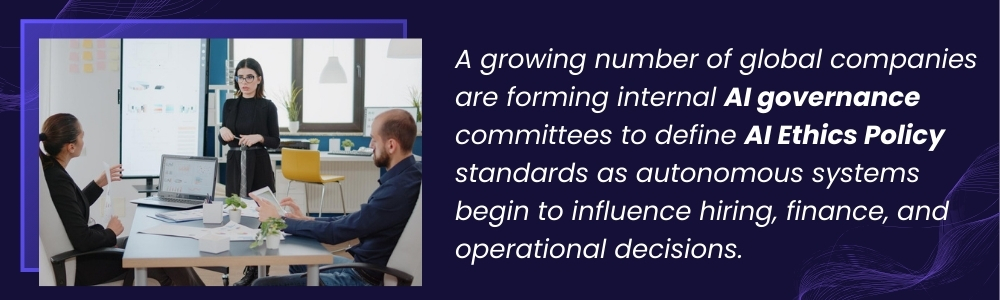
Agentic AI is changing how organizations operate. Software is no longer limited to assisting employees; it can now complete tasks, coordinate workflows, and make operational decisions at machine speed. This shift makes governance essential. Clear policies, defined permissions, human accountability, and continuous monitoring ensure that AI workers remain helpful rather than risky.
Creating an Autonomous Worker Handbook is therefore not just about compliance. It is about building a structured environment where automation works safely alongside human teams.
This is where platforms like HR HUB become valuable. As organizations manage growing workforces, workflows, approvals, and compliance requirements, HR HUB helps centralize employee operations, governance processes, and organizational policies in one system. When businesses introduce AI-driven workflows or digital agents, having a structured HR and operations platform ensures that oversight, accountability, and compliance remain intact.
The future workplace will likely include both human employees and intelligent digital assistants. Organizations that define clear rules today will be the ones that benefit most from the opportunities AI brings tomorrow.