Artificial Intelligence isn't coming to Human Resource Management. It's already here.
Resume screening happens in seconds. Chatbots answer employee questions around the clock. Reports that once took hours are generated in minutes. Routine approvals move automatically through workflows without HR chasing managers for responses.
It's easy to see why organizations are excited. But here's the question many HR leaders are asking today:
Just because AI can automate something, does it mean it should?
That's where many businesses get it wrong.
Some fear AI will replace HR professionals altogether. Others believe every HR process should be automated as quickly as possible. The truth lies somewhere in between. The most successful organizations aren't replacing people with AI they're removing repetitive work, so HR teams can spend more time on people. Think about your own HR department.
- How much time is spent updating employee records?
- Following up on approvals?
- Answering the same policy questions?
- Preparing reports?
- Reviewing hundreds of resumes?
These activities are important, but they aren't necessarily where HR creates the most value.
Modern AI in HR software helps automate repetitive administrative work while leaving decisions that require empathy, judgment, and human understanding exactly where they belong with people.
The goal isn't to make HR less human. It's to give HR professionals more time to be human.
What Does AI in HR Software Actually Mean?
The phrase AI in HR software often creates unrealistic expectations.
Some imagine AI interviewing candidates, replacing managers, or making hiring decisions without human involvement. That isn't what a responsible AI should do.
Instead, AI HR software uses artificial intelligence to analyze information, recognize patterns, automate repetitive activities, and assist HR professionals in making faster, better-informed decisions.
Think of AI as a highly capable assistant. It can organize information.
- Identify trends.
- Draft responses.
- Recommend actions.
- Highlight unusual patterns.
- Summaries reports.
But it shouldn't become the final decision-maker.
For example, AI might recommend candidates whose skills closely match a job description, but HR still decides who progresses to interviews.
AI may identify employees with increasing absenteeism, but managers still need to understand the reasons behind those patterns before taking action.
Technology supports people. It doesn't replace them.
Why Businesses Are Investing in AI HR Software?
The growing interest in AI HR software isn't simply about following technology trends. Businesses are looking for practical ways to improve productivity without increasing administrative workload.
HR departments today manage far more than recruitment.
They handle onboarding, attendance, payroll, employee records, compliance, reporting, policy communication, learning, engagement, and workforce planning.
As organizations grow, so does the volume of repetitive work. This is where artificial intelligence in HR management software helps save time, reduce administrative effort, and improve productivity.
Instead of manually processing routine activities, HR teams can automate repetitive processes while focusing on strategic responsibilities such as talent development, employee wellbeing, succession planning, and organizational culture.
What AI Should Automate in HR Software?
Not every HR activity requires human involvement. Many repetitive tasks follow predictable patterns, making them ideal for automation.
Here are some of the areas where AI in human resource management delivers meaningful benefits.
1. Resume Screening and Candidate Matching
Recruitment teams often receive hundreds or even thousands of applications for a single vacancy. Reading every resume manually takes considerable time.
Modern AI tools for HR can analyze resumes, identify relevant skills, compare qualifications against job requirements, and rank candidates based on predefined criteria.
Instead of spending days reviewing applications, recruiters receive a shortlist of candidates who closely match the role. The important point is that AI recommends that recruiters decide.
2. Interview Scheduling
Finding a suitable interview time can involve multiple emails between recruiters, hiring managers, and candidates.
AI can automate this process by checking calendars, suggesting available time slots, sending invitations, and issuing reminders automatically.
A simple administrative task that once consumed hours can be completed in minutes.
3. Employee Questions and HR Chat Support
Many HR questions are repetitive.
- "How many leave days do I have?"
- "Where can I download my payslip?"
- "What is our work-from-home policy?"
- "When is payroll processed?"
Instead of waiting for HR to respond, employees can receive immediate answers through intelligent chat assistants. It allows HR teams to focus on more complex employee concerns while routine questions are handled automatically.
4. Employee Information Updates
Employee records constantly change such as addresses, emergency contacts, bank account details, dependent information, and more.
Rather than requiring HR to manually verify and update every request, AI-supported workflows can validate information, identify missing details, and route requests for approval automatically. It reduces administrative effort while improving data accuracy of employee infromation.
5. Reports and Analytics
One of the most valuable applications of artificial intelligence in HR is turning large amounts of workforce data into useful insights. Instead of manually creating reports every month, AI can quickly identify:
- Hiring trends
- Attendance patterns
- Leave utilization
- Employee turnover
- Recruitment bottlenecks
- Payroll anomalies
- Department-level workforce insights
Rather than searching through spreadsheets, HR leaders receive meaningful information that supports faster decision-making.
6. Workflow Automation
Many HR processes involve repeated approvals.
- Leave requests.
- Expense claims.
- Policy acknowledgements.
- Document verification.
- Employee onboarding.
- Exit clearance.
Instead of HR manually following up with every manager, HR automation software can route approvals automatically, send reminders, escalate overdue requests, and keep every stakeholder informed throughout the process. This significantly reduces delays while improving accountability.
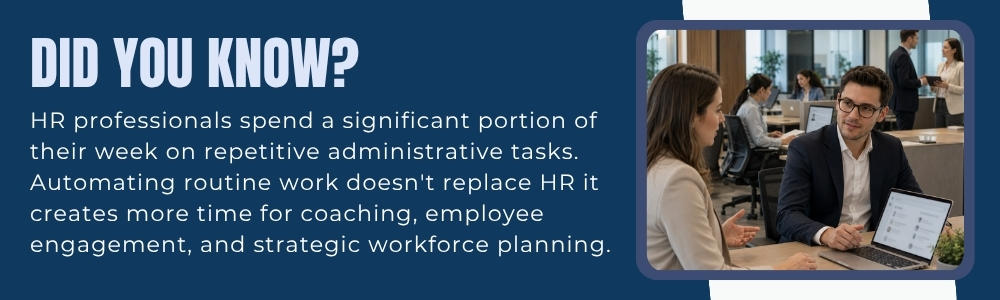
Automation Saves Time, Decisions Still Belongs to Humans
AI is exceptionally good at processing information. Humans are exceptionally good at understanding people. The strongest HR departments combine both.
They allow AI to handle repetitive administration while keeping empathy, fairness, ethics, and critical decision-making firmly in human hands.
The challenge isn't deciding whether to use AI. It's deciding where to use it.
What AI Should Not Automate
As exciting as AI is, not every HR responsibility should be handed over to technology.
Some decisions require context, empathy, experience, and emotional intelligence qualities that no algorithm can fully replicate.
Businesses that use AI in HR software responsibly understand the difference between automating a process and automating a decision.
Here are the areas where people should always remain at the center.
1. Hiring Decisions
AI can review thousands of resumes in minutes. It can identify candidates whose skills closely match a job description. They can even highlight applicants based on qualifications and experience.
But choosing who joins your organization should never become an automated decision. A candidate's attitude, communication style, cultural fit, leadership potential, and problem-solving ability cannot be measured by keywords alone.
The best hiring decisions happen when AI provides insights, and recruiters apply human judgment.
2. Performance Conversations
Employee performance is about far more than numbers. Someone may miss targets because they're struggling with personal challenges.
Another employee may consistently support teammates without receiving recognition in performance metrics. AI can summarize goals, productivity trends, attendance records, and completed objectives.
But meaningful feedback conversations should always remain personal. Employees don't want performance discussions with software. They want conversations with leaders who understand them.
3. Promotions and Career Growth
Career progression changes people's lives. It affects motivation, confidence, compensation, and future opportunities.
While AI in human resource management can identify employees with strong performance records or recommend potential successors, it shouldn't decide who deserves a promotion.
Managers understand qualities that data alone cannot measure initiative, leadership, resilience, collaboration, and growth potential.
These decisions deserve thoughtful human evaluation.
4. Employee Grievances
When employees raise concerns about harassment, discrimination, workplace conflict, or unfair treatment, they aren't simply looking for answers.
They're looking to be heard. No chatbot or automated workflow can replace empathy during sensitive conversations.
Technology can help document cases, organize information, and guide workflows, but HR professionals should always lead discussions involving employee wellbeing and workplace relationships.
5. Disciplinary Actions
Attendance patterns, repeated lateness, or policy violations can certainly be highlighted by AI.
However, disciplinary decisions require context.
Perhaps an employee experienced a medical emergency.
Maybe transportation issues affect punctuality. Perhaps there are performance concerns that aren't reflected in system data. AI should provide visibility, not verdicts.
Biggest Mistake Companies Make with AI Human Resource Management
Many organizations believe implementing AI means automating as much as possible.
That's rarely the right strategy. The most successful companies automate repetitive processes, not human responsibility. There's an important difference.
Good automation removes repetitive administration. Poor automation removes accountability.
Instead of asking: "Can AI do this?"
Businesses should ask: "Should AI do this?"
If the task involves repetitive processing, calculations, document handling, scheduling, reporting, or information retrieval, AI is often an excellent choice.
If the task affects people's careers, wellbeing, trust, or workplace relationships, human involvement should remain essential. This balanced approach is what makes AI HR software truly valuable.
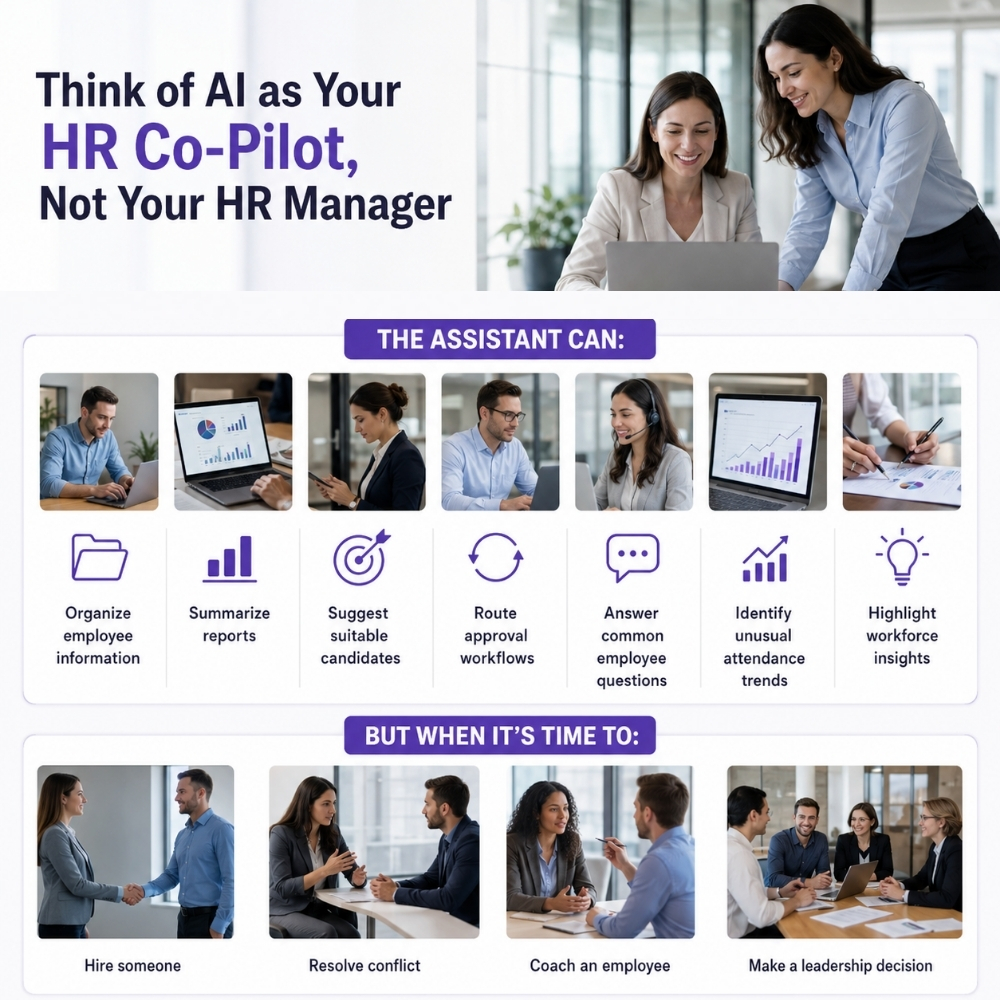
AI in HR Isn't About Replacing People
The conversation around AI has shifted dramatically over the past few years. Organizations are no longer asking whether AI belongs in HR. They're asking how to use it responsibly.
The future isn't about removing HR professionals from the process.
It's about removing repetitive administration that slows them down.
As AI continues to evolve, businesses that balance automation with human judgment will be better positioned to improve employee experiences, make faster decisions, and build stronger workplaces.
Bringing Responsible AI into Everyday HR
A practical approach to AI in HR software is to use it where it delivers the greatest value reducing manual effort while keeping people in control of important decisions.
For example, AI can assist recruiters by screening applications and highlighting suitable candidates, while recruiters make the final hiring decision. It can power workplace conversations through intelligent chat assistants, generate workforce insights from large volumes of data, organize employee information more efficiently, and automate approval workflows so routine requests don't sit waiting in inboxes.
HR HUB applies AI to support everyday work across Recruitment, Reports & Analytics, Employee Information, and Workflow & Escalation.
Routine tasks become faster, approvals move more efficiently, and HR teams gain better visibility into workforce data while critical decisions continue to be made by people.