Picture this.
It is Monday morning. HR has just opened the laptop with a fresh cup of coffee, a clean to-do list, and the innocent hope that today will be calm.
Then the message begins.
- “Can you send my payslip again?”
- “How many leaves do I have left?”
- “My attendance is showing absent, but I was there.”
- “Where do I upload my tax proof?”
- “Who approves my reimbursement?”
- “Can you resend the onboarding document?”
And somewhere between the seventh follow-up and the third “just checking,” the coffee turns cold.
This is the daily reality for many HR teams. They are expected to create a better employee experience, improve engagement, answer questions quickly, support managers, handle compliance, run payroll, manage documents, onboard new hires, and still smile during town halls.
The problem is not that HR teams do not care about employees. They do. The problem is that most employee experience efforts accidentally create more admin work. A new survey becomes another spreadsheet. A new onboarding checklist becomes another follow-up chain. A new engagement activity becomes another task that HR must chase manually.
The better way is not to ask HR to do more. The better way is to remove the friction that makes simple things feel difficult.
That is where employee experience software becomes useful. Not as another shiny system for HR to manage, but to make everyday employee interactions smoother, faster, and easier for everyone involved.
Why HR Employee Experience Goes Beyond Free Snacks and Birthday Emails
For years, employee experience was often linked with feel-good activities. Office lunches, birthday wishes, festival celebrations, team games, welcome kits, and maybe a motivational quote on the notice board.
Those things are nice. Nobody is complaining about cake.
But real employee experience goes much deeper.
It is about how employees feel when they interact with the company. Can they find the information they need? Can they apply for leave without confusion? Can they access payslips easily? Do they know where their request is stuck? Does onboarding feel organized? Are policies easy to understand? Does HR respond faster because the system supports them?
A good HR employee experience is built through everyday moments. Small moments, repeated often, create the real workplace feeling.
An employee may forget the exact wording of a company's value statement, but they will remember waiting three days for a simple attendance correction. A new hire may appreciate the welcome email, but they will remember whether their login, documents, and joining instructions were ready on time.
Employee experience is not only about grand gestures. It is about reducing everyday irritation.
And let us be honest. No employee has ever said, “I love this workplace because the reimbursement process is confusing in a mysterious way.”
Why Poor HR Employee Experience Turns HR Teams Into the Middle Person
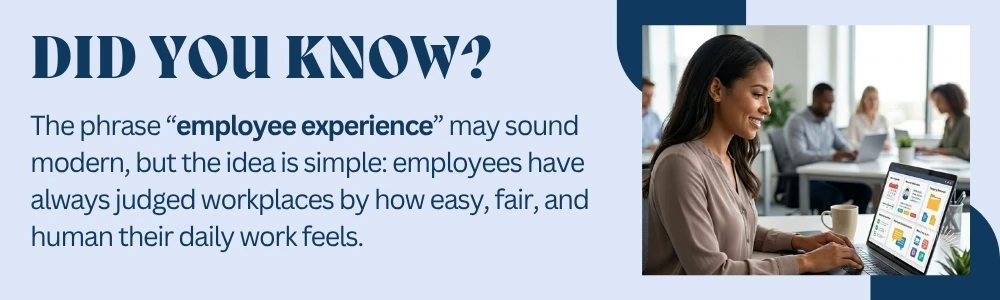
In many companies, HR has become a human search engine.
Employees ask HR for policies. Managers ask HR for reports. Finance asks HR for payroll data. New hires ask HR for onboarding steps. Leadership asks HR for engagement insights. Employees ask HR for the same form that was already emailed last month.
The result is that HR spends a large part of the day moving information from one person to another.
This is not because HR lacks skill. It happens because the process depends too much on people remembering, forwarding, reminding, checking, and updating manually.
When every request has to pass through HR, two things happen.
First, employees feel delayed because they cannot access simple information on their own.
Second, HR loses time that could have been spent on better conversations, workforce planning, employee support, culture building, performance discussions, and solving real people's problems.
That is why improving employee experience starts with one important question:
How can employees get what they need without HR manually pushing every step?
How Employee Experience Software Reduces Repeated HR Queries Through Self-Service
Give Employees Control Over Their Own Information
A strong self-service portal can remove a huge amount of routine admin work. Employees should not need to message HR for every basic detail. They should be able to log in and view their own information whenever needed.
This includes leave balance, attendance records, payslips, tax documents, company policies, holiday lists, reporting manager details, request status, and uploaded documents.
When this information is available in one place, employees feel more independent. They do not have to wait for HR. They do not have to search through old email threads. They do not have to ask three colleagues where a form is stored.
For HR, this means fewer repeated questions and fewer interruptions.
The Real Benefit Is Not Just Speed
Self-service improves more than response time. It improves trust.
When employees can see their information clearly, they feel more confident in the system. They know what has been submitted, what is pending, what is approved, and what still needs action.
This matters even more for companies with teams across India, Cayman Islands, the US, and Canada. Different locations may have different payroll cycles, tax documents, leave rules, benefits, and compliance requirements. A centralized digital HR experience gives employees access to relevant information without creating extra manual effort for HR.
How HRMS Employee Experience Workflows Reduce Follow-Ups and Approval Delays
Every Request Needs a Clear Path
Few phrases are more familiar in the workplace than “just following up.”
It appears in emails, chat messages, HR requests, manager reminders, and sometimes in dreams. A leave request is pending. An attendance correction is waiting. A reimbursement is stuck. A document approval has not been moved. Nobody knows who has to act next.
This is where automated workflows help.
Instead of HR manually pushing every request, the system routes it to the right person. The employee submits the request. The manager receives it. If approval is delayed, reminders can be sent. HR can see the status. The employee can track progress.
No guess. No endless follow-ups. No detective works.
Where Workflows Make the Biggest Difference
Automated workflows can improve several HR processes, including:
- Leave approvals
- Attendance corrections
- Shift change requests
- Document verification
- Policy acknowledgements
- Expense or reimbursement approvals
- Onboarding tasks
- Asset requests
- Role change requests
- Exit clearance steps
These are not small processes. They shape how employees experience the workplace every week.
When workflows are clear, employees feel informed. Managers know what to do. HR does not have to chase every small step manually.
This is one of the most practical ways to improve HRMS employee experience without adding more work to HR’s plate.
How Employee Experience Software Makes Onboarding Feel Simple and Welcoming
The First Few Days Say a Lot
A new employee joins with excitement, curiosity, and maybe a little nervousness. They want to know where to start, whom to contact, what to submit, what to read, and what happens next.
If the onboarding process is scattered, the excitement can fade quickly.
One email has the joining details. Another has a document checklist. A manager sends a separate message. IT is waiting for approval. HR is checking whether the employee uploaded the right file. The new hire is wondering whether asking too many questions on day one is already a bad sign.
That is not a great first impression.
Digital Onboarding Makes the Journey Smoother
Employee experience software can turn onboarding into a clear, guided journey. Once the onboarding process starts, the new hire can receive forms, joining instructions, document upload options, policy acknowledgements, welcome messages, and task updates through one system.
At the same time, HR can assign tasks to managers, IT, finance, admin, or other teams. Everyone knows what needs to be done. HR can track progress without sending reminders all day.
This makes onboarding feel more organized for the employee and much lighter for HR.
For remote and hybrid teams, this becomes even more important. When employees are not physically present in the office, the digital onboarding journey becomes their first real experience of how the company operates.
A smooth and organized employee onboarding for the employee and much lighter for HR, says, “We were ready for you.”
A messy one says, “Please wait while we find the form we created in 2021.”
Why Employee Engagement Tools Must Go Beyond Surveys to Improve Experience
Asking Employees Is Only Step One
Employee engagement tools are useful, but only when companies actually use feedback. Many organizations send surveys, collect responses, review a dashboard, and then quietly move on.
Employees notice that.
If employees share feedback but nothing changes, they stop believing in the process. The next survey becomes another checkbox activity.
The goal of engagement is not to ask more questions. The goal is to understand what employees are experiencing and respond in a meaningful way.
Turn Feedback into Action
Modern employee engagement tools can help HR collect feedback, identify patterns, and understand what is happening across teams, departments, locations, and employee groups.
For example:
- If new hires rate onboarding poorly, HR can review the joining process.
- If employees in one department regularly mention workload pressure, leadership can check team capacity.
- If employees often ask about career growth, managers can improve development conversations.
- If feedback shows confusion around policies, HR can simplify communication.
This helps HR move from scattered comments to clear patterns. Instead of manually reading every response and preparing reports from scratch, HR can use the system to find what needs attention.
The human part still matters. Technology can show the pattern, but HR brings judgment, empathy, and context.
How Employee Experience Software Improves HR Communication Across Teams
Employees Need One Reliable Place for Updates
Every company has one update that somehow travels through five different channels.
One person saw it in an email. Another heard about it from a manager. Someone found it in a group chat. Someone else missed it completely and is now asking HR what happened.
Scattered communication creates confusion. It also creates more work for HR because every missed message turns into another question.
A centralized communication system helps solve this problem. HR can share announcements, policy updates, payroll reminders, holiday notices, event details, compliance deadlines, and company news from one place.
Employees know where to look. HR does not have to repeat the same message repeatedly.
Relevant Communication Works Better
Not every employee needs every update. A payroll reminder for India may not apply to employees in Canada. A location-specific holiday may not apply to a team in the Cayman Islands. A department-specific announcement may not be useful for the entire company.
Good HR communication should be targeted and relevant.
When employee experience software allows role-based, location-based, or department-based updates, communication becomes cleaner. Employees receive what matters to them. HR avoids unnecessary noise.
And everyone is spared from the classic “Please ignore if not applicable” message that somehow makes every message feel less important.
How HRMS Employee Experience Tools Use People Analytics to Improve Decisions
HR Needs More Than Gut Feeling
Experienced HR teams often know when something is off. Maybe one team has rising absenteeism because of ongoing attendance management issues. Maybe one location has more resignations. Maybe new hires are leaving too soon. Maybe approval delays are affecting employee satisfaction.
But knowing something and proving it are different things.
People's analytics helps HR turn patterns into clear evidence. It connects data from attendance, leave, payroll, performance, onboarding, engagement, employee requests, and exit feedback.
This gives HR a clearer view of what employees are experiencing.
Data Can Reveal Friction Points
For example, if attendance correction requests are high, the attendance process may need to be reviewed. If leave approvals are delayed in one department, manager workload or approval habits may need attention. If exit feedback repeatedly mentions limited growth, career development may need more focus.
These insights help HR improve employee experience without guessing.
They also reduce admin work. Instead of preparing reports manually each time leadership asks for data, HR can use dashboards and system-generated reports.
People's analytics do not remove the human side of HR. It gives HR better information so human decisions can be made with more confidence.
Why Manager Support Is a Key Part of HR Employee Experience
Employees Feel the Process Through Their Managers
HR may design the process, but managers often deliver the experience.
A manager approves leave, gives feedback, and completes performance appraisals on time. The manager supports onboarding. A manager responds to workload concerns. A manager helps employees understand priorities.
If managers are overloaded or unclear, employees feel it is right.
That is why HR employee experience should also include manager experience.
Make It Easier for Managers to Act
Managers need simple dashboards, pending approval lists, team calendars, reminders, performance notes, attendance visibility, and request updates.
When managers have the right information, they can act faster. Employees receive timely responses. HR does not have to remind managers repeatedly.
This reduces delays and improves the overall employee journey.
In other words, when managers are not lost in admin work, employees are less likely to feel ignored.
When repetitive HR tasks start eating into people-focused work, the real issue is often deeper than the workload. You can also read HR HUB’s guide on the hidden cost of manual HR processes to understand how manual systems quietly affect time, accuracy, and employee trust.
How Employee Experience Software Makes HR Interactions More Personal
One Size Does Not Fit Every Employee
Employees do not all need the same information at the same time.
A new hire needs onboarding support. A manager needs team insights. A remote employee needs digital access. An employee nearing appraisal season needs performance updates. An employee in India may need tax declaration reminders. An employee in the Cayman Islands may need different compliance documents. Employees in the US or Canada may follow different payroll and benefit processes.
A personalized HR experience helps employees see what is relevant to them.
Personalization Should Not Mean More Manual Work
The challenge is that HR cannot manually create a separate journey for every person. That would be impossible, unless HR secretly has 12 extra hours hidden in the day.
This is where employee experience software helps. Employees can be grouped by location, department, role, employment type, or lifecycle stage. Based on this, the system can show relevant policies, reminders, forms, tasks, and announcements.
Employees get more useful experience. HR avoids repetitive manual communication.
Why Compliance Processes Matter in HR Employee Experience
Confusing Compliance Creates Stress
Compliance may sound like a back-office topic, but employees experience it directly.
They see it when they submit tax proofs, acknowledge policies, upload documents, check payroll deductions, apply for leave, track benefits, or submit work-related forms.
If the process is unclear, employees feel uncertain. HR then has to explain the same thing repeatedly.
That creates pressure on both sides.
Clear Digital Processes Make Compliance Easier
A digital HRMS can make compliance-related tasks easier to manage. Employees can access policies, submit documents, receive reminders, complete acknowledgements, and view request status from one place.
For companies operating in India, Cayman Islands, the US, and Canada, this becomes very useful because requirements may differ by region. A system that organizes location-specific rules and documents reduces confusion.
Compliance should not feel like a maze. Employees should know what is required, when it is due, and where to complete it.
HR should not have to become the full-time reminder department.
How AI and Employee Experience Software Support HR Without Replacing People
Use AI for Repetition, Not Relationships
AI is becoming more common in HR, especially for answering common questions, summarizing feedback, identifying patterns, and helping teams respond faster.
Used properly, AI can support employee experience. It can help employees find policies, answer routine questions, highlight engagement trends, and reduce manual review work.
But AI should not replace human judgment.
Sensitive matters like performance, payroll concerns, disciplinary issues, employee relations, and personal workplace concerns need empathy and context. A system can assist, but people still need people.
The Best Use of AI Is Quietly Practical
The best AI use in HR is not loud or dramatic. It simply removes repetitive work.
It helps HR avoid answering the same policy question fifty times. It helps summarize survey themes. It helps identify which requests need attention. It helps managers see pending tasks.
That means HR gets more time for conversations that actually need a human voice.
What Better HR Employee Experience Looks Like in Everyday Work
Let us imagine the same Monday morning again.
- An employee wants to check leave balance, so they open the self-service portal.
- A manager gets an automatic reminder for pending approvals.
- A new hire uploads documents through the onboarding flow.
- HR sees which onboarding tasks are pending without calling anyone.
- Employees receive a payroll update through the HR system.
- A pulse survey shows that one team is struggling with the workload.
- HR reviews the pattern and speaks with the department head.
No spreadsheet hunt. No repeated “just checking.” No ten-message thread for one simple update.
This is what better employee experience looks like when the process is supported properly.
It does not mean HR does more work. It means the system carries more of the routine work, so HR can focus on the work that actually needs HR.
How HR HUB Employee Experience Software Helps HR Teams Reduce Admin Work
HR HUB helps businesses create a smoother employee experience by bringing everyday HR processes into one connected platform. Instead of managing requests, documents, attendance, leave, payroll, onboarding, performance, workflows, and communication through separate tools, HR teams can manage them from one organized system.
Employees can use self-service features to view information, submit requests, access documents, check updates, and stay informed. Managers can review pending approvals, track team information, support employees better, and complete tasks on time. HR teams can reduce repetitive follow-ups, automate workflows, maintain cleaner records, and use reports to understand where attention is needed.
This makes HRMS employees experience more practically. Employees get faster access. HR gets better control. Managers get clearer visibility. Leadership gets better people's data.
For growing companies across India, Cayman Islands, the US, and Canada, HR HUB can help reduce admin pressure while making employee interactions simpler, faster, and more consistent.
The Smarter Way to Improve HR Employee Experience Without Extra Admin Work
Employee experience does not improve by adding more tasks to HR’s already full plate. It improves when daily work becomes easier for everyone.
Employees do not want to chase updates. Managers do not want to miss approvals. HR does not want to answer the same question repeatedly. Leadership does not want decisions based on guesswork.
The right employee experience software helps connect these needs. It gives employees self-service access, helps managers act faster, supports HR with automation, and gives leadership better visibility.
The workplace does not become better because every process becomes more complicated. It becomes better when simple things actually become simple.
And that is the real goal of modern HR: less confusion, fewer follow-ups, faster support, and more time for the conversations that matter.