Monday morning.
Payroll week.
An HR manager opens the attendance dashboard with full confidence. After all, the company invested in a modern system last year. Everything is automated now. Clean reports. Smart dashboards. Zero manual work… at least that was the promise.
Five minutes later, that confidence quietly disappears.
-
“Why is Rohan marked absent? He was in the office.”
-
“Why does Priya show half day when she worked full hours?”
-
“Who approved this leave? It’s not even in the system.”
Welcome to 2026. Where attendance management problems still refuse to leave, even after automation knocked on the door.
The Day Automation Met Reality: Why Attendance Management Problems Still Exist
Let’s rewind for a second.
The day automation was introduced, it felt like a breakthrough moment. HR teams finally saw a future where attendance headaches would disappear. No registers. No messy handwriting. No awkward “Sir, please adjust, I was here yesterday” conversations.
Everything was going to be clean, structured, and reliable.
And to be fair, it did deliver on some of that promise.
But then came the second phase. The part nobody really talked about.
Reality.
Because once the system went live, something interesting started happening. The obvious problems disappeared, but in their place came a new category of confusion. Not visible. Not simple. Much harder to explain.
Now, HR teams weren’t asking, “Who forgot to mark attendance?”
They were asking:
-
“Why is the system showing 8.47 hours instead of 9?”
-
“Why did the system count this as a half day when the employee stayed late?”
-
“Why does this report not match what we are seeing on the ground?”
The data was there. That wasn’t the issue.
The problem was interpretation.
Automation didn’t remove complexity. It made it more precise.
And precise problems are often harder to solve than obvious ones.
Earlier, if someone didn’t sign the register, you knew what went wrong.
Now, when everything is recorded but still doesn’t add up, you’re left staring at a screen trying to understand where logic and reality parted ways.
It’s like upgrading from a bicycle to a car and then realizing you now have to deal with engines, fuel, sensors, and software.
Yes, the journey is faster. But the system is far more complex.
Attendance Tracking Issues in 2026: It’s No Longer Just “Present or Absent”
There was a time when attendance could be explained in one sentence.
“You came to work or you didn’t.”
That simplicity is gone.
Today’s workplace looks very different.
-
One employee logs in from home at 10 AM.
-
Another clocks in at the office at 9 AM.
-
Someone attends meetings from three different locations in a single day.
-
Someone else finishes their entire workload without ever “logging time” in the traditional sense.
Now pause and think.
If all of them contributed meaningfully, how do you measure their attendance?
Is it about:
-
The number of hours they logged?
-
What time did they start their day?
-
The location they worked from?
-
Or the outcome they delivered?
This is where most HR attendance challenges begin, quietly.
The system is still trying to answer a question that has changed over time.
Earlier, it was measuring presence.
Now it is expected to measure behavior, discipline, flexibility, and sometimes even performance.
And that’s a lot to ask from a system that was originally built to track entry and exit.
So what happens?
The system keeps doing what it was designed to do. The workplace keeps evolving.
And somewhere in between, confusion begins to grow.
Why Employee Attendance Software in India Still Depends on Human Behavior
Here’s something that rarely gets said out loud.
No matter how advanced your system is, it still depends on human consistency.
And humans are not consistent.
Not because they don’t care, but because work doesn’t always follow a predictable pattern.
-
Someone rushes into a meeting and forgets to check in.
-
Someone logs in from their phone instead of their laptop, and the location changes.
-
Someone assumes the system will “auto adjust” because it did last time.
-
Someone ignores reminders because they are buried under ten other notifications.
Individually, these feel like small things.
But when you multiply them across an entire organization, they start forming patterns.
Patterns that lead to:
And suddenly, the system that was supposed to reduce effort is generating follow-ups.
There’s a bit of irony here.
The more automated the system becomes, the more disciplined the inputs need to be.
Automation is not about removing human involvement. It’s about requiring more structured human behavior.
And that’s where reality kicks in.
Workplaces are dynamic. People adapt. Situations change.
But systems? They follow rules.
HR Attendance Challenges Start Here: How Complex Policies Create Problems
Let’s take that simple 9-hour rule again.
At first glance, it feels straightforward. Almost too easy.
But then real-life scenarios start layering on top of it.
-
An employee arrives 20 minutes late but works an extra 30 minutes.
-
Another leaves early for a personal reason but logs in later from home.
-
A team follows a different shift schedule due to clients' time zones.
-
A manager approves flexibility for one employee but not another.
Now try to fit all of this into a system rule.
What you end up building is not a rule. It’s a web of conditions.
-
If late but compensated, then adjust
-
If remote login, then validate differently
-
If shift-based, then override standard timing
-
If the grace period is exceeded, then mark partial
At this point, the policy starts behaving less like a guideline and more like a script.
And the system follows that script exactly.
That’s the catch.
The system doesn’t understand intent. It understands conditions.
So when HR says, “But the employee actually worked,” the system responds with, “That’s not what the rule says.”
This is why many attendance management problems are not system failures.
They are reflections of how complex the underlying logic has become.
When Machines Disagree With Reality: Hidden Attendance Tracking Issues Explained
There’s always that one moment.
Monday morning. Everyone is rushing in. The biometric device decides today is not the day to cooperate.
“Fingerprint not detected.”
You try again. Same result.
A line forms behind you. Someone jokes, “System ko bhi Monday lag raha hai.”
In that moment, technology feels less like a solution and more like an obstacle.
And it’s not just about fingerprints.
Devices go offline. Networks drop. Data sync gets delayed.
Later, when HR checks the logs, the system shows something very different from what actually happened.
Now comes the tricky part.
Do you trust the machine-generated data?
Or do you trust what employees are saying?
Neither option feels perfect.
If you unquestioningly trust the system, you risk being unfair.
If you override it manually, you open the door to inconsistency.
So HR ends up doing what it always does best.
Balancing logic with judgment.
And that’s where manual intervention quietly returns, even in an automated world.
The Silent Villain Behind Attendance Management Problems: Poor System Integration
Let’s continue that earlier story, but with a bit more detail.
-
An employee applies for leave on Friday.
-
The manager approves it instantly.
-
The leave system updates.
But the attendance system? It doesn’t get the message.
Monday comes. The system marks the employee absent.
Payroll runs. Salary is deducted.
By Tuesday afternoon, there’s a long email thread with screenshots, timestamps, and phrases like “As discussed earlier.”
This is not a rare case. It happens more often than most teams would like to admit.
Because behind every “automated system” is a network of multiple systems trying to stay in sync.
Attendance. Payroll. Leave. Shift planning.
If even one connection breaks or experiences a delay, the entire experience falls apart.
What makes this frustrating is that everything looks correct in isolation.
-
Leave is approved
-
Attendance is recorded
-
Payroll is processed
But the story doesn’t match when you look at it end-to-end.
That’s why integration is often the quiet source of some of the most persistent attendance tracking issues.
Remote Work and Attendance Tracking Issues: The Challenge No System Fully Solved
Remote work didn’t just add flexibility. It added ambiguity.
Earlier, presence was visible. Now it’s interpreted.
-
An employee might start their day at 11 AM, but continue working till late evening.
-
Another might take breaks throughout the day but still complete all deliverables.
-
Someone might attend meetings while traveling between locations.
Now imagine trying to fit all of this into a fixed attendance rule.
It starts feeling forced.
The system asks, “When did you start?”
The employee answers, “It depends.”
That mismatch is where confusion begins.
Most systems still operate on structured timelines.
But modern work operates on fluid schedules.
Until those two align better, attendance will continue to feel like something that doesn’t fully capture reality.
If you’re seeing mismatches between logs and salary calculations, it’s worth understanding how biometric data connects with payroll in real scenarios. This breakdown on biometric attendance and payroll automation explains where things usually go wrong.
Set and Forget? Why Attendance Management Problems Grow Without System Reviews
There’s a common belief that once a system is implemented, the job is done.
In reality, that’s just the beginning.
Policies change. Teams grow. Work patterns shift.
But if the system is not updated regularly, it slowly drifts away from how the organization actually functions.
At first, the gaps are small.
A few mismatches here. A few manual adjustments there.
But over time, these small issues stack up.
And one day, HR finds itself spending hours correcting something that was supposed to run automatically.
Automation is not a one-time decision.
It’s an ongoing process that needs attention, updates, and occasional rethinking.
The HR and Tech Gap: A Major Cause of Ongoing HR Attendance Challenges
Imagine explaining a real-world scenario to a system.
“Employee came late but stayed extra, so it should not count as half day.”
Simple, right?
Now translate that into system logic.
Conditions. Exceptions. Overrides. Dependencies.
What feels intuitive to HR often needs a detailed breakdown for the system.
And if that translation is not done properly, the output feels wrong.
This is where the gap between HR and tech becomes visible.
HR speaks in scenarios.
Tech speaks in rules.
Unless both sides collaborate closely, the system ends up reflecting neither perfectly.
And that’s when HR attendance challenges start looking like technical problems, even though they are actually communication gaps.
Why Attendance Management Problems Still Exist Despite Modern Automation
Because attendance today is not a single problem.
It’s a combination of moving parts.
Automation solved the obvious layer.
The deeper layers are still catching up.
How Smart Companies Solve HR Attendance Challenges and Tracking Issues
The conversation is slowly changing.
Instead of chasing the “perfect tool,” organizations are stepping back and asking better questions.
Not “Which software should we buy?”
But:
-
“Are our rules simple enough to be followed without confusion?”
-
“Does our system reflect how our teams actually work?”
-
“Are employees clear about what is expected from them?”
This shift is subtle, but powerful.
Because once clarity improves, systems start working better without needing constant intervention.
Attendance no longer feels like a control mechanism.
And starts feeling like a shared understanding.
Between the system, the organization, and the people who make it all work.
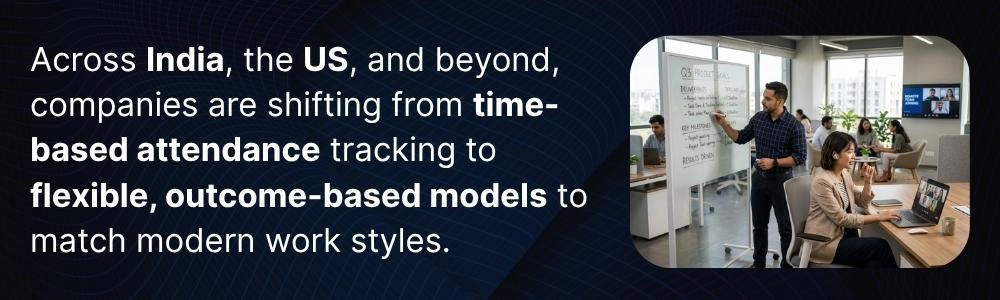
Making Attendance Actually Work: Solving Attendance Management Problems in 2026
Attendance will never go back to being simple. And that’s okay.
What matters is how well your system adapts to reality.
This is where platforms like HR HUB come into the picture. Not just as a tool that tracks time, but as a system that connects attendance with payroll, policies, and employee experience in a way that actually makes sense.
Because at the end of the day, the goal is not just to record attendance.
It’s to make sure what gets recorded is accurate, fair, and easy to trust.
And when that happens, Monday mornings start looking a lot less stressful for HR teams.