A recruiter posts a vacancy on Monday morning.
By Tuesday, there are 180 applications.
By Wednesday, there are 300.
Some candidates clearly do not have the required experience. Others have relevant skills hidden in several lines into their CV. A few appear suitable at first glance but are missing an essential qualification. And somewhere in that growing pile could be the candidate the hiring manager has been waiting for.
The traditional solution is simple: start opening CVs.
One after another. But when application volumes increase, that simple process can consume hours before the recruiter has even spoken to a candidate.
This is where AI resume screening software is becoming useful. Instead of asking recruiters to manually open every CV in the order it arrived, the software can help analyze candidate information against defined job requirements and organize the applications that deserve closer attention.
But there is an important distinction. AI can help answer:
“Which applications appear relevant to this role?”
It should not be given unquestioned authority to answer:
“Who deserves this job?”
Understanding that difference is important before introducing AI into recruitment.
What Is AI Resume Screening?
AI resume screening is the use of technology to read information from CVs and compare that information with criteria related to an open position.
Depending on the system, resume screening software may identify or organize information such as skills, work experience, qualifications, job titles, employment dates, certifications, and other job-related details.
More advanced systems may also look beyond exact keyword matches to identify relationships between a candidate's experience and the requirements of the position.
Imagine you are recruiting a payroll specialist.
Instead of manually opening 250 CVs to determine which candidates have knowledge about payroll processing, compliance, relevant software experience, or the required years of experience. AI recruitment software can help surface those details before the recruiter begins the deeper review.
That does not mean the system knows who the best employee will be. It means the recruiter starts with a more organized candidate pool.
Before Screening Candidates, Get the Job Description Right
The quality of AI candidate screening begins before a single CV is analyzed.
It begins with the job.
If HR has not clearly defined what the role requires, even sophisticated technology has a weak foundation to work from. Consider two job descriptions.
The first says:
“Looking for an experienced HR professional with excellent skills.”
The second identifies:
- 3+ years of payroll experience
- Experience processing monthly payroll
- Knowledge of statutory payroll requirements
- Experience using payroll or HR software
- Strong Excel skills
- Relevant HR, accounting, or payroll qualification preferred
The second description gives AI resume screening software far more meaningful criteria to work with. The second description gives AI resume screening software clearer, job-related criteria for comparing applications. This is why recruiters should first separate requirements into categories such as essential, preferred, and nice to have.
What Does AI Actually Look for Inside a CV?
There is sometimes a misconception that AI reads a CV exactly like an experienced recruiter.
It does not. Different platforms work differently, but automated resume screening generally extracts structured information from a CV and compares relevant evidence with the requirements configured for the position. Here are some of the most useful areas it can examine.
Skills
Skills are often one of the first signals. If a vacancy requires Python, payroll processing, project management, Adobe Creative Suite, inventory management, or another specific capability, the system can identify whether relevant skills appear within the candidate's CV.
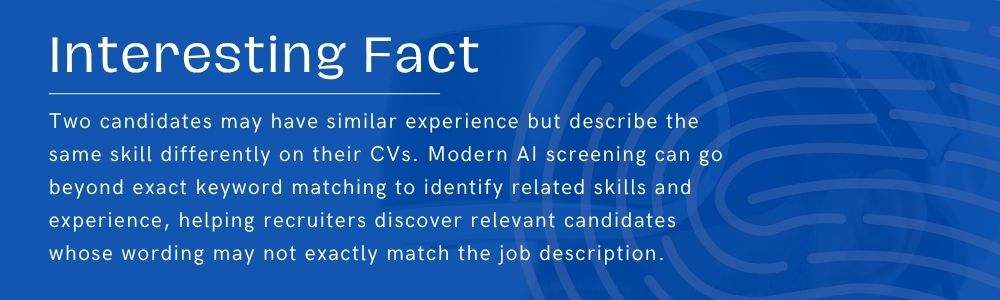
Some systems rely heavily on exact keywords, while more advanced tools may identify related terminology. This is one reason HR should be careful about treating a missing keyword as proof of a missing skill. A candidate may describe the same capability differently.
Good AI recruitment software should help recruiters find relevant evidence, not encourage them to reject every candidate who did not copy the wording of the job advertisement.
Work Experience
Job titles alone rarely tell the whole story. Two people with the title “Operations Executive” may have completely different responsibilities. That is why AI resume screening software can be more useful when it considers experience descriptions alongside job titles.
The system may help identify previous roles, duration of employment, responsibilities, industry experience, seniority, and how closely that experience relates to the vacancy.
For recruiters, this can reduce the time spent opening applications that are clearly far outside the role requirements.
Qualifications and Certifications
Some positions genuinely require particular qualifications. An accountant, nurse, engineer, technician, or specialist may need specific education, licenses, certifications, or professional credentials.
Resume screening software can help identify whether those qualifications are mentioned in the application.
An important word is mentioned. The presence of a qualification on a CV does not automatically verify that it is genuine, current, or applicable. Verification may still be required later in the recruitment process.
Employment Dates and Career History
Screening technology can also structure employment dates and career history, helping recruiters understand how a candidate's experience has developed.
But this information needs careful interpretation. A career gap is not automatically negative. Someone may have taken parental leave, studied, cared for a family member, travelled, recovered from illness, changed industries, or taken time away for another personal reason.
This is exactly AI candidate screening needs human judgment. The software can identify information. A recruiter needs to understand the candidate.
What Should AI Be Allowed to Screen?
This is where organizations need to set clear boundaries. There are job-related criteria that AI resume screening software can help organize efficiently.
For example:
Skills → Experience → Qualifications → Certifications → Role Requirements
These are relatively understandable screening inputs when they are genuinely relevant to the job.
The are characteristics that should not become shortcuts for judging someone's suitability.
The second description gives AI resume screening software clearer, job-related criteria for comparing applications.
Neither should assumptions based on age, gender, ethnicity, disability, religion, family circumstances, or other personal characteristics unrelated to their ability to perform the role.
Organizations using AI candidate screening should therefore understand what information the system considers, how recommendations are produced, and whether recruiters can review the reasoning behind them.
What Should Recruiters Avoid When Using AI Screening?
Speed can be useful, however, blind automation is not. One of the biggest mistakes is configuring automated resume screening and assuming the results must be correct because they came from technology.
Recruiters should avoid making an exact keyword match the only definition of suitability, automatically rejecting unusual career paths, relying on unexplained scores, treating missing CV information as proof that a candidate lacks a skill, or allowing software to make important hiring decisions without appropriate human review.
There is another practical problem.
Candidates are learning how screening systems work too.
They may deliberately add keywords from job advertisements to improve their chances of being surfaced. That means finding the words “project management” inside a CV is not the same as establishing that the person is an excellent project manager.
Resume screening software can identify signals.
Recruitment still needs evidence.
Bias Does Not Disappear Because AI Is Doing the First Screen
AI is sometimes presented as a way to remove human bias from recruitment.
Reality requires more care. Technology can make screening more consistent, but the criteria, historical information, configurations, and models behind a system can still produce problematic outcomes.
Suppose an organization historically hired people from a narrow set of universities and then trains or configures a system around patterns found among previous successful hires.
The system could potentially reproduce that preference even if attending those universities is not actually necessary to perform the job.
HR teams should periodically examine who is being surfaced, who is being filtered out, whether job criteria are genuinely necessary, and whether recruiters can challenge the system's recommendations.
Recruiter Should Still Open the CV
The goal of AI candidate screening should not be to create a recruitment process where HR never looks at applications.
It should help HR spend its limited review time more intelligently. Instead of manually reading 300 applications with equal attention, recruiters can use screening technology to organize relevant evidence, identify likely matches, and prioritize where deeper review should begin.
- The recruiter then brings something the software does not fully possess: context.
- They can recognize transferable skills.
- They can understand an unconventional career path.
- They can question an unexplained gap.
- They can notice an achievement that does not neatly match a keyword.
And eventually, they can talk to the person behind the CV. That human layer remains essential.
How Does AI Helps HR Teams Work Faster And Smarter?
Recruitment teams spend significant time on repetitive administrative work.
Opening files, scanning for minimum requirements, comparing qualifications, checking experience, organizing applications, and moving candidates through recruitment stages all take time.
AI resume screening software can shorten part of that first screening stage. Screening becomes even more useful when it is connected with the wider recruitment process. HR recruitment software can bring job requirements, incoming applications, candidate profiles, screening results, interview stages, and hiring progress into one workflow. Instead of moving shortlisted candidates between spreadsheets, emails, and separate tools, recruiters can continue working with the same candidate information as they move from application to review, interview, and selection.
This is where automated resume screening becomes valuable.
Not because AI makes recruitment automatic. Because it gives recruiters more time for the parts of recruitment that should not be automatic.
Hiring the Right Talent Starts With Smarter Screening
Hiring the right person is one of the most important decisions an organization makes, and resume screening software can help recruiters reach relevant candidates sooner.
Instead of spending hours manually searching every CV for the same skills, qualifications, and experience, the software can organize candidate information around clearly defined job requirements.
Recruiters can then focus their attention where it matters most understanding experience, identifying transferable skills, comparing suitable profiles, and deciding who should move forward.
A smarter screening process can follow a simple path:
Define Job Requirements → Screen Relevant Candidate Information → Identify Strong Matches → Recruiter Reviews Profiles → Move Suitable Candidates Forward
This combination of technology and recruiter expertise makes the first stage of hiring faster and more organized while keeping people at the center of the recruitment process.
The real value of resume screening software is not simply how quickly it can process applications. It is how effectively it helps HR find relevant talent and spend more time evaluating the candidates who could be right for the role.
Before You Ask AI Who Fits, Tell It What Fit Means
AI can read hundreds of CVs faster than a recruiter. That is impressive. But speed is only useful when the recruitment process knows what it is looking for.
The strongest use of AI resume screening software starts with clearly defined job requirements and ends with informed recruiter judgment. Between those two points, technology can help organize candidate profiles, surface relevant skills and experience, and reduce repetitive screening work.
HR HUB brings Recruitment, Candidate Profiles, Job Requirements, Resume Screening, and Recruitment Workflow into one connected hiring process.
Frequently Asked Questions
What is AI resume screening software?
AI resume screening software helps analyze information contained in CVs and compare it with job-related requirements such as skills, experience, and qualifications. It can help recruiters organize and prioritize applications before deeper human review.
Can AI automatically reject a candidate's CV?
Some recruitment systems can be configured with filters or rules that affect whether applications progress. However, organizations should be careful about allowing automated decisions to determine important hiring outcomes without appropriate human oversight, particularly when reasoning is unclear.
What does AI look for when screening a resume?
Depending on the system, AI recruitment software will examine skills, qualifications, job titles, experience, employment dates, certifications and other information relevant to the vacancy.
Is automated resume screening the same as an ATS?
Not necessarily. An applicant tracking system manages applications and recruitment workflows, while automated resume screening refers specifically to technology used to analyze or filter candidate information. Screening functionality may be built into an ATS or provided through another recruitment platform.
How can HR reduce bias in AI candidate screening?
HR can begin by using job-related criteria, reviewing how recommendations are produced, checking screening outcomes, questioning unnecessary requirements, and maintaining human oversight. AI candidate screening should support consistent evaluation rather than turn historical hiring patterns into automatic rules.
How does AI screening make recruitment faster?
Screening technology can extract and organize relevant candidate information before recruiters manually review every application. This allows recruiters to focus more attention on promising or relevant profiles instead of repeatedly searching every CV for the same basic requirements.