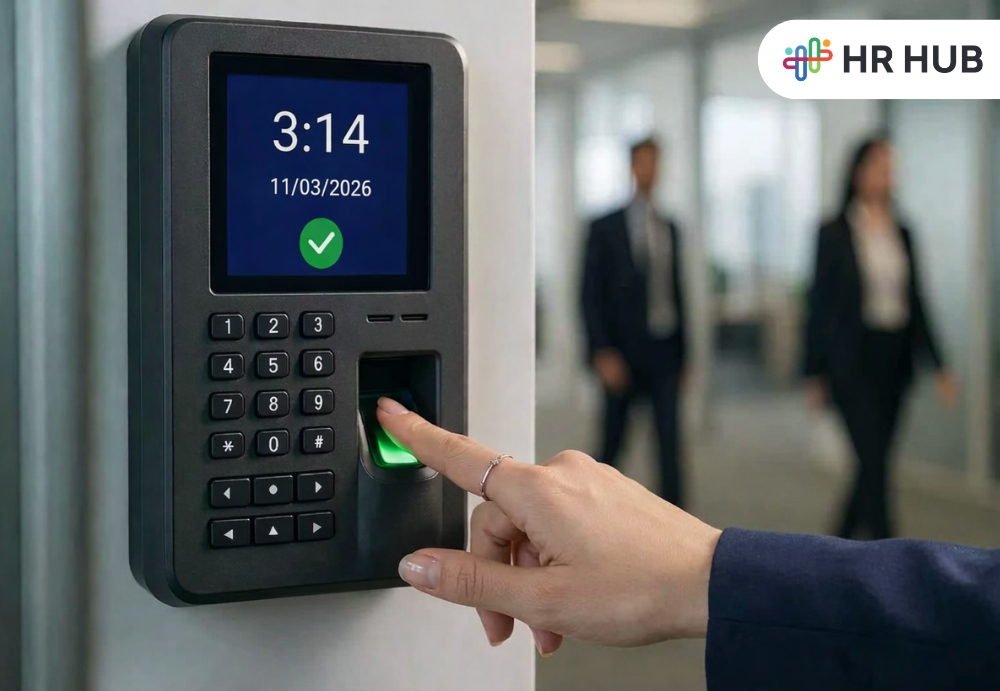
Nowadays, you'll see a tiny gadget outside the door of most offices. The workday officially starts when employees touch the scanner with their finger and hear a confirmation beep. Biometric attendance solutions have long been regarded as a dependable means of supporting payroll accuracy, preventing time fraud, and streamlining attendance tracking.
But a quiet shift has begun in India’s regulatory environment.
The arrival of the DPDP Act 2023 has changed how organizations must handle employee data. What was formerly thought of as a straightforward attendance tool is now intimately linked to legal duties, privacy rights, and compliance requirements. These days, fingerprint scanners are used for more than merely monitoring attendance. They currently occupy the nexus of employee trust, legislation, and technology.
For organizations that rely on biometric devices, one important question is beginning to surface across HR and compliance teams.
Could the same device that improved operational efficiency now create a compliance challenge under the Digital Personal Data Protection Act?
Understanding this shift is essential for businesses operating under the evolving Indian Labor Law 2026, especially those managing large workforces, multiple offices, or sensitive employee data.
Why the DPDP Act 2023 Is Bringing Workplace Data Protection into the Spotlight
Indian workplaces have experienced a swift digital transformation in the last ten years. Attendance gadgets replaced registers, payroll systems moved to the cloud, employee onboarding forms went online, and HR departments began collecting large amounts of personal data on digital platforms. What used to be a few paper files in a cabinet has evolved into a sophisticated network of cloud servers, databases, apps, and devices.
This digital transformation made HR operations faster and more organized, but it also created a new challenge. The amount of personal information companies collect has grown significantly.
This is where the DPDP Act 2023 comes into play.
The Digital Personal Data Protection Act was introduced to create precise guidelines for how businesses handle personal data. The law acknowledges that people need to have control over how their personal information is used because it has become a valuable digital asset.
This regulation gives workers more control over how their personal information is gathered, stored, and used.
It creates a new compliance environment for companies.
Under the Digital Personal Data Protection Act, any organization that determines the purpose and method of data processing is considered a Data Fiduciary. In simple terms, if a company collects employee data and decides how it will be used, that company becomes legally responsible for protecting it.
Because companies frequently deal with substantial volumes of worker data, employers immediately fall into this group. Employee identity documents, addresses, bank account information for salary transfers, tax data, medical declarations, performance records, attendance logs, and occasionally biometric identifiers are all included in this.
Once an organization becomes responsible for personal data, several Data Fiduciary Responsibilities automatically apply.
These responsibilities go beyond basic IT security. They require organizations to establish a transparent and accountable data management system. Employers must inform employees about what data is being collected, why it is required, and how it will be protected. They must also limit unnecessary data collection and ensure that only relevant information is processed.
Consent also becomes a central pillar under the DPDP Act 2023. Employees must be informed of the purpose of data collection and understand how their data will be used.
This forces organizations to reconsider how HR procedures function in many workplaces. To comply with the Digital Personal Data Protection Act, consent clauses, data policies, employee handbooks, and onboarding forms may need to be amended.
Accountability is another important component of the law. Organizations may be subject to regulatory action if personal data is handled improperly, disclosed, or processed without the necessary precautions.
While this law protects many types of employee data, biometric information receives particular attention.
A password can be changed. A bank card can be replaced. But a fingerprint is permanent.
Once biometric data is compromised, it cannot be reissued or reset like other forms of identification. This makes biometric information extremely sensitive.
Because of this, the Digital Personal Data Protection Act requires organizations using biometric technologies to implement stronger safeguards, stricter data-handling practices, and clear employee communication.
This is why workplace technologies that once seemed harmless are now being examined through a new compliance lens.
How Fingerprint Scanners Impact Biometric Attendance Compliance Under the Digital Personal Data Protection Act
Fingerprint scanners swiftly spread into workplaces, manufacturing facilities, retail establishments, and service companies. These gadgets resolved several operational issues for HR departments overseeing huge workforces.
Attendance monitoring relied on paper registers, punch cards, or supervisor verification before the widespread use of biometric technology. These techniques frequently led to time manipulation, human mistakes, and erroneous records.
Attendance management became more disciplined because of biometric technology. Employers received accurate payroll data, and workers could no longer clock in for one another.
For industries with strict working hour regulations, this data also supported compliance reporting and workforce analytics.
Yet beneath this operational convenience lies a deeper layer of responsibility.
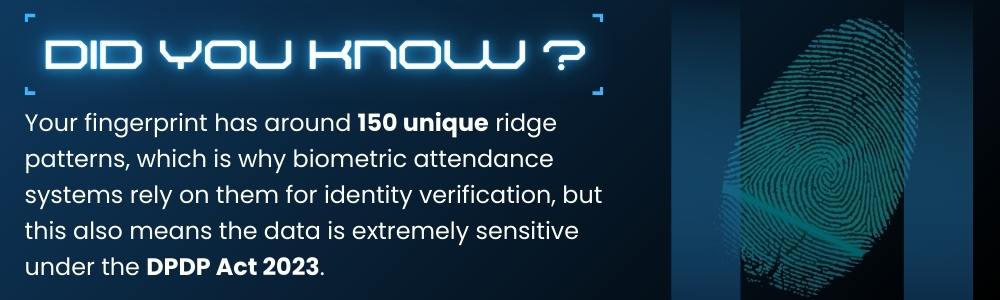
Biometric attendance devices capture a unique biological identifier from the employee. In the case of fingerprint scanners, the device records fingerprint patterns and converts them into a digital representation called a biometric template.
This template is then stored in a database. Every time the employee scans their finger, the system compares the new scan with the stored template to confirm identity.
From a technology standpoint, the system appears simple. From a legal perspective, it involves the collection and storage of highly sensitive personal data.
Under the DPDP Act 2023, this transforms biometric attendance into a data protection issue.
Every fingerprint scan now becomes part of a regulated data lifecycle. Organizations must consider where the data is stored, how it is encrypted, who has access to it, and how long it remains in the system.
For example, if biometric data is stored in plain format or without encryption, the organization exposes itself to potential security risks. If third-party vendors manage attendance devices without proper contractual safeguards, biometric information could be mishandled.
Similarly, if biometric records remain stored indefinitely even after an employee leaves the organization, the company may fail to meet Data Fiduciary Responsibilities under the Digital Personal Data Protection Act.
These risks are why HR and IT leaders are increasingly discussing Biometric Attendance Compliance.
What was once an operational tool now requires legal awareness, security planning, and structured data governance.
Employee Privacy Rights India: Why the DPDP Act 2023 Is Changing Workplace Data Practices
Another powerful shift introduced by the DPDP Act 2023 is the recognition of stronger Employee Privacy Rights in India.
In earlier years, employees rarely questioned workplace technologies. Attendance scanners, surveillance cameras, access cards, and monitoring tools were often accepted as part of company policy.
Today, the mindset is changing.
Employees are more aware of digital privacy issues and are increasingly curious about how their personal information is handled. News about data breaches, identity theft, and misuse of digital data has made workers more conscious of their privacy rights.
This awareness is reflected in the expectations employees now bring into the workplace.
Employees want transparency.
They want to know why their biometric data is required, how it will be used, and what safeguards are in place to protect it.
Common questions employees raise include:
- Why is my fingerprint data necessary for attendance?
- Where exactly is my biometric data stored?
- Who inside the organization can access it?
- Is the data shared with external vendors or service providers?
- How long will the company retain my biometric records?
- What happens to my data once I leave the company?
Under the Digital Personal Data Protection Act, employees have the legal right to receive answers to these questions.
Organizations must therefore shift from silent data collection to open communication.
The handling of personal data, including biometric information, must be made explicit in privacy notices, employee policies, and onboarding papers.
The workforce is more confident as a result of this openness.
Employees feel more at ease utilizing workplace technology when they are aware of how their data is protected.
Reputational risks may result from disregarding these expectations. Employees who feel their privacy is not respected may raise complaints, approach regulators, or lose trust in the organization.
That is why respecting Employee Privacy Rights in India is not just about compliance. It has become a critical component of responsible leadership and modern HR management.
Key Data Fiduciary Responsibilities Under the Digital Personal Data Protection Act for Employers
With the introduction of the DPDP Act 2023, employers must move beyond informal data practices and adopt structured frameworks for managing employee information.
These obligations fall under the category of Data Fiduciary Responsibilities, and they define how organizations must treat personal data throughout its lifecycle.
The first responsibility is purpose limitation.
Organizations should collect personal data only for a clearly defined and legitimate reason. If fingerprint data is collected for attendance verification, it should not be reused for unrelated activities such as employee monitoring or productivity analysis without additional justification and consent.
The second responsibility involves informed consent.
Employees must be clearly informed before their biometric data is collected. Consent should be documented and presented transparently. Employees should understand what information is being captured and how it will be used.
The third responsibility is data security.
Strong technical measures must be implemented to protect biometric data. Essential elements of biometric data protection include encryption, secure storage systems, limited database access, and system monitoring.
Data minimization is the fourth duty.
Companies should refrain from gathering more information than is required. Businesses should use safer technological methods if it is possible to verify attendance without storing raw biometric photos.
Another important responsibility involves retention control.
Biometric data should not remain stored indefinitely. When an employee leaves the organization or a biometric system is replaced, the data should be securely deleted in accordance with documented retention policies.
These measures collectively help organizations maintain Biometric Attendance Compliance while staying aligned with the expectations of the Digital Personal Data Protection Act.
When Biometric Attendance Systems Become a Compliance Risk Under the DPDP Act 2023
Many organizations implemented biometric attendance systems long before privacy regulations were introduced.
As a result, some systems currently operating in workplaces may not meet the standards expected under the DPDP Act 2023.
Compliance gaps often appear in unexpected places.
For instance, some biometric devices store fingerprint templates directly on the hardware without strong encryption. If the device is stolen or accessed by unauthorized personnel, sensitive employee data could be exposed.
In other cases, attendance devices connect to external cloud servers managed by third-party vendors. If the organization does not maintain proper vendor agreements or security protocols, biometric information may travel through systems that lack adequate protection.
Another common risk involves missing consent documentation.
If employees were enrolled in biometric systems years ago without proper consent records, organizations may struggle to demonstrate that biometric data was collected lawfully.
Even something as simple as unclear privacy policies can create regulatory exposure.
These scenarios highlight the importance of reviewing biometric systems through the broader lens of the Indian Labor Law 2026 and the Digital Personal Data Protection Act.
Organizations must treat biometric attendance not just as an HR tool but as a sensitive data management system.
Businesses that want to stay ahead of evolving regulations should also explore how modern compliance systems work in practice. This detailed guide on HR compliance software explains how organizations can track regulations, automate policy monitoring, and maintain audit-ready HR systems.
How to Build a Biometric Attendance Compliance Framework Under the Digital Personal Data Protection Act
The solution is not necessarily to abandon biometric attendance systems.
Instead, organizations must build a structured compliance framework around them.
A strong starting point is conducting a detailed data audit. HR and IT teams should identify where biometric data is stored, how it travels between systems, and who has permission to access it.
Next comes consent documentation.
During the enrollment process, employees should be given clear explanations of the collection of biometric data. The goal of data collection, the length of data storage, and the security measures should all be included in consent forms.
Additionally, security architecture needs to be reinforced.
Role-based access controls should be in place, biometric templates should be encrypted, and they should be kept in secure databases. Biometric records should be managed or accessed only by authorized personnel.
Developing explicit retention policies is another crucial step.
When biometric data is no longer needed, organizations should specify how long it will remain in the system and establish safe deletion procedures.
By putting these measures in place, businesses respect Indian employees' right to privacy while strengthening Biometric Attendance Compliance.
Attendance Technology and Data Protection in the Era of Indian Labor Law 2026
Workplace technology continues to evolve rapidly. Attendance tracking is no longer limited to physical devices mounted at office entrances.
Many organizations are exploring modern alternatives such as mobile attendance apps, GPS-based clock-in systems, or cloud-integrated HR platforms.
Regardless of the technology used, the underlying principle remains the same.
Employee data must be handled responsibly.
The DPDP Act 2023 ensures that businesses adopting digital workforce management tools do so with privacy protection in mind.
Organizations that proactively align their HR systems with Data Fiduciary Responsibilities not only reduce legal risks but also strengthen workplace trust.
In a world where employee data flows through multiple digital systems, respecting Employee Privacy Rights India is quickly becoming a core element of responsible leadership.
Navigating Biometric Attendance Compliance and Employee Privacy Rights in India with Modern HR Technology
As organizations adjust to the expectations introduced by the DPDP Act 2023, the role of modern HR technology becomes increasingly important.
Managing employee data securely, maintaining attendance records, documenting consent, and ensuring regulatory alignment can become complex when handled through disconnected tools.
This is where integrated HR platforms can make a meaningful difference.
Solutions like HR HUB help organizations manage employee records, track attendance, process payroll, and maintain compliance documentation in a centralized system. By organizing employee data with strong access controls and structured workflows, HR teams gain greater visibility and control over sensitive information.
For companies operating across India and other regions, platforms like HR HUB support the broader compliance journey by helping businesses align HR operations with the expectations of the Digital Personal Data Protection Act, strengthen Biometric Attendance Compliance, and maintain transparency around Employee Privacy Rights India.
As the Indian Labor Law 2026 continues to evolve, organizations that adopt privacy-conscious HR systems will find it easier to balance operational efficiency with responsible data governance.
The fingerprint scanner at your office entrance may remain part of the modern workplace. The difference today is that it must operate within a carefully managed framework of trust, security, and legal responsibility. Businesses that understand their Data Fiduciary Responsibilities and implement thoughtful HR technology will be better prepared for the future of employee data protection.