Every company wants to offer meaningful employee benefits. Health insurance, paid leave, retirement plans, loans, wellness programs, reimbursements, bonuses, and other perks help attract talented people and encourage them to stay longer.
However, managing these benefits is often more complicated than providing them with a good idea.
Many HR teams still rely on spreadsheets, emails, paper forms, and multiple systems to enroll employees, update records, answer questions, and coordinate with payroll providers. As organizations grow, these manual processes become slower, more error-prone, and increasingly difficult to manage.
Employees also expect more than they did a few years ago. They want quick answers, digital access to their benefit information, timely notifications, and the ability to make changes without waiting for HR.
This is why employee benefits administration software has become an essential part of modern HR operations.
Instead of spending hours on repetitive administrative work, HR teams can automate routine processes, centralize employee information, improve compliance, and deliver better employee experience through journey.
The result is not just happier employees it is also a more efficient HR department.
What Is Employee Benefits Administration Software?
Employee benefits administration software is a centralized digital platform that helps organizations manage every stage of employee benefits, from enrollment and eligibility to payroll deductions, document management, approvals, notifications, and employee communication.
Rather than relying on disconnected spreadsheets, paper forms, and email chains, everything related to employee benefits is managed from one secure system. Depending on the organization, the software may manage:
- Health insurance
- Life insurance
- Retirement plans
- Employee loans
- Wellness benefits
- Leave-related benefits
- Allowances
- Salary deductions
- Benefit eligibility
- Employee documents
- Benefit enrollment
- Policy acknowledgements
More importantly, it connects these activities with other HR processes instead of treating benefits as a separate function. Think of it as the bridge between HR, payroll, finance, employees, and benefit providers.
Instead of asking, "Which spreadsheet has the latest information?" HR teams always know where to find accurate employee benefit data.
Freeing HR Teams from Administrative Gridlock
One of the biggest misconceptions about HR is that most of the department's time is spent on developing people. HR professionals often spend hours completing administrative work. Such as:
- Updating benefit records.
- Responding to routine employee questions.
- Correcting payroll deductions.
- Following up for documents.
- Sending reminders.
- Verifying eligibility.
These repetitive activities create administrative gridlocks.
Instead of focusing on employee engagement, workforce planning, leadership development, or organizational culture, HR becomes occupied with paperwork. Employee benefits administration software changes that.
By automating routine processes, HR professionals gain more time to focus on strategic initiatives that create value for both employees and the organization.
This shift transforms HR from an administrative function into a strategic business partner.
Why Administrative Gridlock Costs More Than You Think
Administrative delays don't only affect HR. They affect the entire employee experience. An employee waiting several days to receive confirmation about their insurance enrollment.
- Or discovering an incorrect payroll deduction after salary has already been processed.
- Or repeatedly email HR to ask whether their reimbursement has been approved.
These situations create unnecessary frustration. Over time, employees begin associating company benefits with complicated processes instead of valuable support.
Ironically, organizations may invest thousands in employee benefits while losing much of their value because the administration feels slow and confusing. A modern employee benefits platform helps remove these friction points by creating a smoother experience for everyone involved.
Why You Need Benefits Administration Software for Your Employees
Offering employee benefits is only the first step. Managing them efficiently determines whether employees actually appreciate them. As businesses grow, manual administration becomes increasingly difficult.
- Employees expect quick answers.
- HR expects accurate records.
- Finance expects correct payroll deductions.
- Leadership expects compliance.
Trying to meet all these expectations using spreadsheets and emails eventually creates unnecessary delays and mistakes.
This is where employee benefits administration software becomes more than just another HR tool. It becomes a system that connects people, information, and processes into one centralized platform.
Instead of asking employees to wait for answers, organizations can provide instant access to benefit information while giving HR complete visibility into every stage of the process.
In the next section, we'll explore the features that make modern employee benefits management software an essential investment for growing organizations and how platforms like benefit management software simplify benefits administration from end to end.
Features of Top Employee Benefits Management Software
The best employee benefits administration software does more than store employee benefit information. It connects different HR functions into one system, reducing administrative effort while giving employees a smoother experience. If you're evaluating a solution, these are the features that truly matter.
1. Centralized Employee Information
Every employee benefit depends on accurate employee records.
Whether it's enrolling in a new hire in a health insurance plan, updating a dependent information, or checking benefit eligibility, everything begins with reliable employee data.
A centralized employee information system ensures that HR always works with updated records, eliminating duplicate entries and reducing manual errors across benefit administration.
2. Automated Benefit Enrollment & Approval Workflows
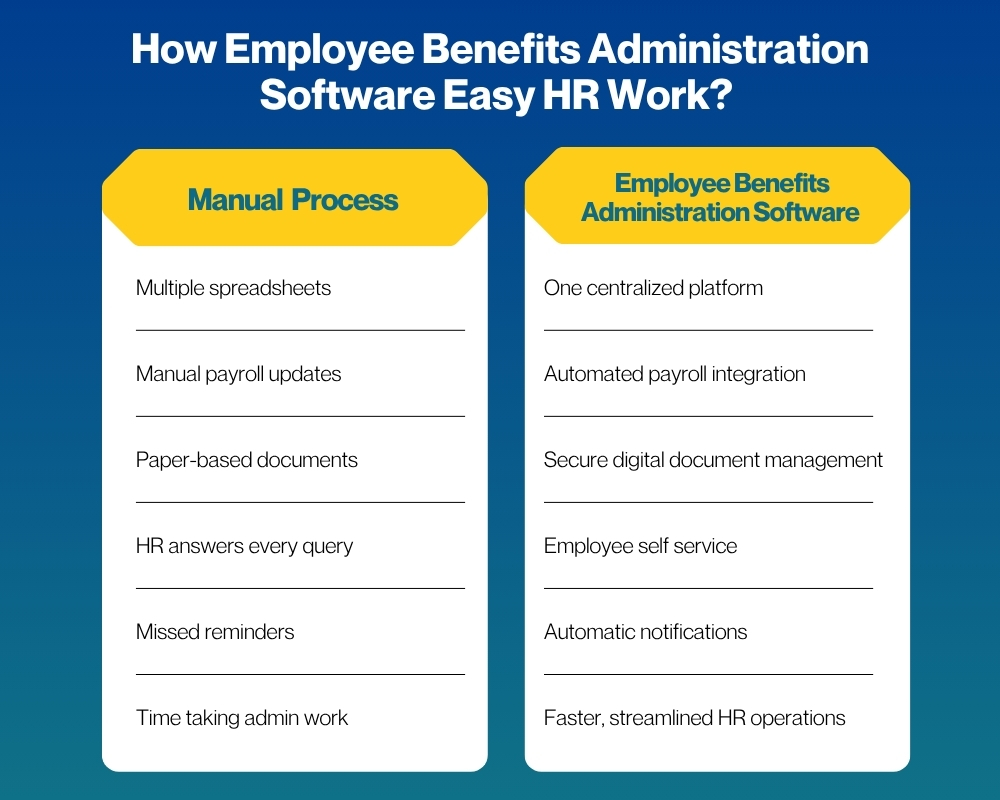
Managing benefit enrollment manually often leads to long email chains, delayed approvals, and missing documents.
Modern benefits administration software automates the entire process by allowing employees to submit requests digitally while routing approvals to the right people automatically.
This reduces paperwork, speeds up enrollments, and gives HR complete visibility into every request without constant follow-ups.
3. Payroll Integration
Employee benefits and payroll should always work together. Insurance premiums, retirement contributions, employee loans, reimbursements, and benefit deductions directly affect salary calculations.
When payroll is integrated with employee benefits management, approved changes automatically flow into payroll. Reducing duplicate data entry and minimizing costly payroll errors.
4. Automated Compliance Dashboard
Benefit administration involves more than employee convenience. Organizations must also stay compliant with company policies, insurance requirements, statutory regulations, and internal deadlines.
An Automated Compliance Dashboard helps HR stay ahead by tracking important compliance activities from one place. It can monitor:
- Insurance policy renewals
- Expiring employee documents
- Pending employee declarations
- Mandatory acknowledgements
- Benefit enrollment deadlines
- Compliance-related approvals
Instead of relying on manual reminders or spreadsheets, HR receives timely alerts, helping reduce compliance risks and ensuring important activities are completed on time.
5. Document Management
Benefits administration generates a large number of important documents throughout an employee's journey.
Insurance forms, employee declarations, policy acknowledgements, reimbursement documents, loan agreements, and supporting records should all be stored securely.
An integrated document management system keeps these files organized in one centralized location, making it easier for HR to retrieve information during audits, employee requests, or compliance reviews.
6. Smart Notifications and Reminders
Missing a benefit enrollment deadline or forgetting to renew important documents can create unnecessary problems for both employees and HR.
Built-in notifications automatically remind employees and managers about upcoming actions, helping everyone stay informed without manual follow-ups. Automatic alerts can be sent for:
- Open enrollment periods
- Document expiry
- Policy renewals
- Pending approvals
- Benefit updates
- Payroll deduction changes
- Loan installment reminders
This improves communication while reducing administrative workload.
7. Employee Self Service Portal
Employees shouldn't have to contact HR every time they need a copy of an insurance card or want to check their benefit deductions. An Employee Self Service Portal gives employees secure access to their benefit information anytime, from anywhere.
Through a self-service portal, employees can:
- View enrolled benefits
- Download policy and insurance documents
- Update personal or dependent information
- Submit benefit-related requests
- Track approval status
- View payroll deductions
- Access loan balances
By allowing employees to manage routine tasks themselves, HR spends less time answering repetitive questions and more time supporting strategic initiatives.
Make Employee Benefits Accessible
Employee benefits play a major role in attracting, engaging, and retaining talented employees. However, the true value of those benefits depends on how efficiently they are managed.
Manual processes may work for a small workforce, but as organizations grow, they become slower, more complex, and more prone to errors.
Investing in employee benefits administration software allows organizations to simplify administration, improve payroll accuracy, strengthen compliance, reduce HR workload, and give employees the digital experience they increasingly expect.
When benefits become easier to manage, HR gains more time to focus on people instead of paperwork.
Managing employee benefits shouldn't require endless spreadsheets, repeated follow-ups, or disconnected systems.
With HR HUB, you can bring Employee Information, Payroll, Employee Self Service, Loan Management, Document Management, and Notifications together in one secure platform, making benefits easier for HR to manage and simpler for employees to access.
Whether you're growing your workforce or modernizing your HR processes, HR HUB helps you deliver a more efficient, transparent, and employee-friendly benefits experience.