Picture this.
It is Monday morning. HR has just opened the laptop, coffee is still hot, and before the first sip, the messages begin.
- “Can you send my payslip?”
- “How many leaves do I have left?”
- “Where is the holiday list?”
- “I changed my bank account. Can you update it?”
- “My attendance is showing absent, but I was there.”
- “Can you send the policy document again?”
By 11 AM, HR has answered the same question seven different ways, forwarded three files, checked five leave balances, and still has actual HR work waiting. Recruitment is pending. Payroll inputs need checking. Compliance reports are calling from the corner like an ignored houseplant.
This is exactly why the employee self-service portal is becoming the new HR standard in 2026.
Not because HR teams want to avoid employees. Not because technology should replace human support. But because employees should not need to chase HR for every basic thing, and HR should not spend the entire day acting like a human search bar.
The workplace has changed. Employees expect faster access. HR teams need cleaner systems. Businesses want fewer delays, fewer errors, and better visibility.
Employee self-service brings all of that together.
What Is an Employee Self-Service Portal?
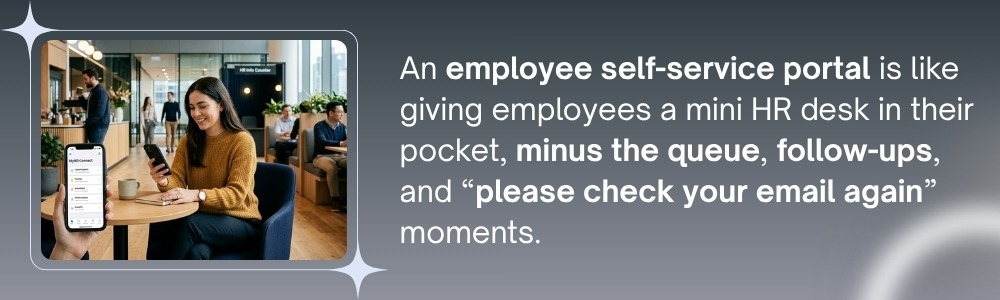
An employee self-service portal is a secure digital space where employees can access, update, request, download, and track their HR-related information independently.
In simple words, it is like giving every employee their own HR counter, open 24/7, without making HR sit behind it all day.
Through an employee self-service portal, employees can usually:
- View and update personal details
- Check attendance records
- Apply for leave
- View leave balance
- Download payslips
- Access tax documents
- Upload important documents
- Read company policies
- Track approval status
- Submit HR requests
- View announcements
- Complete onboarding tasks
- Check shift or roster details
The best part is that employees do not need to wait for HR for every small activity. They can get the information they need when they need it.
For HR, this means fewer repeated questions. For employees, it means less waiting. For managers, it means faster approvals. For the business, it means smoother HR operations.
Why the Employee Self-Service Portal Is Becoming a Workplace Standard in 2026
A few years ago, self-service in HR was treated like an extra feature. Nice to have, but not urgent.
In 2026, that thinking no longer works.
Employees are used to instant access in almost every part of life. They can check bank transactions in seconds, book a cab in minutes, track food delivery in real time, and download invoices without speaking to anyone.
Then they enter the workplace and hear, “Please send an email to HR and wait.”
That gap feels bigger than ever.
Employees Want Quick Answers
Employees do not want to wait two days to know their leave balance. They do not want to search old email chains for policies. They do not want to ask HR for a payslip; they should be able to download it in ten seconds.
This is not impatience. It is the new normal.
A good employee self-service portal gives employees access to information without unnecessary follow-ups.
HR Teams Are Already Overloaded
Modern HR is not just about attendance and payroll. HR teams now manage hiring, onboarding, compliance, performance, employee experience, policy updates, reporting, engagement, documentation, and workforce planning.
When the same HR team is also answering basic repeated questions all day, something has to give.
Employee self-service software helps HR teams reduce manual HR work so they can focus on work that needs judgment, planning, and people skills.
Businesses Need Better HR Data
When HR information is scattered across emails, spreadsheets, WhatsApp messages, paper forms, and random folders named “Final HR Data Latest Updated New Final,” errors are almost guaranteed.
An HR self-service system helps keep employee data structured, up to date, and easier to track.
Employees can update their information. HR can review and approve changes. Managers can act on requests. The system keeps a record of what happened.
That is much better than searching through 17 email threads and hoping the latest attachment is the correct one.
Why Businesses Need an HR Self-Service System to Reduce Daily HR Dependency
In many companies, HR serves as the middleman even when the task does not truly require HR involvement.
- An employee wants a payslip. HR sends it.
- An employee wants the leave policy. HR forwards it.
- An employee wants to check attendance. HR verifies it.
- An employee wants to know the approval status. HR checks with the manager.
- An employee wants to update personal details. HR enters the data manually.
None of these tasks is unimportant. But many of them do not need to go through HR manually every time.
That is where employee portal software changes the experience.
It removes unnecessary dependencies and gives employees direct access while still maintaining control, security, and approval rules.
How Employee Self-Service Software Reduces Repetitive HR Requests
Let’s be honest. In many companies, HR teams become the internal helpdesk for everything.
Sometimes the questions are HR-related. Sometimes they are not. Sometimes someone asks HR where the office stapler is, because at this point, why not?
Employee self-service does not solve stapler mysteries, but it does solve a large part of everyday HR traffic.
Fewer Repeated Questions
Most HR teams know the pattern. The same questions come again and again.
- “When will salary be credited?”
- “How much leave balance do I have?”
- “Where can I find the policy?”
- “Has my request been approved?”
- “Can you send last month’s payslip?”
With an employee self-service portal, these answers are available inside the system. Employees can check them directly.
This reduces the number of repeated emails, calls, and messages HR has to handle.
Faster Request Handling
When requests come through email, they can get missed. When they come through chats, they can get buried. When they come in on paper forms, they can sit on a desk, waiting for someone to remember them.
A self-service system gives each request a clear path.
The employee submits the request. The right approver gets notified. The status is visible. HR can track the full history.
This makes the process cleaner and easier for everyone.
Better Use of HR Time
HR teams should not spend most of their day downloading files, checking balances, forwarding policies, and manually updating basic details.
They should be able to work on hiring better people, improving retention, managing compliance, building better processes, supporting managers, and improving the employee experience.
Employee self-service software helps HR move from “request handler” to “people operations partner.”
That shift matters.
Why Employees Prefer an Employee Self-Service Portal for Everyday HR Tasks
Some companies worry that employees may not use self-service tools.
The truth is, employees usually use them happily when the system is simple and useful.
The problem is not self-service. The problem is bad self-service.
If the portal looks confusing, loads slowly, hides basic options, or requires five clicks just to apply for leave, employees will avoid it.
But when the system is clean and practical, employees prefer it.
It Gives Employees Control
Employees like knowing where things stand.
When they apply for leave, they want to know whether it is pending, approved, rejected, or awaiting a manager's approval. When they upload a document, they want to know if HR has accepted it. When they raise a request, they want to track it.
An HR self-service system gives employees that visibility.
No guessing. No repeated follow-ups. No “Let me check and get back to you” for every small thing.
It Protects Privacy
Some HR matters are personal.
Salary details, tax documents, bank information, family details, identification documents, and employment letters should not be circulated casually via email or chat.
Secure employee portal software provides employees with controlled access to sensitive information without unnecessary sharing.
That builds trust.
It Works Beyond Office Hours
Employees may need information outside HR working hours.
Someone may need a payslip at night for a loan application. Someone may want to apply for leave over the weekend. Someone may need to upload a document after office hours.
An employee self-service portal gives access when employees need it, not only when HR is online.
Key Features Every Employee Self-Service Portal Should Offer in 2026
Not every portal is useful just because it exists. A good self-service system should make life easier, not create a new digital maze.
Here are the features businesses should look for.
1. Employee Profile Management
Employees should be able to view and update their basic information, such as:
- Personal details
- Contact number
- Address
- Emergency contacts
- Family details
- Bank details
- Identity documents
- Work-related information
Some changes should go through HR approval, especially sensitive details like bank information. This keeps employees involved while maintaining proper control.
2. Leave Management
Leave is one of the most common HR activities, so it must be easy.
Employees should be able to:
- Check leave balance
- Apply for leave
- View holidays
- Upload supporting documents
- Track approval status
- Cancel or edit requests where allowed
Managers should be able to approve requests quickly. HR should be able to monitor leave records without having to check everything manually.
For businesses with teams across India, the Cayman Islands, the US, and Canada, location-wise holiday and leave rules are also important.
3. Attendance and Shift Details
Attendance confusion can quickly become payroll confusion.
Employees should be able to view:
- Daily attendance
- Punch-in and punch-out records
- Missed punches
- Shift schedules
- Overtime entries
- Attendance regularisation status
- Monthly attendance summaries
This is especially useful for industries like hospitality, healthcare, retail, manufacturing, security, and field services.
When employees can check attendance early, they can raise corrections before payroll starts. That saves everyone from month-end panic.
4. Payroll and Payslip Access
Payroll-related questions are among the most sensitive and frequent HR queries.
A good employee self-service software should allow employees to:
- Download payslips
- View salary details
- Access tax documents
- Check deductions
- View reimbursements
- Access year-end documents
- Review payroll-related information
For Indian companies, this may include tax declarations, Form 16, proof submissions, and income tax regime details.
For companies in the Cayman Islands, the US, and Canada, this may include salary statements, benefit details, contribution records, and tax-related documents.
The goal is simple: employees should not need to message HR every month for documents that can safely be available in the system.
5. Document Management
Employee documents are too important to be scattered across inboxes and shared drives.
An employee self-service portal should support:
- Document upload
- Document verification
- Expiry tracking
- Secure storage
- Download access
- Policy acknowledgements
- Compliance records
This is useful for identity documents, work permits, contracts, certificates, visa records, proof of address, tax forms, and policy confirmations.
For compliance-heavy businesses, this feature can save a lot of trouble.
6. Request and Approval Workflows
Employees should be able to raise requests from one place.
For example:
- Leave request
- Attendance correction
- Salary certificate request
- Asset request
- Travel request
- Reimbursement claim
- Shift change request
- Document update
- HR letter request
The system should automatically send each request to the appropriate approver.
This removes confusion and keeps every request traceable.
7. Policy and Announcement Access
Company policies should not live only in old emails.
Employees should be able to access:
- Leave policy
- Attendance policy
- Payroll policy
- Travel policy
- Reimbursement rules
- Code of conduct
- Holiday calendar
- Company announcements
- Employee handbook
When policies are updated, employees can be notified. For important documents, the system can collect a digital acknowledgement.
This helps employees stay informed and gives HR proof that important policies were shared.
8. Mobile-Friendly Access
A self-service portal must work well on mobile devices.
Not every employee sits at a desk. Many employees work in stores, hotels, warehouses, hospitals, client locations, field roles, or remote setups.
They need HR access from their phone.
A mobile-friendly HR self-service system makes it easier for every employee to use the platform, not just office-based staff.
9. Role-Based Access and Security
Employee data must be protected.
A self-service system should allow controlled access based on roles.
Employees should see their own information. Managers should see team-related records. HR should have access based on responsibility. Admins should control permission settings.
The system should also maintain audit trails so the company knows who changed what and when.
Security is not a bonus feature here. It is a must.
How Employee Self-Service Software Improves Payroll Accuracy
Payroll errors rarely happen because someone wants to make a mistake.
They happen because information is late, missing, incorrect, or scattered.
The attendance correction was not submitted on time.
Leave was not updated.
Bank details changed, but payroll did not know.
A reimbursement claim was approved too late.
A salary component was updated manually in one place but not another.
An employee self-service portal helps reduce these issues by giving employees a way to check, correct, and submit information before payroll processing.
This does not remove payroll review. HR and payroll teams still need control. But it does make the input process cleaner.
When employees can view attendance, raise corrections, upload documents, and track approvals, payroll becomes less stressful.
And honestly, anything that makes payroll less stressful deserves respect.
Why Self-Service Is a Big Help for Hybrid and Remote Teams
Hybrid and remote work have changed how employees interact with HR.
Earlier, an employee could walk to the HR desk and ask a question. Now, employees may be working from different cities, branches, countries, or time zones.
A physical HR desk cannot serve everyone equally.
An employee self-service portal gives remote and hybrid employees the same access as office employees.
They can:
- Apply for leave
- Download documents
- View policies
- Submit requests
- Upload files
- Track approvals
- Access payroll information
- Complete onboarding steps
This creates a consistent HR experience across locations.
For businesses in India, the Cayman Islands, the US, and Canada, where teams may be spread across offices, branches, client sites, or remote setups, this consistency is extremely useful.
For businesses planning to move beyond basic HR access, this guide on setting up an employee self-service portal explains how ESS can simplify leave, payroll, attendance, and employee data management in one place.
Business Benefits of Employee Self-Service Software in 2026
Employee self-service software helps more than just HR. It improves the daily experience for employees, managers, finance teams, admin teams, and leadership.
For Employees
Employees get faster access, better visibility, and fewer delays.
They can manage basic HR tasks without having to chase anyone.
For HR Teams
HR teams get fewer repetitive queries, cleaner data, and more time for meaningful work.
They can focus on people, not just paperwork.
For Managers
Managers can approve requests, view team information, and track pending actions without searching through emails.
For Finance and Payroll
Payroll teams get cleaner attendance, leave, reimbursement, and employee information before salary processing.
For Leadership
Leadership gets better visibility into workforce data, HR trends, pending approvals, and employee-related activities.
Common Mistakes to Avoid When Implementing an HR Self-Service System
Buying employee portal software is one thing. Getting people to use it properly is another.
Here are mistakes companies should avoid.
Making It Too Complicated
If employees need a manual to download a payslip, the system has already lost the battle.
The portal should be simple enough for everyday use.
Not Updating the Data
Employees will trust the portal only if the information is correct.
If leave balance, attendance, or salary details are outdated, employees will stop using the system and go back to asking HR directly.
Skipping Employee Training
Even a simple system needs a proper introduction.
Employees should know what they can do, where to find information, and how to raise requests.
Not Setting Approval Rules
Requests should not float around without ownership.
Every request needs a clear approver, status, and timeline.
Ignoring Mobile Users
If the portal is not mobile-friendly, adoption will be limited.
For many teams, mobile access is the main way they will use the system.
Giving Everyone the Same Access
Access should be based on role and responsibility. Employees, managers, HR, payroll, and admins should not all see the same data.
Proper access control protects employee privacy and company records.
What to Look for in Employee Portal Software in 2026
When choosing employee portal software, companies should look at how useful it will be in real-world daily operations.
A strong system should include:
- Easy employee dashboard
- Mobile-friendly access
- Profile update options
- Leave and attendance access
- Payroll and payslip access
- Document upload and verification
- Request and approval workflows
- Policy and announcement section
- Manager approval panel
- Role-based access control
- Audit history
- HR reports
- Notifications and reminders
- Multi-location support
- Integration with HRMS, payroll, and attendance modules
The best system is not always the one with the longest feature list.
The best system is the one employees actually use without needing HR to explain it every week.
How HR HUB Supports a Smarter Employee Self-Service Portal Experience
HR HUB helps businesses create a more organized and employee-friendly HR experience through a connected HRMS platform.
With HR HUB, employees no longer need to email HR for routine requests. Leave balances, attendance, payslips, tax documents, approvals, company policies, and employee records are available from one secure platform, helping HR teams spend less time on administration and more time supporting people.
For managers, it makes approvals easier to track. For employees, it removes unnecessary waiting. For leadership, it gives better visibility into HR operations.
As businesses expand across locations and work models, HR HUB helps them transition from scattered HR processes to a cleaner, more reliable self-service experience.
The Future of HR Is a Digital Employee Self-Service Portal
Employee self-service is becoming the new HR standard because the old way of handling every HR request manually is no longer practical.
Employees want quick access. HR teams need breathing room. Managers need faster approvals. Businesses need accurate records. Nobody wants to search through old emails with subject lines like “Updated Final Latest V3.”
An employee self-service portal brings all of this into one place.
It gives employees control without removing HR oversight. It reduces repeated work without reducing HR’s importance. It helps companies create a smoother, faster, and more transparent workplace experience.
In 2026, self-service is not just a feature inside HR software.
It is how modern HR should work.
And with HR HUB, businesses can make that shift in practice by giving employees the access they need, giving HR teams the control they need, and giving the organisation a better way to manage everyday HR operations