“Hey HR, Just One Small Thing…”
It always starts with one small thing.
- “Can you share my payslip?”
- “Can you check how many leaves I have left?”
- “Can you update my address?”
- “Can you approve this quickly?”
Multiply that by 50 employees. Then 200. Then 500.
Before anyone notices, HR is no longer managing people. They are managing requests.
Somewhere between spreadsheets, emails, and follow-ups, HR quietly becomes a support desk.
And that is exactly the moment where an employee self-service portal steps in and changes the story.
The Shift No One Notices: How an Employee Self-Service Portal Changes Daily Work
Picture this a little more closely.
It is Monday morning. A new employee logs in for the first time. There is usually confusion on Day 1. Where do I upload documents? Who do I ask for leave? How do I get my payslip?
But this time, something feels different.
- By Tuesday, they have already updated their bank details without asking anyone.
- By Wednesday, they apply for leave and see the approval status in real time.
- By Thursday, they check attendance and realize they no longer need to maintain their own records.
- By Friday, they download their payslip and share it with their landlord.
And HR? Quietly watching dashboards instead of inboxes.
No reminders. No follow-ups. No “Just checking again…” No internal chats saying “Hey, did you approve this?”
The shift is not loud. No one sends a company-wide message saying, “Things are better now.”
It just happens.
And a week later, people stop noticing how much easier everything feels. That is when you know your employee self-service portal is actually working.
What an Employee Self-Service Portal Actually Does for Employees and HR
At first glance, an employee self-service portal looks like just another HR tool. A place with tabs, buttons, and maybe a dashboard.
But its real value is not in what it shows. It is in what it quietly removes from daily work life.
- It removes dependency.
- It removes waiting time.
- It removes confusion.
- It even removes that slightly awkward “Should I follow up again?” moment.
Think about a typical scenario before ESS.
An employee needs a payslip. They send an email. HR replies after a few hours. If HR is busy, it becomes a day. If something is missing, another email goes out.
Now imagine the same situation with an ESS portal.
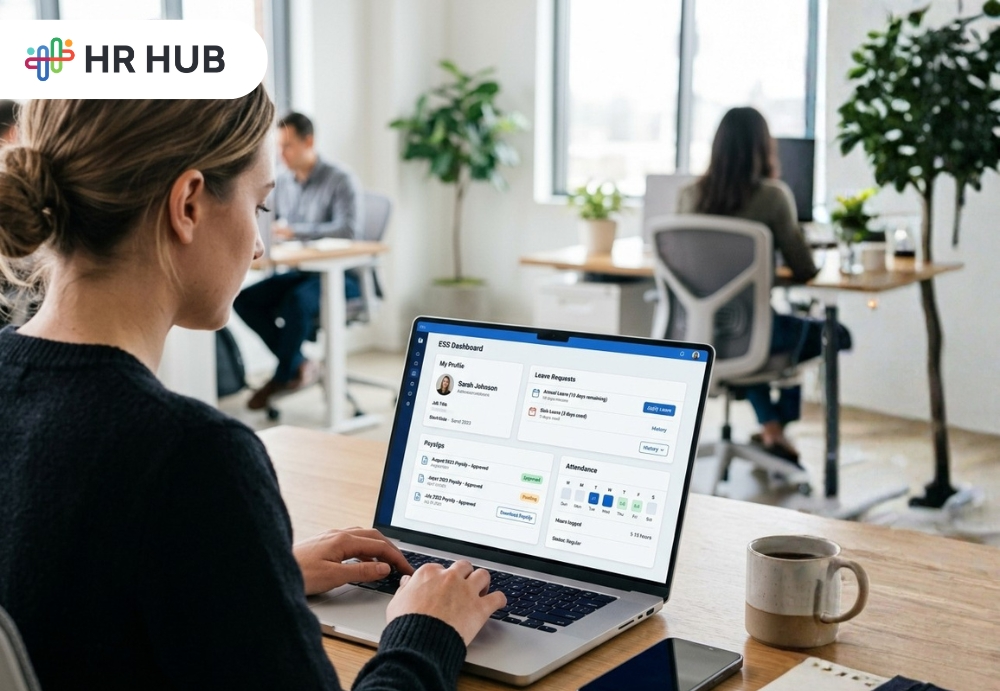
The employee logs in, clicks once, downloads it, and moves on with their day.
No friction. No delay. No conversation required.
Employees can:
- Apply for leave without wondering who to email
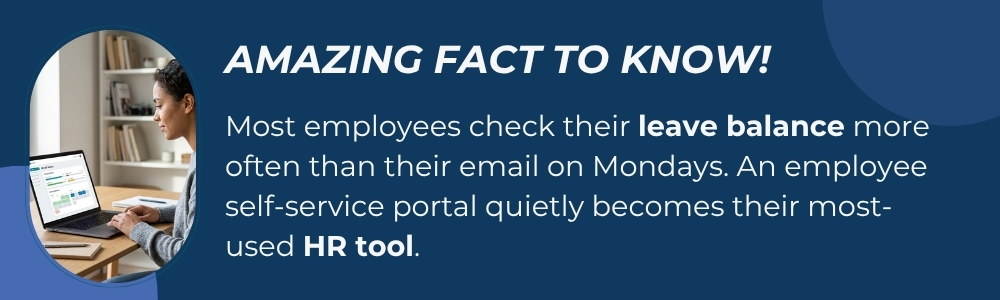
- Access payroll details anytime, even outside office hours
- Track attendance without maintaining parallel records
- Update their own information instantly without waiting in a queue
It sounds simple. It is simple.
And that simplicity is what makes the employee self-service portal so effective. It replaces effort with clarity.
ESS Benefits That Feel Small… Until Your Employee Self-Service Portal Takes Over
Most HR tools try to impress with big promises. Dashboards, analytics, reports.
But the real ESS benefits show up in small, almost invisible ways.
And those small moments add up.
1. The End of “Following Up.”
You know that one email chain that never seems to end.
- “Just a reminder…”
- “Gentle follow-up…”
- “Any update on this?”
- “Sorry to bother again…”
It is almost a routine.
With an ESS portal, that routine disappears.
Employees can see exactly where their request stands. Approved, pending, rejected. No guessing, no chasing.
And suddenly, inboxes feel lighter. Not because fewer people are working, but because fewer people need to ask.
2. HR Finally Gets Time to Think
This is where things get interesting.
When HR is not answering repetitive queries all day, something unexpected happens.
They start doing the work they were actually hired for.
- Planning better hiring strategies
- Reviewing policies with real insight
- Improving employee experience instead of reacting to complaints
It is the difference between being busy and being productive.
An employee self-service portal does not just reduce work. It changes the type of work HR focuses on.
3. Fewer Errors, Less Blame
Manual systems have a pattern.
Someone sends data. Someone updates it. Someone forgets something. And then comes the conversation nobody enjoys.
- “Sorry, I think your leave balance was updated incorrectly.”
- “I thought this was already approved.”
- “This was not reflected in payroll.”
With ESS, employees become part of the process rather than dependent on it.
They enter their own details. They track their own requests.
The result is fewer mistakes and fewer awkward explanations.
And most importantly, more trust.
4. Employees Feel More in Control
There is something subtle but powerful about not having to ask.
No one enjoys waiting for basic information, especially when it is about their own salary, leave, or attendance.
When employees can access everything instantly, it changes how they experience work.
They feel:
- More independent
- More informed
- More confident in systems
And that is one of the most underrated ESS benefits. It improves how people feel, not just how systems function.
Why an Automated Leave Management System Is the Real Hero of Any ESS Portal
If there is one topic that can create chaos in any organization, it is leave management.
Not because it is complex, but because it is handled differently by everyone.
- “How many leaves do I have?”
- “Was this approved or still pending?”
- “Why is my balance different from last month?”
- “Did my manager even see my request?”
These questions show up everywhere. Emails, chats, even hallway conversations.
An ESS portal with an automated leave management system removes all of this confusion in one go.
Employees can:
- See exact leave balances without asking
- Apply in seconds without filling out long forms
- Track approvals in real time without reminders
- Understand policies without reading long documents
Managers can approve requests instantly, even from their phones, without searching for emails.
And HR? They no longer have to repeatedly explain the same leave policy.
This is where the employee self-service portal moves from being useful to being essential.
Setting Up an Employee Self-Service Portal: A Practical Approach That Works
Let’s move away from ideal scenarios for a second.
Setting up an employee self-service portal is not a smooth, perfectly planned journey.
It usually starts with frustration.
Step 1: Accept That Something Is Broken
If HR feels overwhelmed, employees are constantly asking questions, and approvals take longer than they should, then something is not working.
And that is okay.
You do not need a perfect system to begin with. You just need to acknowledge that improvement is needed.
Step 2: Identify What Annoys People the Most
Every organization has its own pain points.
- Employees are frustrated with leave approvals
- Managers are tired of tracking attendance manually
- HR spends hours sending payslips
Start there.
Fix the problems that people complain about the most. That is where your ESS portal will make the biggest impact.
Step 3: Keep It Simple (Seriously)
Here is a simple test.
If an employee opens your portal and thinks, “This looks complicated,” you have already lost them.
The best systems feel obvious.
Apply leave. Click. Done. Download payslip. Click. Done.
No manuals. No confusion.
Step 4: Choose a Platform That Feels Easy
This is where solutions like HR HUB ESS come into the picture.
Instead of spreading HR functions across multiple tools, everything comes together in one place:
- Employee data
- Leave management
- Attendance
- Payroll
Employees do not need to remember multiple logins. HR does not need to manage multiple systems.
It just works.
Step 5: Roll It Out Like You Mean It
This step is often underestimated.
Sending a single email saying “Portal is live” does not create adoption.
You need to show employees how their lives can become easier.
Show them:
- How quickly can they apply for leave
- How easily they can access payslips
- How can they avoid waiting for approvals
When employees see the benefit for themselves, adoption happens naturally.
If you're exploring how digital tools are reshaping HR operations beyond ESS, this detailed breakdown on modern HR systems offers a broader perspective on where workplace management is heading.
Why Employees Resist an Employee Self-Service Portal (And Why They Eventually Love It)
No matter how good your system is, there will always be that one person.
- “I will just send an email.”
- “This feels different.”
- “Can you do it for me this time?”
They are not wrong. They are just used to the old way.
But here is the fun part.
Give it a few days.
Once they realize they can get things done faster on their own, they stop asking.
And then suddenly, they are the ones telling others, “Just check it on the portal.”
Every company has this moment. It is almost predictable.
How HR HUB ESS Brings All Employee Self-Service Portal Features Into One Place
When organizations start exploring ESS, they often run into a common problem.
Too many tools.
One for attendance. One for payroll. One for leave. Another for documents.
And before you know it, employees are juggling logins instead of getting work done.
HR HUB ESS removes this complexity.
Employees can:
- Manage their profiles
- Access payroll details instantly
- Use an automated leave management system
- Track attendance in real time
All from a single platform.
For HR teams, this means fewer interruptions and better visibility.For employees, it means no waiting and no confusion.
The Bigger Impact of an Employee Self-Service Portal on Workplace Behavior
An employee self-service portal does more than reduce workload.
It changes behavior in ways that are hard to measure but easy to feel.
Employees stop asking for small things because they do not need to. Managers stop chasing updates because they can see everything. HR stops firefighting because processes run on their own.
Over time, work starts feeling smoother.
Not faster in a dramatic way. Just easier.
And that is the real impact.
Because when systems stop getting in the way, people can finally focus on the work that actually matters.
When an Employee Self Service Portal Lets HR Step Back, and Employees Take Control
The moment an employee self-service portal is properly set up, something interesting happens.
- HR inboxes get quieter.
- Employees get faster.
- Processes feel lighter.
It is not a dramatic change. It is a steady one.
And over time, it becomes the new normal.
If you are looking at building a workplace where people do not wait, where HR does not chase, and where systems actually support work, then this is the shift worth making.
With solutions like HR HUB, this shift becomes easier to implement and even easier to scale as your organization grows.
Because sometimes, the biggest improvement is simply letting people do things on their own.