Every HR team has one invisible enemy.
It is not always a difficult employee. It is not always a last-minute payroll change. It is not even the manager who remembers approval only after three follow-up calls, two reminders, and one “I thought I already approved this” message.
The real enemy is confusion.
Confusion about who needs to approve what? Confusion about whether a request is pending, rejected, edited, or forgotten. Confusion about whether an employee’s leave was approved before payroll ran. Confusion about who changed the salary component and why.
And in HR, confusion is not a small inconvenience. It can turn into payroll errors, compliance gaps, employee frustration, reporting mistakes, and a lot of unnecessary back-and-forth.
That is exactly why a clear HR approval workflow is no longer just a nice feature in an HR system. It has become one of the most practical ways to protect accuracy, build accountability, and make sure HR work does not depend on memory, guesswork, or endless email chains.
How an HR Approval Workflow Brings Clarity to Everyday Employee Requests
Imagine this.
An employee applies for leave. The manager is supposed to approve of it. The HR team needs to know the final status. Payroll needs the correct leave data before salary processing. The employee expects a clear answer.
Simple, right?
Now add to real life.
The manager is traveling. HR is handling onboarding for five new joiners. The payroll cutoff is tomorrow. The employee has already booked tickets. Someone says, “Please check with the reporting manager.” Someone else says, “Was this approved-on WhatsApp?” Then the employee says, “But I informed last week.”
At this point, the leave request is not a problem. The missing process is the problem.
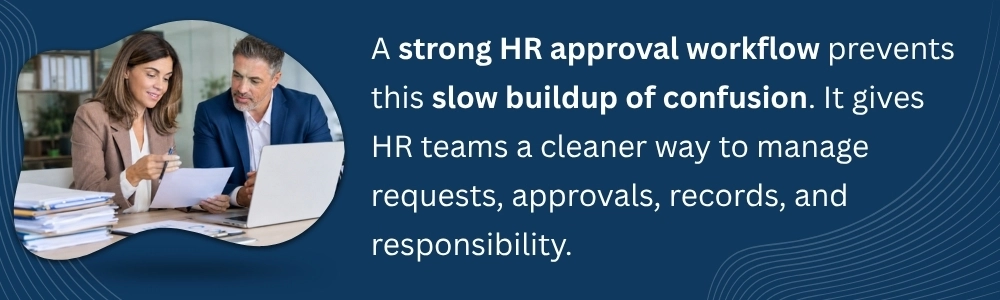
A proper HR approval workflow gives every request a defined route. It decides where the request starts, who reviews it, who approves it, what happens if it is rejected, and how the final decision is recorded. No detective works. No inbox digging. No “who said what” confusion.
Why HR Accuracy Depends on a Clear HR Approval Workflow
Accuracy in HR is not only about entering the right data. It is also about making sure the right person approves the right action at the right time.
A salary change, for example, may need approval from a department head, HR, and payroll. A reimbursement request may need supporting documents. An overtime request may need manager approval before it affects payroll, especially when leave, shift changes, and payroll data need to stay connected. A role change may need extra checks because it can affect system permissions.
Without a structured approval path, HR data can become unreliable very quickly. One missed approval may create a wrong payslip. One unchecked update may affect employee records. One undocumented change may become difficult to explain during an audit.
That is where HR process automation becomes valuable. It reduces dependency on manual tracking and makes sure each step follows the expected order. When the system controls the approval route, HR teams spend less time chasing updates and more time checking the quality of decisions.
How HR Approval Workflow Improves Accountability with Clear Approval Records
Accountability sounds serious, but in daily HR work, it simply means this:
- Who requested it?
- Who reviewed it?
- Who approved it?
- Who changed it?
- When did it happen?
- What was the final decision?
If these answers are not available, accountability becomes a guessing game. And nobody enjoys a guessing game when payroll, compliance, or employee trust is involved.
A digital HR approval workflow keeps a record of each action. If a manager approves a leave request, the system records it. If HR rejects a document because proof is missing, the system records it. If a request is escalated because an approver did not respond, the system records that too.
This does not only protect HR. It also protects managers and employees. Everyone can see the process clearly, which reduces blame, confusion, and unnecessary arguments.
In simple words, approval of workflows makes HR decisions easier to trust.
Why Employee Requests Approval Needs Better Visibility and Faster Updates
Employees do not enjoy waiting without updates.
When an employee submits a request and hears nothing for days, the silence starts creating frustration. They may wonder whether the request was received, whether the manager saw it, whether HR is processing it, or whether they need to send another reminder.
And yes, they usually send another reminder.
Then another.
Then maybe one more thing, just to be safe.
A proper employee requests approval process gives employees visibility. They can see whether the request is pending, approved, rejected, or under review. That small visibility makes a big difference because people do not feel ignored.
It also reduces the pressure on HR. Instead of answering repeated status questions, HR can rely on the system to show the latest update. This makes the process calmer for everyone involved.
How Workflow Automation HR Turns Manual Follow-Ups into Timely Actions
In many companies, HR professionals spend a surprising amount of time following up.
- “Please approve this leave.”
- “Please check this claim.”
- “Please confirm this salary update.”
- “Please review this onboarding document.”
- “Please approve before payroll cutoff.”
At some point, HR starts sounding less like HR and more like a reminder app with better manners. This is where workflow automation HR brings real relief. The system can send notifications, route requests, trigger reminders, and escalate pending items based on defined rules. HR does not have to manually remember every pending request.
For example, if a leave request is pending for two days, the system can remind the manager. If it remains pending after the defined time, it can move to the next approver or notify HR. If a payroll-related approval is still open before cutoff, the system can highlight it.
This kind of automation does not remove people from HR decisions. It simply makes sure people act at the right time.
How HR Approval Workflow Reduces Missed Approvals and Process Confusion
Every HR team has heard some version of this sentence:
“I didn’t know I had to approve it.”
Sometimes it is true. Sometimes it is convenient. Either way, it creates delays.
A clear workflow removes that excuse because responsibilities are defined in advance. Managers know what comes to them. HR knows what needs to be reviewed. Finance knows what needs confirmation. Employees know where their request stands.
With HR process automation, these responsibilities can be mapped into the system. The request does not float around waiting for someone to take ownership. It moves based on the rules already configured.
For growing organizations, this is especially important. When teams are small, people may manage approvals through personal coordination. But as the company grows, informal approval habits start breaking down. More employees, more managers, more locations, and more policies create more chances for mistakes.
Approval workflows help organizations scale without turning HR into a daily rescue mission.
Approval workflows become even more powerful when they connect with the full employee journey. To understand how connected HR systems support every stage from hiring to exit, read this guide on modern HR management software and employee lifecycle management.
Why Employee Requests Approval Needs Flexible Rules for Different HR Processes
Not every request should follow the same path.
A casual leave request may only need one manager approval. A resignation request may need reporting manager review, HR discussion, exit process initiation, asset clearance, and payroll settlement. A salary revision may need department approval, HR review, and management confirmation. A role change may need approval because it can affect system access.
This is why a flexible HR approval workflow matters. HR should be able to create different approval routes based on request type, employee level, department, location, or policy.
For example:
Leave Requests
Leave approvals need speed and clarity because they affect attendance, shift planning, and payroll. If leave is approved late or not updated correctly, it may lead to salary mismatch or attendance confusion.
Reimbursement Requests
Claims often require proof, bill validation, budget checks, and approval limits. A workflow ensures that incomplete or incorrect claims do not directly reach payroll.
Attendance Regularization
Missed punches, late marks, and work-from-home corrections need proper review. Without approval of tracking, attendance changes can become difficult to verify later.
Payroll Changes
Salary updates, arrears, deductions, bonuses, and corrections need strict control. These changes directly affect employee payments, so every update must be approved and recorded.
Employee Data Changes
Bank details, personal information, reporting manager changes, and role updates need proper checks. A workflow helps HR avoid unauthorized or incorrect updates.
When each request has the right approval journey, HR becomes more accurate and employees get a smoother experience.
How HR Process Automation Makes Audit Readiness Easier for HR Teams
Audits are not scary because of the audit itself. They are scary because someone suddenly asks for proof six months ago.
- Who approved this change?
- Why was this request rejected?
- When was this employee record updated?
- Was the policy followed?
If HR depends on emails, spreadsheets, and chat messages, finding proof becomes painful. It is like searching for one specific spoon in a kitchen after a family function.
With workflow automation HR, approval records are stored in one place. The system can show request history, approval status, timestamps, remarks, and supporting documents. That makes audits easier because HR does not have to rebuild the story manually.
Good workflows do not just help teams work better today. They also help them explain past decisions with confidence.
How HR Approval Workflow Builds Employee Trust Through Transparent Decisions
Employees may not always understand HR policies in detail, but they notice fairness.
They notice when one person’s request gets approved quickly while another person waits for days. They notice when rules are applied differently. They notice when approvals are unclear. They notice when HR says, “We are checking,” but no one knows what exactly is being checked.
A structured employee requests approval process brings consistency. Employees may not always get the answer they want, but they can see that the process is clear. That matters.
Fairness in HR is not only about the final decision. It is also about how the decision is handled.
When employees know their request follows a defined route, they feel more confident in the system. When managers know their approvals are recorded, they become more careful. When HR has full visibility, they can step in before issues become bigger.
Why HR Process Automation Supports Better Decisions Without Removing Human Judgment
Some people hear automation and immediately imagine a cold system making decisions without context.
That is not what good HR process automation should do.
HR still needs human judgment. Managers still need to review requests. HR still needs to understand the exceptions. Leadership still needs to make sensitive decisions carefully.
Automation simply handles the movement of the request. It makes sure the right people are involved, the right steps are followed, and the right records are saved.
Think of it like a traffic signal. It does not drive the vehicle for you, but it prevents chaos at the intersection. Without it, everyone may still reach somewhere, but not without honking, confusion, and possibly a few scratches.
Key Features That Make an HR Approval Workflow Strong and Reliable
A strong approval workflow is not just about adding an “Approve” and “Reject” button. It needs to be practical enough for real HR situations.
Clear Approval Levels
The system should allow HR to define who approves each type of request. This could be a reporting manager, department head, HR admin, finance team, or senior management.
Status Visibility
Employees and HR teams should be able to track whether a request is pending, approved, rejected, cancelled, or escalated.
Notifications and Reminders
The workflow should notify approvers when action is needed. It should also remind them when requests stay pending for too long.
Escalation Rules
If an approver is unavailable or delays action, the request should not remain stuck forever. Escalation helps keep the process moving.
Remarks and Attachments
Approvers should be able to add comments, request documents, or explain rejection of reasons. This keeps the process transparent.
Audit Trail
Every action should be recorded with date, time, user, and status. This is one of the most important parts of accountability.
Policy-Based Conditions
Some requests may need different approval rules depending on the amount, employee category, department, location, or request type.
When these elements work together, the approval workflow becomes more than a process. It becomes a control system for HR accuracy.
The Hidden Cost of Ignoring HR Approval Workflow in Growing Organizations
Skipping approval of workflows may feel manageable in the beginning. Many companies start with emails, spreadsheets, or chat-based approvals because it feels quick.
But over time, the hidden cost becomes clear.
Payroll teams spend extra time checking corrections. HR spends hours following up. Managers miss approval. Employees lose patience. Reports become unreliable. Audits take longer. Errors become harder to trace.
The company may still function, but the process becomes heavier than it needs to be.
How HR HUB Strengthens HR Approval Workflow for Accuracy and Accountability
HR accuracy does not happen by chance. It comes from clear processes, defined responsibilities, timely approvals, and reliable records.
Approval workflows bring all of this together. They help HR teams manage employee requests for approval with more clarity, reduce manual follow-ups, improve payroll and attendance accuracy, and create a proper record of every decision.
HR HUB helps organizations manage this entire approval journey through structured workflows, request tracking, notifications, role-based approvals, and complete visibility across HR processes. Whether it is leave, attendance, payroll, employee data changes, onboarding, or other HR actions, HR HUB helps teams move away from scattered approvals and build a more accountable way of working.
Because when HR knows exactly who approved what, when it happened, and why it happened, the whole organization runs with more confidence.