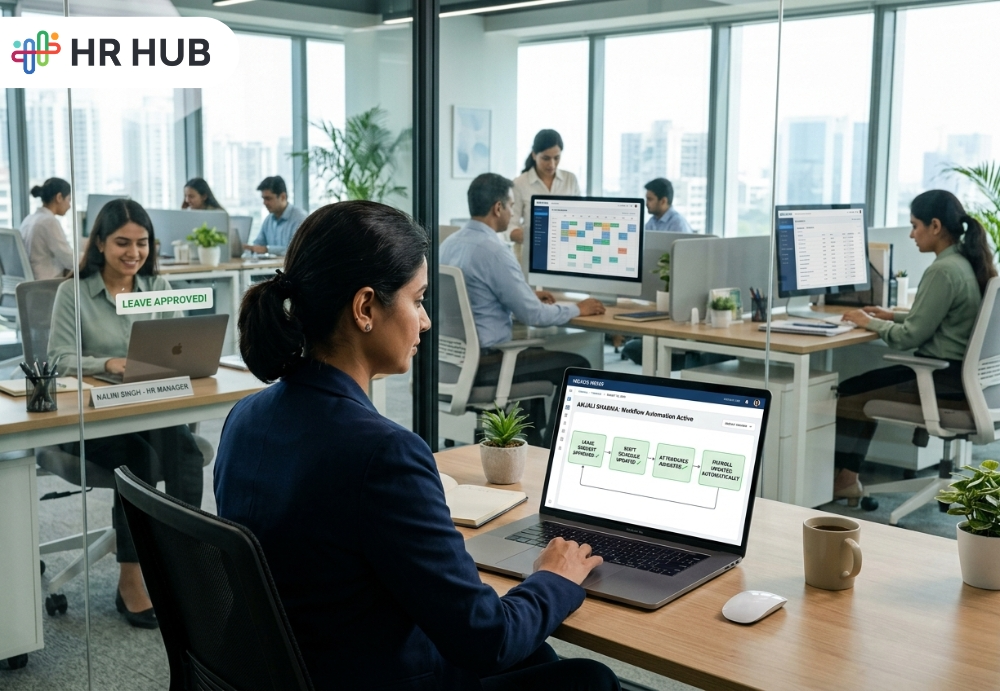
There is a familiar kind of panic that appears in many HR teams right before payroll day.
Someone approved leave, but payroll did not get the update. A manager changed an employee’s shift, but attendance still followed the old timing. An employee worked extra hours, but the approval is buried inside a message thread. Now HR has to check spreadsheets, emails, attendance logs, and manager confirmations before salary can be processed.
This is not a payroll problem alone. It is a connection problem.
When leave, attendance, shifts, approvals, and payroll operate independently, even a small update can cause a bigger issue later. That is why integrated HR software is becoming essential for businesses that want fewer errors, better visibility, and smoother HR operations.
There is a familiar kind of panic that appears in many HR teams right before payroll day.
Someone approved leave, but payroll did not get the update. A manager changed an employee’s shift, but attendance still followed the old timing. An employee worked extra hours, but the approval is buried inside a message thread. Now HR has to check spreadsheets, emails, attendance logs, and manager confirmations before salary can be processed.
This is not a payroll problem alone. It is a connection problem.
When leave, attendance, shifts, approvals, and payroll operate independently, even a small update can cause a bigger issue later. That is why integrated HR software is becoming essential for businesses that want fewer errors, better visibility, and smoother HR operations.
Why Payroll Problems Start Early Without Payroll Attendance Integration
Payroll errors usually do not begin during salary processing. They begin earlier.
A missed leave update, a wrong shift assignment, an unapproved attendance correction, or a delayed overtime confirmation can all affect the final salary.
Payroll is simply where the mistake becomes visible.
For example, if an employee takes unpaid leave and that leave is not synced with payroll, the salary may be calculated incorrectly. If an employee’s shift changes but attendance still follows the old timing, they may be wrongly marked late or absent.
This is why HR system integration matters. It helps ensure daily HR actions are correctly processed into payroll without relying on repeated manual checks.
How Integrated HR Software Connects Leave Approvals With Payroll Accuracy
Leave may look simple from the employee’s side. Apply, approve, and take the day off.
For HR, it is connected to several things.
How Leave Affects HR and Payroll
Approved leave impacts:
- Employee availability
- Attendance records
- Leave balance
- Paid or unpaid salary calculation
- Payroll inputs
- Monthly reports
- Compliance records
If leave is approved in one place but payroll is handled somewhere else, HR has to transfer the information manually. That may work for a very small team, but once the team grows, missed updates become common.
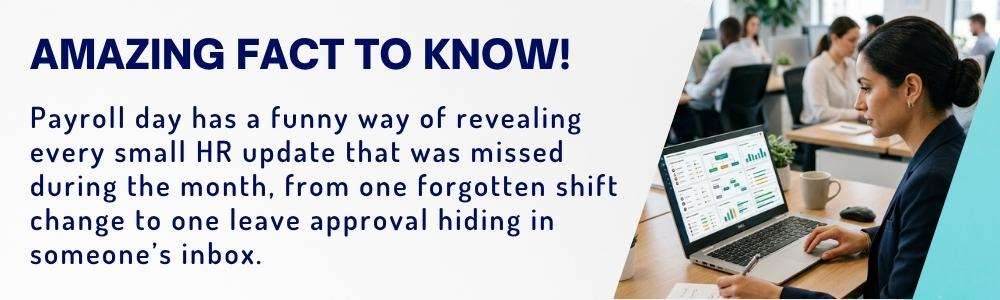
With integrated HR software, approved leave can automatically reflect in attendance and payroll records. This helps HR avoid last-minute checks and gives employees clearer information about their leave status and its impact on their salary.
Why HR System Integration Matters for Accurate Shift Changes
Shift changes sound simple.
- “Move this employee to the evening shift.”
- “Let this person cover Saturday.”
- “Swap these two employees for tomorrow.”
But if the system is not updated properly, the attendance record may become inaccurate.
Common Issues Caused by Unconnected Shift Changes
- An employee may be marked late even though they followed the new shift.
- A swapped weekly off may be treated as an absence.
- Overtime may not be calculated correctly.
- Holiday or weekend work may be missed.
- Payroll may receive wrong attendance data.
This is where payroll attendance integration becomes important. When approved shift changes are connected with attendance, the system calculates working hours based on the correct schedule.
That means fewer disputes, fewer manual corrections, and fewer “but I was told to work that shift” conversations.
How Payroll Attendance Integration Makes Attendance Tracking Clearer
Attendance should tell HR whether an employee worked as expected.
But when leave, shifts, holidays, weekly offs, and regularizations are not connected, attendance becomes confusing.
HR ends up asking:
- Was the employee absent or on leave?
- Was the shift changed?
- Was the missed punch regularized?
- Was overtime approved?
- Was the attendance exception sent to payroll?
- This turns a simple attendance review into detective work.
An all-in-one HR software setup helps connect these details. If leave is approved, attendance reflects it. If a shift is changed, working hours are calculated against the updated shift. If a regularization request is approved, payroll receives the corrected data.
The result is a cleaner attendance process and fewer disputes.
Why Payroll Sync Builds Trust in an Integrated HR Software Setup
Employees may not check every HR policy, but they always check salary.
If the salary is wrong, trust is affected quickly.
A payroll error can make employees wonder whether their leave, attendance, overtime, or deductions were handled correctly. Even if HR fixes the issue later, the employee experience has already been affected.
Payroll should not depend on last-minute corrections. It should receive clean, approved, and verified data from leave, attendance, shifts, and approvals.
That is the real value of payroll attendance integration. It helps payroll teams process salaries with greater confidence, rather than chasing missing details at month-end.
The Hidden Cost of Poor HR System Integration
A spreadsheet may look free, but manual HR work has a hidden cost.
The Hidden Cost of Disconnected HR Work
Disconnected systems lead to:
- More payroll corrections
- More attendance disputes
- More employee follow-ups
- More manager dependency
- More time spent preparing reports
- More compliance risk
- More stress before payroll day
The cost is not only financial. It affects time, accuracy, employee trust, and HR productivity.
When HR becomes the team that is always “checking and getting back,” it usually means the system is not supporting them enough.
Why Growing Businesses Need All-in-One HR Software to Scale HR Operations
Separate tools may work when a company is small. But as the business grows, the volume of leave requests, attendance exceptions, shift changes, approvals, and payroll inputs increases.
At that stage, scattered systems become harder to manage.
All-in-one HR software brings related HR functions into one connected platform. It helps businesses manage employee records, leave, attendance, shifts, approvals, payroll, reports, and self-service from one place.
For growing teams in India, the Cayman Islands, the US, and Canada, this is especially useful because policies, payroll rules, working hours, and compliance needs may differ by region.
A connected system gives HR better control without making the process harder for employees.
If your HR team is already struggling with scattered tools and repeated manual updates, this guide on integrated HR software for workflow automation explains how connected systems can reduce data silos and make everyday HR tasks easier to manage.
How Integrated HR Software Helps Employees and Managers Work With Clarity
Connected HR systems are useful not only to HR and payroll teams.
For Employees
Employees can check leave balance, attendance status, shift schedule, approval status, and payslips without repeatedly asking HR.
This gives them clarity and reduces unnecessary follow-ups.
For Managers
Managers can see who is available, who is on leave, which shifts are active, and which approvals are pending.
This helps them plan work more effectively and avoid staffing gaps.
When employees, managers, HR, and payroll teams work from the same system, everyone has a clearer view of what is happening.
What a Connected Workflow Looks Like in an All-in-One HR Software Platform
A connected HR workflow is simple.
- An employee applies for leave.
- The manager approves it.
- The leave balance updates.
- Attendance reflects the approved leave.
- Payroll receives the correct input.
- Reports stay updated.
- The employee can see the status.
Now compare this with a disconnected workflow.
- The employee sends a message.
- The manager says it has been approved.
- HR misses the update.
- Attendance marks the employee absent.
- Payroll deducts salary.
- The employee complains.
- HR checks old messages.
- Payroll correction is made later.
This is why connected systems matter. They prevent small updates from becoming payroll problems.
Signs Your Business Needs Better HR System Integration
Your HR system may need a better connection if:
- Payroll takes too long every month.
- Leave, and attendance records do not match.
- Shift changes are handled through messages.
- Employees often ask for attendance corrections.
- Payroll corrections happen after salary processing.
- Managers do not have clear data on team availability.
- Reports take too much time to prepare.
- HR depends heavily on spreadsheets.
These are signs that HR is carrying too much manual work.
The Connected HR Advantage of Integrated HR Software
Leave approvals, shift changes, attendance, and payroll are not separate activities. They are closely connected parts of the employee journey.
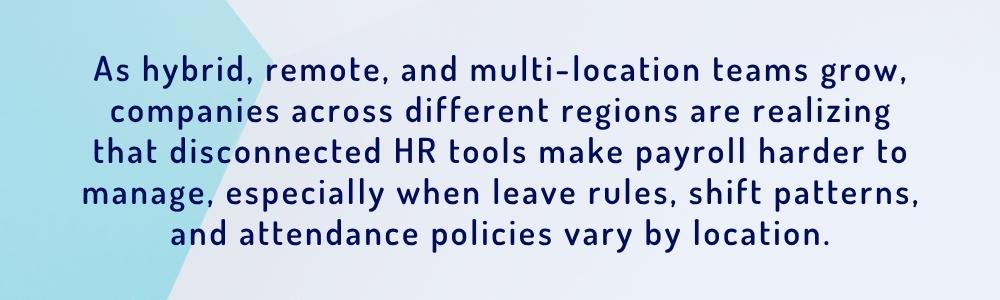
When they work separately, HR spends too much time correcting mistakes. When they work together, payroll becomes cleaner, employees gain greater clarity, and managers have greater visibility.
Integrated HR software helps businesses reduce manual work, avoid payroll surprises, and manage workforce data with more confidence.
HR HUB helps companies bring employee records, leave management, attendance, shift planning, approvals, payroll, reporting, and self-service into a single connected HRMS platform. For businesses operating across India, the Cayman Islands, the US, Canada, or multiple locations, HR HUB supports configurable workflows and payroll-ready data, ensuring important updates do not get lost between departments.
Because HR should not feel like a monthly search for missing data, it should be clear, connected, and ready for the next step.