It usually starts with one innocent question.
“Why has payroll increased this month?”
Then comes the silence.
Finance says overtime went up. HR says attendance issues have increased. Managers say the workload was high. Someone mentions a new hire. Someone else says, “Actually, three people resigned last month.”
And suddenly, one payroll question turns into a full business investigation.
This is exactly why HR analytics reports matter.
Not because business owners need more charts. Not because HR teams need more files. But because people-related decisions affect cost, performance, compliance, customer service, and growth. When employee data is scattered across spreadsheets, emails, attendance systems, payroll files, and manager updates, business owners end up making decisions with half the picture.
Good HR reports bring that picture together.
They show what is happening, where the problem is growing, and what needs attention before it becomes expensive.
Why Business Owners Need Better HR Analytics Reports
In a small team, it is easy to know what is going on. You know who is punctual, who is overloaded, who is underperforming, and who always seems to take leave right before a deadline.
But once the business grows, memory is not enough.
You may have multiple departments, shifts, branches, remote employees, payroll categories, and approval flows. At that stage, “everything is fine” is not a reliable business update.
Business owners need HR reports that answer real questions:
- Are we hiring in the right areas?
- Is payroll increasing for the right reasons?
- Are employees regularly absent or late?
- Are good employees leaving?
- Are managers approving too much overtime?
- Are performance reviews actually happening?
- Are compliance records complete?
That is where HR reporting software becomes useful. It gives owners and HR teams a cleaner way to track people data without relying on manual follow-ups when questions arise.
Headcount HR Analytics Reports: Are You Growing or Just Adding People?
A headcount report sounds simple, but it can reveal a lot.
It shows how many employees are active, where they work, which departments they belong to, and how the team structure is changing over time.
For example, your company may have hired 20 people in the last quarter, but if most of them joined support roles while operations are short-staffed, the business may still feel stretched. Or sales headcount may have increased, but revenue may not have moved much.
That is not just an HR concern. That is a business planning concern.
What to Track?
A good headcount report should include:
- Active employees
- Department-wise employee count
- Location-wise employee count
- New joiners
- Exits
- Employment type
- Probation and confirmed employees
This report helps owners see whether the company is growing in a structured way or simply getting bigger.
Attendance HR Analytics Reports: The Daily Reality Check for Workforce Discipline
Attendance reports are not just about who came in and who did not.
They show discipline, reliability, staffing pressure, and sometimes even manager control.
If one department has repeated late marks, frequent missed punches, or too many attendance corrections, something needs attention. Maybe shift timing is unrealistic. Maybe the team is disengaged. Maybe the manager is approving corrections too casually. Or maybe everyone is genuinely stuck in traffic, and the office location deserves a small apology.
Either way, the report gives you a starting point.
What to Track?
Attendance reports should include:
- Present and absent days
- Late marks
- Early exits
- Missed punches
- Shift-wise attendance
- Work-from-home entries
- Attendance correction requests
- Department-wise attendance trends
The goal is not to create a strict workplace where everyone feels watched. The goal is fairness. When attendance rules are visible and consistent, employees trust the process more.
Leave HR Analytics Reports: Because “Just One Day” Adds Up
Leave is normal. Employees need time off.
The problem begins when leave patterns are not visible.
One casual leave is fine. Repeated unplanned leaves during payroll week, customer rush, month-end closing, or project delivery may create real business pressure.
A leave report helps business owners understand how time off is used across teams and whether managers are properly planning coverage.
What to Track
A useful leave report should include:
- Leave balance
- Leave taken
- Pending leave approvals
- Unpaid leave
- Department-wise leave usage
- Frequent leave patterns
- Approval delays Leave during critical business periods.
This helps managers plan more effectively rather than react at the last minute. It also protects employees from unfair treatment because leave decisions are based on clear records rather than memory.
Payroll HR Analytics Reports: Follow the Money Before Costs Get Out of Control
Payroll is one of the highest monthly costs for most businesses.
Still, many owners only check the final payout amount. That is like looking at the total on a restaurant bill without checking who ordered the extra dessert.
A payroll report should explain what changed and why.
Did overtime increase? Were incentives paid? Did new employees join? Were arrears processed? Did unpaid leave reduce salary? Were deductions applied correctly?
Payroll reports help owners understand cost movements rather than just the final number.
What to Track?
Payroll reports should include:
- Gross salary
- Net salary
- Allowances
- Deductions
- Overtime payout
- Incentives and bonuses
- Employer contributions
- Department-wise payroll cost
- Payroll variance from the previous month
- Salary hold cases
When payroll data is linked to attendance and performance data, it becomes even more useful. If payroll cost is rising but output is not improving, the business needs to investigate.
Overtime HR Analytics Reports: The Silent Cost Leak Business Owners Should Track
Overtime can be necessary. Some projects, seasons, and service businesses genuinely need extra hours.
But overtime should not become a habit that nobody questions.
If the same employees are working extra hours every week, it may mean the team is understaffed, shifts are poorly planned, or work is not being distributed properly.
What to Track
An overtime report should show:
- Total overtime hours
- Overtime payout
- Employee-wise overtime
- Department-wise overtime
- Weekend overtime
- Holiday overtime
- Manager-wise approvals
- Repeated overtime cases
Overtime affects both cost and employee health. A team that is always working late may look committed today, but tomorrow it may become tired, frustrated, and ready to resign.
Employee Performance Metrics: Loud Is Not Always Productive
Every workplace has a few familiar characters.
- The quiet performer who delivers consistently.
- The busy-looking employee whose work somehow never finishes.
- The highly visible employee who appears in every meeting.
- The talented employee who needs better guidance.
This is why employee performance metrics are important. They help business owners move beyond gut feeling.
Performance reports show who is meeting goals, who needs support, who is improving, and who may be ready for more responsibility.
What to Track
A performance report should include:
- Goal completion
- Manager ratings
- Self-review status
- Performance review completion
- Training needs
- Improvement plans
- Top performers
- Low performers
- Department-wise performance trends
The purpose is not to reduce people to numbers. The purpose is to make decisions fairer. Promotions, increments, rewards, and training plans should not depend only on who speaks the loudest in meetings.
Attrition HR Analytics Reports: The Goodbye Pattern Every Business Owner Should Notice
One resignation may be normal.
Five resignations from the same department are not normal.
Attrition reports help business owners understand who is leaving, when they leave, and why.
This matters because every exit has a hidden cost. Hiring takes time. Training takes effort. Knowledge leaves with the employee. Team morale gets affected. Customers may feel the gap.
What to Track
Attrition reports should include:
- Monthly exits
- Voluntary and involuntary exits
- Department-wise attrition
- Location-wise attrition
- Probation exits
- Tenure before exit
- Exit reasons
- Manager-wise attrition
- High performer exits
If employees are leaving within the first few months, the quality of onboarding or hiring may need to be reviewed. If experienced employees are leaving, growth, pay, workload, or manager behavior may be the reason.
The report helps you catch the pattern before more resignation emails arrive.
Recruitment HR Analytics Reports: Hiring Without Guesswork
Hiring can look simple until it starts dragging.
Candidates do not respond. Managers delay feedback. Offers get rejected. Someone accepts and then disappears before joining. Suddenly, one vacancy becomes a two-month headache.
A recruitment report shows whether the hiring process is moving properly.
What to Track
Recruitment reports should include:
- Open positions
- Applications received
- Shortlisted candidates
- Interview status
- Offer status
- Offer acceptance rate
- Time to hire
- Source of hire
- Joined candidates
- Dropouts before joining
- Hiring manager delays
This helps business owners understand which roles are hard to fill, which sources bring better candidates, and where the process is getting stuck.
For business owners who want to understand how dashboards turn scattered attendance, payroll, and performance data into clearer decisions, this detailed guide to HR reporting dashboards and analytics software explains the concept in practical terms.
Onboarding HR Analytics Reports: The First Impression Test for New Employees
A new employee’s first week says a lot about the company.
If login access is delayed, documents are missing, the manager is unprepared, and no one explains the role properly, the employee may begin to question the decision to join.
An onboarding report helps HR and managers make sure every new hire gets a proper start.
What to Track
Onboarding reports should include:
- Joining formalities
- Pending documents
- System access status
- Policy acknowledgements
- Training completion
- Manager check-ins
- Probation review status
- New hire feedback
- Early resignation cases
Good onboarding reduces confusion and improves early employee confidence. Poor onboarding quietly increases early attrition.
Compliance HR Analytics Reports: The Report You Do Not Want to Prepare in Panic
Compliance is usually ignored until someone urgently needs a document.
Then everyone starts searching through folders, emails, and old files as if it were a treasure hunt.
A compliance report helps businesses stay prepared.
For companies in India, the Cayman Islands, the US, and Canada, HR compliance may involve contracts, payroll records, statutory deductions, benefits, work permits, policy acknowledgments, employee classifications, and document renewals.
What to Track
Compliance reports should include:
- Missing employee documents
- Expired documents
- Contract status
- Policy acknowledgment status
- Payroll compliance summary
- Statutory deduction records
- Work permit or visa document status, where applicable
- Pending approvals
- Audit trail of HR changes
This report reduces risk and helps owners avoid last-minute stress during audits, renewals, inspections, or internal reviews.
HR Dashboards: One Clear View for Busy Business Owners
Business owners do not always have time to read every report in detail.
That is why HR dashboards are helpful.
A good dashboard brings the most important HR numbers into one clean view. It should not look like someone added every chart possible just because the software allowed it.
What to Track
A useful dashboard should show:
- Total headcount
- New joiners
- Exits
- Attendance exceptions
- Leave trends
- Payroll cost
- Overtime cost
- Open positions
- Performance review status
- Compliance alerts
- Pending approvals
HR dashboards help owners quickly see what changed, what needs attention, and where follow-up is required.
How Often Should You Review HR Analytics Reports?
Not every report needs daily review.
Some should be checked weekly, some monthly, and some quarterly.
Weekly Reports
- Attendance exceptions
- Overtime
- Pending approvals
- Leave conflicts
- Recruitment status
Monthly Reports
- Payroll cost
- Attrition
- Onboarding
- Compliance gaps
- Performance review progress
- Department-wise workforce trends
Quarterly Reports
- Training outcomes
- Engagement trends
- Manager effectiveness
- Retention patterns
- Workforce planning
The frequency depends on the business. A retail store may check attendance and overtime more often. A software company may focus more on hiring, performance, and retention. A compliance-heavy business may regularly review documents and approval trails.
The Real Mistake: Tracking Too Many HR Reports Without Clear Action
More reports do not always mean better control.
Sometimes businesses create so many reports that nobody knows which ones matter.
The best HR analytics reports are not the longest ones. They are the ones that lead to action.
A useful report should help you decide whether to hire, train, reward, review, reduce overtime, support a manager, improve onboarding, or fix a compliance gap.
If a report does not help anyone make a better decision, it may just be digital clutter.
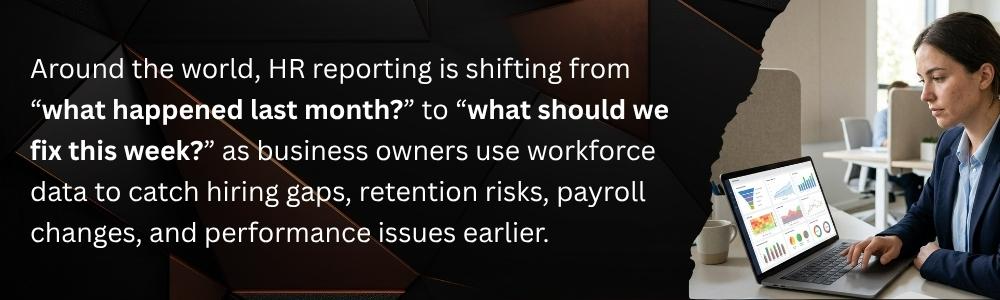
The Reports Are Speaking: Is Your HR Reporting Software Helping You Listen?
HR reports are not just admin documents. They are business signals.
- Attendance reports show reliability.
- Leave reports show planning gaps.
- Payroll reports show cost movement.
- Overtime reports show hidden pressure.
- Performance reports show growth and support needs.
- Attrition reports show retention risks.
- Recruitment reports show hiring health.
- Compliance reports show business readiness.
When business owners track the right reports, they stop depending on assumptions and start seeing patterns earlier.
This is where HR HUB can help.
HR HUB brings employee information, attendance, leave, payroll, workflows, approvals, performance records, and reporting into one organized HR platform. With structured reports and practical dashboards, business owners can get clearer visibility into their workforce without chasing scattered updates or waiting for manual spreadsheets.
For businesses in India, the Cayman Islands, the US, and Canada, this kind of visibility makes daily HR management easier, records cleaner, and people decisions more confident.
Because the right HR reports do not just tell you what happened.
They show what needs your attention next.