Picture this.
It is Monday morning. The head office HR team is ready to process payroll. Coffee is on the desk. The laptop is open. Everything feels under control.
Then the message begins.
The Mumbai branch says two employees forgot to mark attendance last week. The Toronto office has a leave correction pending. The Cayman branch has a holiday update that was not reflected in the sheet. The US team has overtime entries waiting for approval. One manager says, “I already approved it.” Another says, “I thought finance was checking it.” Someone else sends an updated Excel file named Final_Version_3_Actually_Final.xlsx.
At that point, HR is no longer managing people. HR is solving a mystery.
For companies with multiple branches, this is not rare. It happens quietly every month. One location follows one process. Another location follows its own style. A third location has a manager who believes WhatsApp approvals are a complete HR system. Over time, these small differences create confusion, payroll mistakes, delayed approvals, compliance gaps, and inconsistent employee experiences.
This is where multi-location of HR software becomes more than just another business tool. It becomes a common thread that connects every branch, every manager, every employee, and every HR process into one organized system.
For growing companies in India, the Cayman Islands, the US, and Canada, managing people across locations is not only about having more employees. It is about keeping every branch connected without turning HR into a daily firefighting department.
Why Multi-Location HR Software Solves More Than Distance Across Branches
When a company opens a new branch, everyone is excited. New market, new team, new customers, new opportunities. The trouble usually starts later, when each location slowly begins creating its own way of handling HR.
At first, it seemed harmless.
One branch tracks attendance in Excel. Another uses biometric data. One manager approves leave over email. Another wants employees to send a message first. One location updates employee document on time. Another keeps them in a folder that only one person knows about. If that person goes on leave, the folder might as well be hidden treasure.
The issue is not that branches are doing something wrong on purpose. Most of the time, people are simply trying to get work done with whatever system they have. The problem is that every separate method creates a separate version of the truth.
That is dangerous for a growing company.
If attendance is different in every location, payroll becomes risky. If leave rules are not followed consistently, employees begin comparing experiences. If documents are not tracked properly, compliance becomes weak. If managers approve requests differently, HR loses control over the process.
This is why HR software for multiple locations matters. It does not force every branch to become identical. It gives every branch a shared structure, so people know what to do, where to do it, and who is responsible.
Why Multi-Branch Employee Management Gets Complicated as Companies Grow
Multi-branch employee management becomes complicated because people in operations touch almost every part of the business. HR is not only about hiring and salary processing. It includes attendance, leave, payroll, documents, assets, onboarding, exits, approvals, compliance, reporting, policies, and employee communication.
Now multiply all of that into five branches. Or ten. Or twenty.
Suddenly, even a simple question like “How many employees are active right now?” It can take half a day to answer.
Why? Because the HR team may need to check:
- Branch-wise employee lists
- New joiners not yet added to payroll
- Employees serving notice period
- Contract staff
- Transferred employees
- Employees on long leave
- Inactive records that were never updated
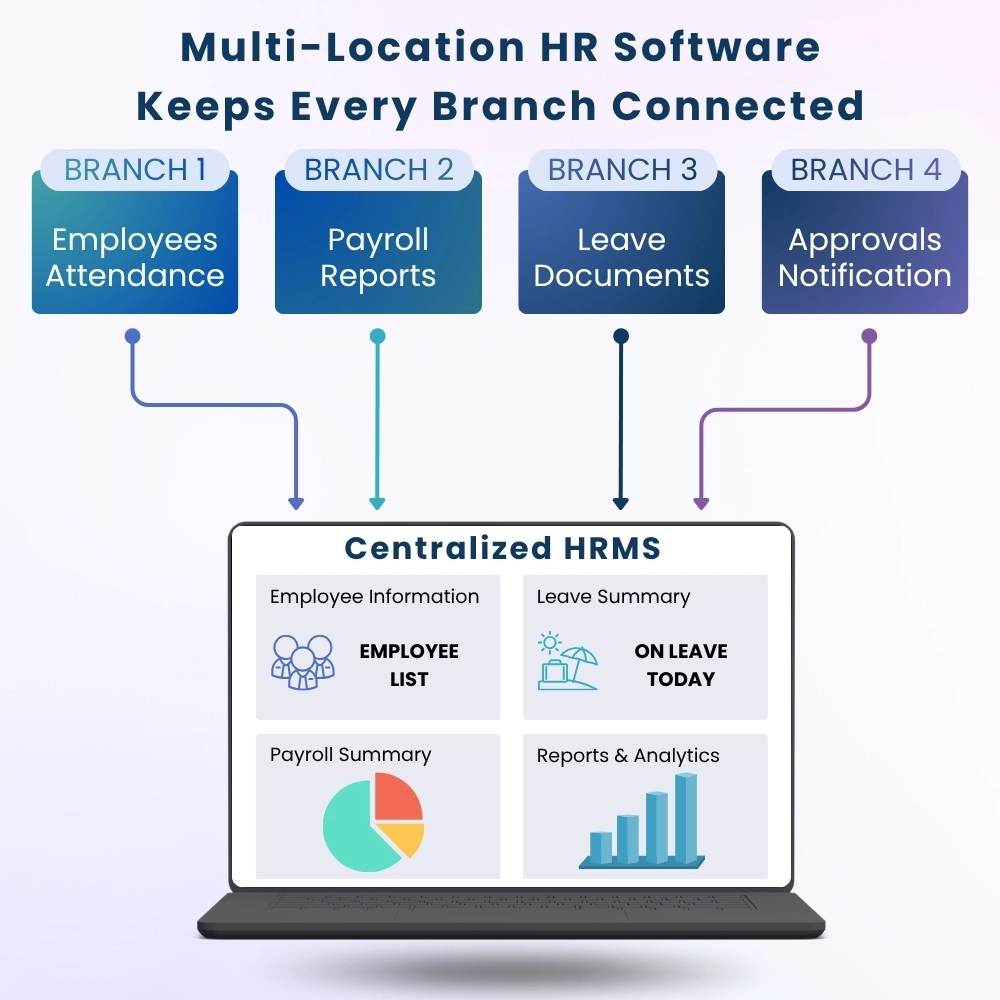
This is where a centralized HRMS changes the experience. Instead of asking every branch to send updates, HR can view employee information from one system. Instead of depending on memory, the system becomes the source of truth.
And honestly, HR deserves better than chasing branch-wise spreadsheets like it is a competitive sport.
How a Centralized HRMS Gives Every Branch One Reliable Employee Record
Employee data is the starting point for almost every HR decision. If employee records are incomplete, everything that follows becomes shaky.
A centralized HRMS gives companies one place to maintain employee information across all branches. Personal details, job details, department, designation, reporting manager, branch, salary structure, joining date, documents, emergency contacts, tax details, and compliance records can all be managed from one system.
This is especially helpful when employees move between locations.
Imagine an employee joining the India office, later shifting to Canada, and then working with the Cayman team on a project. Without a centralized system, HR may need to manually update several records, collect documents again, check reporting changes, and confirm payroll settings. With a proper HRMS, the employee’s branch, manager, payroll group, and policy mapping can be updated without losing history.
That history matters.
It helps HR understand the employee’s journey, past roles, document submissions, leave records, payroll changes, and approval trail. It also helps the company avoid duplicating records, missing files, and confusion during audits.
In short, a centralized HRMS gives every employee a clean identity across the company. Not five versions, not six files, not one spreadsheet in someone’s downloads folder.
How HR Software for Multiple Locations Simplifies Attendance Across Branches
Attendance is one of the first areas where inconsistency shows up. One branch may have fixed office hours. Another may work in rotating shifts. A retail store may need weekend scheduling. A warehouse may have overtime. A field team may need mobile attendance. A remote employee may not visit any office at all.
If all of this is managed manually, payroll week becomes stressful.
Multi-location HR software helps companies define attendance rules based on location, department, employee type, or shift pattern. This means every branch can have the flexibility it needs, while HR still gets attendance data in one common system.
How this helps in daily work
Branch managers can review attendance for their own teams.
HR can track late marks, absences, missed punches, and overtime.
Payroll teams can use verified attendance instead of waiting for manual sheets, reducing many common attendance management problems before payroll is processed.
Employees can raise attendance correction requests through a proper workflow.
Management can view branch-wise attendance trends.
This brings order to one of the most sensitive HR processes.
Because let’s be honest, nothing creates office drama faster than salary deductions caused by attendance confusion. One missed punch can produce more emotion than an entire quarterly review meeting.
What a Multi-Location HR Software Makes Leave Management Fair Across Every Branch
Employees do not only care about leave balance. They care about fairness.
If one branch approves leave quickly and another takes days, employees notice. If one manager allows informal leave messages and another follows strict policy, employees notice. If one location updates leave balances properly and another makes employees ask HR every time, employees notice that too.
A centralized leave system helps companies create fairer experience.
Employees can apply for leave through self-service. Managers can approve or reject requests within the system. HR can track balances, holidays, carry-forward rules, unpaid leave, leave history, and approval delays.
This becomes more important for companies working across India, the Cayman Islands, the US, and Canada because leave rules, holiday calendars, and employment expectations can differ by region. A strong system lets companies handle location-specific rules while keeping the process clear for everyone.
The result was simple. Employees know where to apply. Managers know what to approve. HR knows what is pending. Payroll receives cleaner data.
No guesswork. No “I told my manager last week.” No mystery leaves entries appearing after payroll is closed.
How a Centralized HRMS Helps Multi-Branch Companies Reduce Payroll Errors
Payroll is often where all HR mistakes come together.
Attendance errors, leave mismatches, overtime confusion, wrong branch mapping, outdated salary details, missing deductions, and pending approvals all show up during payroll processing. By then, the deadline is close, and everyone wants the salary to be completed.
For multi-branch companies, payroll can become even more complicated because every location may send inputs differently.
A centralized HRMS helps by connecting payroll with employee records, attendance, leave, shifts, overtime, allowances, deductions, and approvals. Instead of collecting files from every branch at the last minute, payroll teams can review verified data from the system.
What becomes easier
- Branch-wise payroll preparation
- Leave without pay tracking
- Overtime calculation
- Salary revision updates
- Allowance and deduction handling
- Payslip generation
- Payroll approval tracking
- Compliance-related records
For India, payroll may include PF, ESI, professional tax, TDS, gratuity, and other statutory considerations. For the US and Canada, payroll may involve federal, state, provincial, or local requirements. For the Cayman Islands, companies may need to track pension, health insurance, work permit-related details, and other employment records.
A good HR system helps organize these differences without turning every payroll cycle into a rescue mission.
How HR Software for Multiple Locations Creates a Consistent Onboarding Experience
A new employee’s first week says a lot about the company.
In one branch, the new joiner may receive a welcome email, document checklist, login details, reporting instructions, policies, and a planned introduction. In another branch, the new joiner may be told, “Just come Monday, we will see.”
That is not a great first impression.
Multi-location HR software helps companies standardize employee onboarding across branches. HR can create onboarding checklists, document requirements, approval steps, asset allocation tasks, policy acknowledgements, and training activities. Branch managers can complete their part, while HR tracks progress from one place.
This makes the new hire experience more reliable.
Whether the employee joins in Ahmedabad, George Town, Toronto, New York, or any other branch, the process can feel organized. The employee knows what to submit. The manager knows what to prepare. HR knows what is completed.
A good onboarding process also reduces follow-up later. Documents are collected properly. Policy acknowledgements are recorded. Access is planned. Probation details are visible. The new employee feels expected, not accidentally discovered.
What a Multi-Location HR Software Keeps HR Policies Consistent Across Branches
A company may have one HR policy, but every location may interpret it differently. This is common in growing companies.
Attendance of grace period, overtime approvals, leave usage, reimbursement rules, travel claims, document submission, remote work approvals, and disciplinary steps can slowly become branch-specific habits. Before long, employees in different branches experienced the same company in different ways.
That is not ideal.
Multi-location of HR software helps companies control policy applications through workflows, system rules, and role-based permissions. HR can define what should be common across the company and what can vary by location.
For example, the company may keep one common approval structure for attendance corrections, but different holiday calendars for each region. It may keep one onboarding checklist for all employees but add extra documents for work permit holders or contractors. It may keep one reporting format for leadership but allow different shift settings for different branches.
This is where a centralized HRMS becomes practical. It does not remove local reality. It gives HR a way to manage local reality without losing control.
How a Centralized HRMS Keeps Approvals from Getting Lost in Email Threads
Every company has one approval request that disappears into the great unknown.
The employee says it was submitted. The manager says they did not receive it. HR says it is still pending. Finance says payroll cannot proceed without approval. Everyone checks emails. Someone searches WhatsApp. Someone says, “Maybe it was discussed on call.”
This is exactly why branch-wise approvals need to be structured.
With HR software for multiple locations, companies can create workflows for leave, attendance correction, overtime, expense claims, shift changes, asset requests, document updates, recruitment approvals, and more.
Requests can move automatically to the right manager based on branch, department, role, or reporting line. HR can see pending items. Employees can track their status. Managers can receive reminders. Escalation rules can help avoid long delays.
This creates accountability without making HR sound like the office police.
The system simply answers three questions:
- Who requested it?
- Who needs to approve it?
- What is the current status?
That alone can remove a lot of daily confusion.
When multi-branch teams depend on spreadsheets, emails, and branch-wise manual records, the cost is not always visible at first. To understand how manual HR quietly drains time, money, and employee trust, read this detailed guide on the hidden cost of manual HR
Reporting Finally Becomes Useful Instead of Painful
Branch-wise reporting is one of the biggest headaches for HR leaders.
When data is scattered, every report becomes a collection exercise. HR asks branches for headcount, attendance, leave, hiring updates, exits, payroll inputs, document status, and pending approvals. Branches respond in different formats. Some send updated files. Some send old files. Some say they will “share shortly,” which is business language for “please remind me again.”
A centralized HRMS changes this by giving leadership access to clean, structured reports.
Useful reports for multi-branch companies
- Branch-wise headcount
- Department-wise employee count
- Attendance trends by location
- Leave usage by branch
- Overtime reports
- Payroll cost by location
- New joiner and exit reports
- Document expiry reports
- Pending approval reports
- Employee turnover by branch
- Recruitment status by location
These reports help leaders understand what is really happening across the company.
If one branch has high absenteeism, HR can look deeper. If another branch has frequent overtime, staffing may need attention. If one location has delayed approvals, the manager may need support. If employee exits are rising in one region, leadership can investigate before it becomes a bigger issue.
Good reporting turns HR from a recordkeeping function into a decision-support function.
Employees Get a Better Experience When HR Is Not Trapped in Admin Work
Employees do not want to chase HR for every small thing. HR does not want to answer the same question fifty times.
- “Can you send my payslip?”
- “How many leaves do I have?”
- “Was my attendance correction approved?”
- “Where is the holiday list?”
- “Did my document get uploaded?”
- “Who approves this request?”
Employee self-service helps solve this problem.
With multi-location HR software, employees can access their own information, apply for leave, view attendance, download payslips, submit documents, check request status, and update selected details based on company rules.
This is especially useful for companies with employees across different locations and time zones. An employee in Canada should not need to wait for India office hours just to download a payslip. A branch employee in the Cayman Islands should not have to send three follow-up emails for a leave balance. A field employee should not feel disconnected from HR because they are not sitting in the head office.
A better employee experience often starts with simple access to the right information.
What a Multi-Location HR Software Helps HR Teams Grow Without Adding Chaos
Business growth is exciting. HR chaos is not.
When a company opens new branches, hires more employees, enters new regions, or adds more departments, HR processes must be strong enough to support that growth. If the company depends only on manual records, each new branch adds more pressure.
More employee files. More attendance data. More payroll inputs. More approval. More documents. More reports. More follow-ups.
At some point, HR becomes busy but not always productive.
Multi-location of HR software helps companies scale their HR operations with better control. New branches can be added to the system. Employees can be mapped to the right location. Policies can be assigned. Approval workflows can be configured. Payroll inputs can be reviewed. Reports can be generated without asking every branch for updates.
This helps HR teams spend less time chasing information and more time improving employee experience, compliance readiness, workforce planning, and manager support.
That is the real value. The software does not replace HR. It gives HR breathing room.
Signs Your Company Has Outgrown Manual Multi-Branch Employee Management
Sometimes companies do not realize they need a better system until the problems become regular.
Here are a few signs that your business may need multi-location HR software:
- Every branch maintains its own employee records.
- Payroll depends on manually shared attendance files.
- Leave approvals happen through emails, calls, or messages.
- Employees receive different HR experiences in different locations.
- Branch managers follow different approval habits.
- HR struggles to get accurate branch-wise reports.
- Employee documents are stored in multiple places.
- Payroll corrections are increasing.
- Transfers between branches take too much manual work.
- Leadership cannot quickly view accurate employee data across locations.
If several of this sound familiar, the company has likely outgrown branch-wise manual HR management.
And no, adding one more Excel sheet is not the answer. That is just giving the problem a new outfit.
What to Look for in HR Software for Multiple Locations
Choosing HR software for a multi-branch company should not be based only on a feature checklist. The system must fit how the business actually works.
A company should look for software that supports both central control and branch-level flexibility.
Key capabilities to consider
- Centralized employee database
- Branch-wise employee mapping
- Location-specific policies
- Attendance and shift management
- Leave workflows
- Payroll-ready data
- Role-based access
- Employee self-service
- Document management
- Branch-wise reporting
- Approval workflows
- Audit trails
- Mobile access for remote or field employees
- Regional compliance support
- Scalable setup for future branches
The right system should make daily HR work simpler for employees, managers, HR teams, and leadership. If the software creates more confusion than it solves, it is just a digital version of the old problem.
How HR HUB Helps Multi-Branch Companies Stay on the Same Page
Multi-branch companies do not struggle because they have too many people. They struggle because people-related processes are happening in too many different ways.
One branch cannot run on spreadsheets, another on emails, another on memory, and another on “ask Rajesh, he knows.” That may work for a few weeks, but it cannot support serious growth.
Multi-location of HR software gives companies a better way to manage employees across branches. It connects employee data, attendance, leave, payroll inputs, approvals, onboarding, documents, and reports into one organized system. It helps HR create consistency without ignoring local requirements. It gives managers clearer responsibility. It gives employees better experience. It gives leadership better visibility.
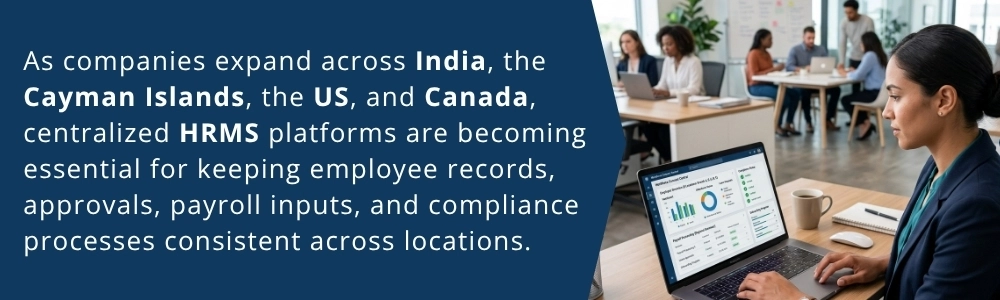
For companies operating across India, the Cayman Islands, the US, and Canada, this kind of control is especially useful because every region can bring different payroll rules, holiday calendars, compliance needs, and workforce expectations.
HR HUB is designed to help growing companies manage these moving parts from one place. With modules for employee information, attendance, leave, payroll, workflows, self-service, document management, onboarding, and reporting, HR HUB helps multi-branch businesses create a more consistent employee management experience across every location.
Because when every branch works from the same HR playbook, the company does not just become easier to manage. It becomes easier to trust.