What if the biggest barrier in your workplace is not talent, but design?
Not office design. Not culture decks. Not policies framed on walls.
System design.
In 2026, organizations across India, the Cayman Islands, the US, and Canada are waking up to a powerful realization. Inclusion does not begin with statements. It begins with systems. The tools employees use every day either empower them quietly or exhaust them silently.
And that is exactly where inclusive HR software changes the story.
This is not about adding an accessibility checkbox. It is about designing HR technology that supports every brain type, every processing style, and every way of thinking.
The Silent Friction in Modern Workplaces: Why Inclusive HR Software Matters for Neurodiversity in the Workplace
Picture this more clearly.
An employee logs into the HR portal to submit a leave request before an important medical appointment. The screen loads slowly. Multiple banners flash announcements. A chatbot window pops up. Five widgets compete for attention. The leave application link is buried inside a submenu. The approval workflow is not explained. There is no confirmation message after submission.
What should have taken two minutes now feels like ten.
For some employees, this is irritating.
For others, especially those contributing to neurodiversity in the workplace, it is exhausting.
Cognitive overload is real. When systems are visually crowded, instructions are unclear, and processes are unpredictable, they demand extra mental effort. Employees who are autistic, ADHD, dyslexic, dyspraxic, or who process information differently often expend additional energy simply navigating systems before they even begin their actual work.
Over time, this silent friction accumulates.
It impacts confidence. It impacts speed. It impacts willingness to engage.
Here's the unsettling reality. Many businesses mistakenly believe that this friction indicates a lack of competency or disengagement.
However, capability is not the problem.
Design is the problem.
HR technology inadvertently excludes people with varied perspectives because it presupposes a single, universal method of reading, responding, and navigating. The irony is potent. The same professionals who bring analytical precision, pattern recognition, creativity, and hyper-focus may struggle with the administrative systems meant to support them.
Removing silent friction is not about simplification for its own sake. It is about respecting cognitive diversity at a structural level.
Neurodiversity in the Workplace as a Competitive Advantage in the Era of Inclusive HR Software
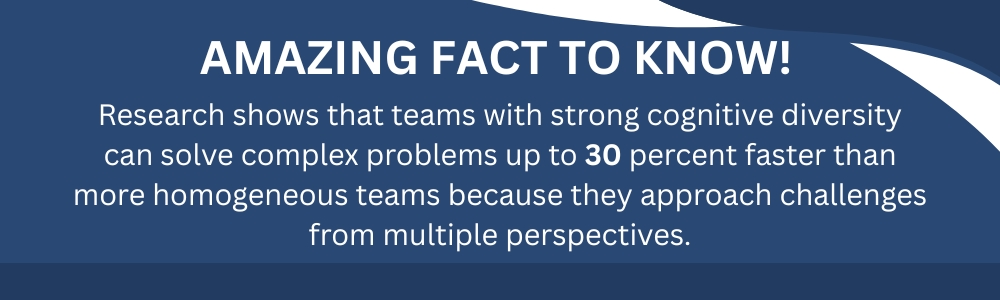
The global workforce is changing quickly. Leaders at public institutions in Canada, hospital networks in the US, financial services in the Cayman Islands, and technology companies in India are noticing a trend. Teams with a variety of cognitive styles function better than homogeneous ones.
Why?
Because contrast fosters inventiveness.
Visually minded professionals see things that others miss. Risks are identified early by those who absorb information thoroughly. Unconventional communicators may address issues from perspectives that challenge groupthink.
However, traditional HR systems were developed decades ago based on the assumption of homogeneity.
- Standardized appraisals assume identical communication styles.
- Rigid onboarding assumes one learning pace.
- Text-heavy policies assume a comfortable reading pace and speed.
- Overstimulating dashboards assume a high level of visual tolerance for complexity.
To truly support neurodiversity in the workplace, organizations must stop treating it as a diversity checkbox and start recognizing it as a strategic resource.
Workshops to raise awareness are a first step; however, irritation results from awareness that is not structurally aligned. Digital architecture must incorporate inclusion.
At this point, inclusive HR software becomes a competitive advantage rather than just a nice-to-have. It turns neurodiversity into a performance driver rather than a compliance issue.
Inclusive HR Software Designed for Clarity: How Accessible HR Platforms Reduce Cognitive Load
The most effective techniques are effortless.
One tenet underpins an HR software platform that is genuinely inclusive. Reduce cognitive load so workers can focus on important tasks.
This goes beyond simple design. It denotes deliberate organization.
- Clear navigation without hidden steps eliminates guesswork.
- Structured workflows replace ambiguity with predictability.
- Adjustable notification settings prevent distraction overload.
- Visual goal trackers provide measurable clarity.
- Simplified dashboards reduce decision fatigue.
Employees recover power when they have a say in how information is conveyed. Anxiety is lessened with control. Performance is enhanced when anxiety is reduced.
For this reason, top companies are investing in accessible HR systems that emphasize high-contrast display modes, readable fonts, consistent layout patterns, logical workflows, and screen reader compatibility.
Being clear is not a superficial trait. It's efficiency in operations.
Reducing expectations is not the goal of inclusion. The goal is to eliminate pointless obstacles that squander mental energy.
Building a Sensory-Friendly Employee Experience with Accessible HR Platforms and Inclusive HR Software
We often talk about sensory overload in physical spaces. Loud offices. Bright lights. Constant interruptions.
But digital overload can be just as intense.
Icons that flash. banners with animation. charts with lots of color. endless pop-ups. Sound warnings. streams of unfiltered notifications.
This artificial noise subtly raises stress levels among many workers. Others see a direct decrease in focus and productivity.
Intentional stillness is the first step in creating a sensory-friendly work environment.
- Minimalist interface options reduce clutter.
- Dark mode features support visual comfort.
- Clear typography improves readability.
- Reduced animation prevents distraction.
- Controlled notification frequency limits interruption.
It has a modest yet potent effect. Employees stay engaged longer and commit fewer mistakes when they feel secure and at ease using technology.
A sensory-friendly employee experience recognizes that increasing notifications is not the only way to boost productivity. It involves designing spaces that are conducive to concentration.
Technology creates psychological safety when it respects sensory limitations.
Cognitive Diversity Tech: How Inclusive HR Software Turns Different Thinking Styles into Performance Drivers
The next chapter of HR is not automation for speed alone. It is intelligence aligned with human variation.
Cognitive diversity tech goes beyond accommodation. It actively amplifies strengths.
- Imagine recruitment systems that assess real skills instead of personality similarity.
- Imagine performance platforms that let employees choose from structured feedback templates instead of open-ended narratives.
- Imagine analytics tools that identify strength clusters rather than highlighting communication gaps.
Progressive organizations have already begun to experience this.
Systems reveal untapped potential when they provide visual progress tracking, flexible evaluation techniques, and multiple communication channels.
A worker who finds it difficult to provide candid verbal criticism could do well in structured written reflections. Goal dashboards may be more effective for a professional who prefers visual mapping than for those who prefer reports with a lot of text.
Inclusion becomes scalable when cognitive diversity technology is integrated into HR processes. It shifts from case-by-case accommodations to design for the entire company.
At that point, diversity ceases to be reactive and begins to have a quantifiable influence on business.
From Policy to Practice: RPWD Act Compliance (India) and the Role of Inclusive HR Software
Regulation often feels like an obligation. But when approached strategically, it becomes clear.
The Rights of Persons with Disabilities Act, 2016, in India outlines employers' obligations regarding accessibility and equal opportunity. It requires written policies, accessible records, easy-to-use systems, and open accommodation procedures to comply with the RPWD Act (India).
The Americans with Disabilities Act establishes guidelines for accessibility and nondiscrimination in the US. The Accessible Canada Act bolsters inclusive policies in Canada.
Compliance can feel overwhelming when systems are fragmented.
But with inclusive HR software, compliance becomes structured.
- Organizations can securely track accommodation requests.
- Maintain confidential disability-related records.
- Generate audit-ready reports.
- Document policy acknowledgment digitally.
- Ensure accessible recruitment and onboarding workflows.
HR teams go from reactive paperwork to proactive governance when technology facilitates compliance with the RPWD Act (India) and other international norms.
Then, rather than being a last-minute rush, compliance becomes the cornerstone of trust.
To learn more about features that make onboarding systems more intuitive and supportive for diverse employees, check out this article on Top Features to Look for in Employee Onboarding Software in 2026.
Accessible HR Platforms That Support Neurodiversity in the Workplace from Recruitment to Onboarding
Inclusion must begin before the first day of work.
Long, confusing job application forms can discourage highly capable candidates. Timed assessments may disadvantage thoughtful processors. Ambiguous job descriptions may create unnecessary uncertainty.
Modern accessible HR platforms approach recruitment differently.
- They use plain-language job descriptions that clarify expectations.
- They offer flexible assessment timing.
- They provide structured interview scoring to reduce bias.
- They include digital accommodation request options.
- They design step-by-step onboarding trackers that remove ambiguity.
Anxiety is decreased by predictability. Openness fosters trust.
New hires feel more grounded rather than overwhelmed when onboarding tools clearly show progress, forthcoming tasks, and expected dates.
Inclusion thus turns from a theoretical concept to a practical one.
Technology as a Signal of Belonging: How Inclusive HR Software Enables a Sensory-Friendly Employee Experience
Employees notice small details more than leaders realize.
- They notice when systems allow font resizing.
- They notice when instructions are broken into structured steps.
- They notice when feedback templates guide rather than judge.
- They notice when dashboards can be personalized.
These details communicate respect.
When organizations invest in inclusive HR software, they communicate something powerful without saying it directly. Every mind matters here.
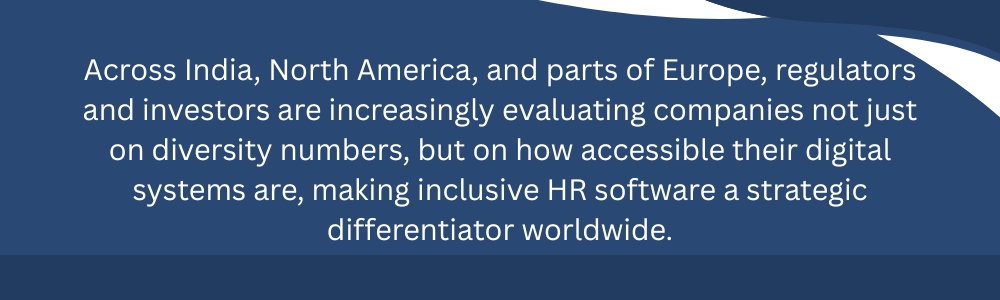
Across India, the Cayman Islands, the US, and Canada, workplaces are becoming more cognitively and culturally diverse. Companies that prioritize accessible HR platforms, integrate cognitive diversity tech, and design for a sensory-friendly employee experience are not just meeting compliance standards; they are also creating a better employeeexperiences. They are shaping innovation cultures.
Inclusion embedded into technology becomes almost invisible.
And yet, it transforms everything.
Designing Workplaces That Work for Every Mind with Inclusive HR Software and Cognitive Diversity Tech
Neuro-inclusion is not an initiative that sits inside a presentation deck. It is a design philosophy.
Supporting neurodiversity in the workplace requires rethinking recruitment, onboarding, performance, communication, and compliance from the ground up. It requires systems that comply with the RPWD Act (India) and global accessibility laws. It requires digital environments that feel calm, clear, and adaptable.
This is where HR HUB steps in.
HR HUB is built as an inclusive HR software solution designed to support modern, diverse workplaces. With configurable workflows, structured performance systems, customizable dashboards, secure compliance tracking, and accessible design principles, HR HUB enables organizations to create truly inclusive digital ecosystems.
From onboarding to performance management and compliance reporting, HR HUB supports accessible HR platforms, integrates elements of cognitive diversity tech, and helps organizations move closer to a genuinely sensory-friendly employee experience.
The future of work is not about forcing people to fit systems.
It is about designing systems that understand people.
And in 2026, that is the real competitive advantage.