There was a time when payday meant relief.
Payday now lasts only a few hours for many workers in the US, Canada, the Cayman Islands, and India. The bills have been paid. EMIs are subtracted. The amount on credit cards decreases a little. The question "How do I make this last?" then comes up again.
Most corporations are gradually realizing this difficult fact. Security is not ensured by salary alone. Furthermore, why is payroll still restricted to numbers if it represents the most reliable means of communication between workers and their employers?
In 2026, the conversation shifts from “How much do we pay?” to “How stable do our employees feel?”
That is where employee financial wellness solutions enter the picture, not as an optional benefit, but as a strategic payroll upgrade.
The Hidden Cost of Financial Stress and the Need for Financial Health in the Workplace
Financial stress rarely announces itself loudly. It does not arrive with a formal complaint or an HR ticket. It seeps in quietly and embeds itself into everyday work behavior.
- An employee is distracted in meetings, nodding along but mentally calculating upcoming bills.
- A top performer updating their resume late at night, not because they are dissatisfied with the job, but because they need a higher income.
- A team member saying yes to overtime, not out of ambition, but because the month feels longer than the salary cycle.
Money-related stress affects how decisions are made. It helps focus. It shifts the focus from innovation to survival.
In India, middle-class professionals are severely impacted by the rising costs of urban living and education. Employees in the US and Canada are forced into credit cycles by housing and healthcare demands. Even steady earners in the Cayman Islands are affected by rising living costs. The pattern is the same in each of these areas.
When financial pressure builds:
- Productivity shrinks because money worries consume mental bandwidth.
- Engagement weakens because employees operate in defensive mode.
- Absenteeism rises due to stress-related health concerns.
- Mental health deteriorates under constant financial uncertainty.
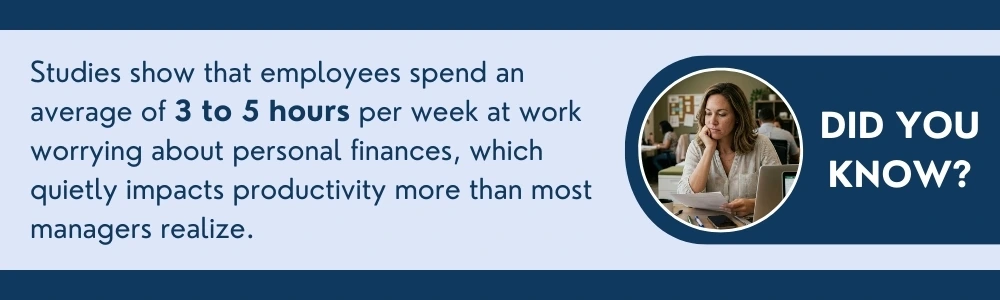
Money-related stress impairs cognitive function. Studies regularly demonstrate that anxiety related to money affects one's capacity for concentration, memory recall, and problem-solving.
For this reason, workplace financial health is no longer a wellness fad. It's a measure of performance. It affects long-term organizational stability, retention, and output.
Businesses that disregard this fact suffer from decreased morale, disengagement, and turnover expenses. Recruiting expenses increase. Investments in training are lost. Silently, culture suffers.
Organizations that address it build something far more valuable than payroll accuracy. They build trust. And trust converts into loyalty.
From Salary Processing to Stability Strategy with Employee Financial Wellness Solutions
Payroll departments in the past were built with accuracy in mind. adherence. rapid transfers. clean audits.
That basis is still essential. There is no compromise on accuracy. Adherence to regulations is crucial.
However, stability cannot be achieved by precision alone.
Payroll in the modern era needs to develop into a systematic support system. Implementing financial wellness programs for staff members that seamlessly interface with payroll systems is the first step in that transition.
Payroll is transformed from a monthly transaction into a living system that supports workers throughout the pay cycle.
A forward-thinking payroll strategy:
- Enables structured savings directly from salary before discretionary spending occurs.
- Offers controlled liquidity access during emergencies.
- Supports debt reduction through automated repayment scheduling.
- Improves financial literacy through embedded tools and nudges.
- Encourages long-term planning with retirement and investments with prompts.
With this change, payroll becomes a foundation for workforce stability rather than an expense-processing engine.
Work quality automatically improves when payroll promotes consistency. When workers are not in a state of financial survival, they perform better.
How Payroll-Linked Wellness Transforms Employee Financial Wellness Solutions into Measurable Impact
Imagine if every payroll cycle quietly strengthened your employees’ financial position without adding complexity to their lives.
That's what payroll-linked wellness is all about.
Payroll systems can be integrated with structured financial tools to enable businesses to build background-operating, automated support systems.
This includes:
- Micro savings allocation that diverts small amounts into emergency funds.
- Responsible advance wage options tied to earned income visibility.
- Scheduled debt repayments aligned with salary cycles.
- Budget tracking dashboards are integrated within employee self-service portals.
- Financial education nudges triggered at key salary milestones.
Payroll-linked wellness's strength lies in its seamless integration. Workers don't require manual procedures, external lenders, or different apps. The system that already manages their revenue includes built-in support.
This framework guarantees traceability, audit trails, and regulatory compliance in regulated markets such as the US, Canada, and India. It improves employer trust and openness within the Cayman Islands' closely-knit business community.
Wellness linked to payroll eliminates friction. Additionally, involvement rises when support is seamless.
Earned Wage Access (EWA) Benefits: A Smarter Approach to Payroll-Linked Wellness
Unexpected medical bills. School fees. Car repairs. Emergency travel. These events do not align with payroll calendars.
Life does not wait for payday.
Earned Wage Access (EWA) perks are changing payroll discussions around the world. Before the planned payday, EWA enables workers to access a portion of their previously earned wages.
It becomes a safety valve that lessens financial worry when used properly.
However, success depends on how it is implemented.
It is never appropriate for EWA to function as an unofficial credit facility. It must be:
- Capped to prevent overuse.
- Transparent with clear cost structures.
- Compliant with local labor regulations.
- Clearly documented within employment policies.
- Structured and automated within payroll systems.
Compliance with wage payment regulations is crucial in India. State and provincial laws need to be examined in the US and Canada. Clear contracts guarantee employer protection in the Cayman Islands.
Benefits from Earned Wage Access (EWA) can lessen reliance on credit cards, payday lenders, and unofficial lending networks when properly designed.
Employees gain flexibility without long-term damage.
Liquidity without chaos. That is the balance payroll must achieve in 2026.
Solving Workplace Debt with Employee Debt Management Tech and Financial Health in the Workplace
Debt is more than just a sum of money. It is a load on the mind.
Financial confidence is impacted by emergency borrowing, credit card balances in North America, personal loans in various economies, and education loans in India.
Decisions in life are delayed by debt. It makes you more stressed. It lessens hope.
This is the point at which employee debt management technology becomes revolutionary.
Integrated payroll systems can now:
- Facilitate structured loan repayments directly through payroll deductions.
- Provide visibility into repayment progress via employee dashboards.
- Partner with financial advisors or institutions for negotiated repayment plans.
- Offer voluntary deduction options for accelerated debt reduction.
- Enable confidential financial counseling programs.
Instead of employees manually managing multiple repayment schedules, payroll becomes the organizing system.
When employees see tangible progress in reducing debt, their financial confidence improves. And confident employees demonstrate higher engagement and better focus.
Employee debt management tech is not about employer control. It is about structured empowerment.
HR-Driven Financial Wellbeing: Why Leadership Must Champion Employee Financial Wellness Solutions
Benefits teams no longer quietly oversee financial wellness as a side project. Leadership is starting to prioritize it.
Businesses send a strong statement when they prioritize HR-driven financial well-being: "We care about your stability, not just your performance."
This strategic shift impacts:
- Employer branding in competitive markets.
- Talent acquisition among financially aware candidates.
- Retention rates among mid-level professionals.
- Employee loyaltyis built on long-term trust.
- Engagement scores are influenced by reduced stress.
Candidates are assessing employers' financial assistance systems in the rapidly changing employment landscape of India, the innovative US workforce, the structured corporate environments of Canada, and the close-knit Cayman business community.
They are asking:
- Will this company help me build security?
- Will this company support me during financial uncertainty?
- Will this company think beyond salary?
That is the power of HR-driven financial well-being. It converts payroll into a competitive advantage.
For a deeper look at how modern employee wellness programs improve overall well-being and contribute to long-term workplace satisfaction, explore the full insights in this article on enhancing employee well-being programs.
Why Financial Health in the Workplace Is a Core Business and Payroll Performance Metric
It is tempting to categorize financial wellness as a soft initiative. That assumption is outdated.
Organizations that invest in financial health in the workplace see measurable results:
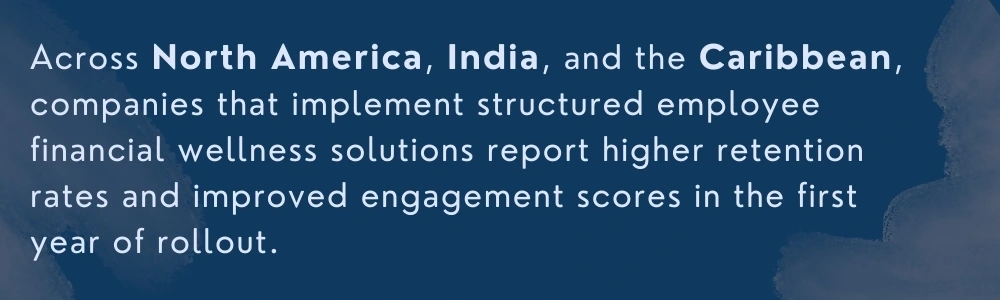
- Lower attrition because employees feel supported.
- Fewer payroll grievances are related to financial stress.
- Improved engagement survey scores reflecting reduced anxiety.
- Reduced stress-related absenteeism.
- Higher overall employee satisfaction.
Financial stability increases cognitive clarity. Clarity enhances decision-making. Better decisions improve performance.
Payroll is no longer a backend administrative function. It directly influences culture, retention, and profitability.
What a 2026 Payroll Strategy Must Include: Employee Financial Wellness Solutions, Payroll-Linked Wellness, and Earned Wage Access (EWA) Benefits
If payroll strategy still revolves solely around salary processing and compliance checklists, it is incomplete.
A future-ready payroll model must integrate:
- Structured employee financial wellness solutions embedded within payroll architecture.
- Responsible and compliant Earned Wage Access (EWA) benefits.
- Comprehensive payroll-linked wellness systems that automate savings and budgeting.
- Secure and transparent employee debt management tech.
- Data-driven tracking of financial wellness participation and outcomes.
- Clear compliance documentation tailored to regional regulations.
Adding flimsy benefits is not the goal of this change.
Payroll needs to be redesigned to reflect actual financial circumstances. It's about realizing that pay is just one aspect of financial stability.
Businesses that comprehend this change will do more than simply handle payroll effectively. They will create workforces that are financially stable and ready for 2026 and beyond.
Beyond Payroll Processing: Strengthening HR-Driven Financial Wellbeing with HR HUB
Payroll is one of the most powerful touchpoints between an employer and an employee. Used correctly, it becomes a platform for long-term financial resilience.
This is where HR technology must step forward.
HR HUB understands that modern organizations need more than just payroll processing. With advanced payroll architecture, configurable compliance modules, and scalable integration capabilities, HR HUB enables organizations to embed employee financial wellness solutions, structured payroll-linked wellness, and responsible Earned Wage Access (EWA) benefits directly into their HR ecosystem.
Through centralized dashboards, secure workflows, and transparent reporting, HR HUB supports HR-driven financial well-being while maintaining compliance across India, the Cayman Islands, the US, and Canada.
Because in 2026, payroll is not just about paying employees.
It is about strengthening them.
And when employees feel financially secure, organizations do not just survive; they thrive. They lead.