You walk into a store, scan a QR code, enter the amount, type your UPI PIN, and leave.
For years, that experience has trained millions of Indians to think of UPI in one simple way:
Scan. Pay. Done.
So when headlines started appearing around new charges on UPI payments above ₹2,000, the obvious question was:
“Am I now going to pay extra every time I use UPI?”
For most consumers, the answer is NO.
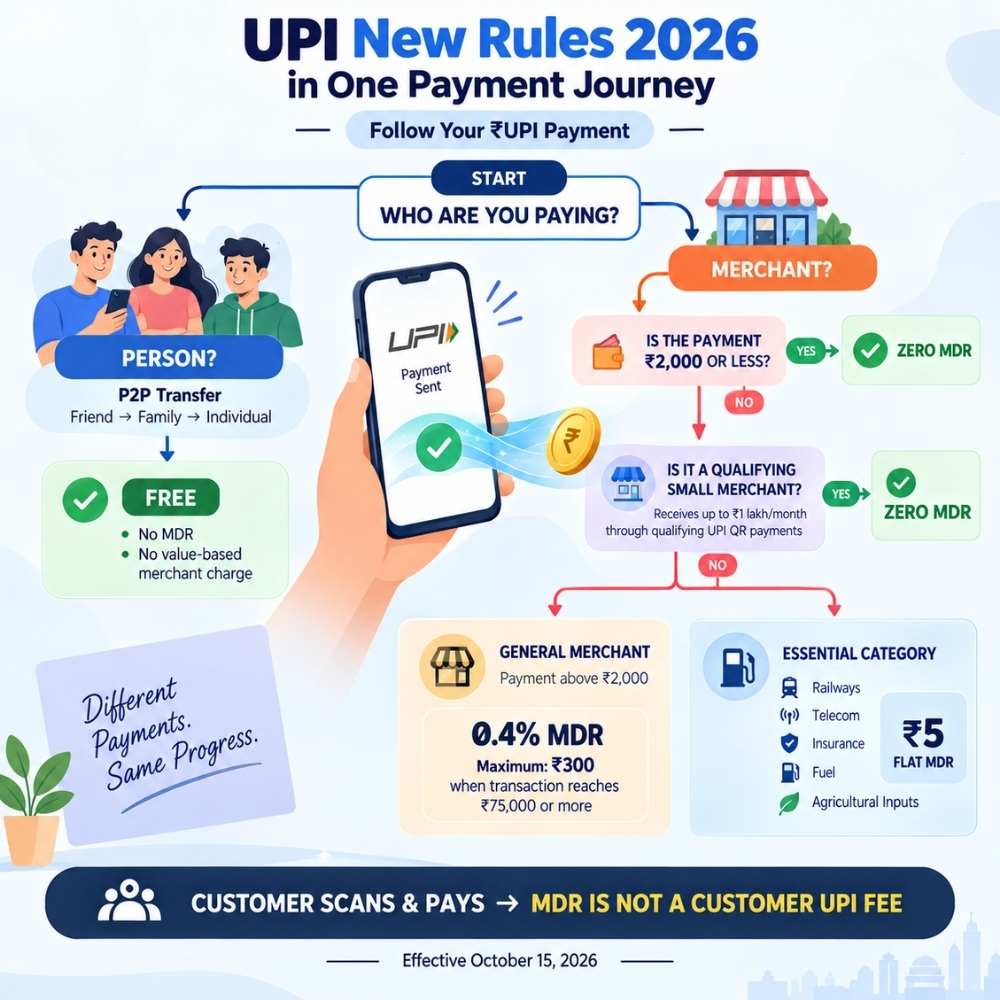
The UPI new rules 2026 introduce a Merchant Discount Rate, or MDR, on selected merchant transactions, but the charge is designed to sit within the merchant-payment ecosystem rather than being charged to the customer. Person-to-person transfers remain free, merchant payments up to ₹2,000 remain free of MDR, and qualifying small merchants continue to receive additional protection.
The important part is understanding that not every UPI payment is being treated the same way.
A ₹500 payment to a shop is different from a ₹10,000 merchant payment.
Sending ₹25,000 to a friend is different from paying ₹25,000 to a business.
And paying an insurance premium is treated differently from an ordinary retail purchase.
So, what exactly changes from October 15?
Let us break it down.
When were the UPI New Rules 2026 Announced?
The timeline matters because some reporting initially described the changes as a proposal.
The Central Government issued the relevant notification on September 14, 2026, establishing the zero-charge framework for specified electronic payments. NPCI then issued its detailed operational circular on September 15, 2026, following deliberations by the UPI Steering Committee.
The revised UPI MDR charges 2026 framework will become effective on October 15, 2026. That gives banks, payment companies, merchants, aggregators, and other ecosystem participants time to update billing and settlement arrangements before the new structure starts.
What Is MDR?
Merchant Discount Rate sounds more complicated than it is. MDR is essentially a fee charged within the payment ecosystem when a merchant accepts certain digital payments.
Under the new framework, UPI merchant charges may be shared among participants such as banks, payment service providers, and UPI app providers.
The Ministry of Finance has specifically clarified that MDR is not a tax collected by the government or NPCI.
The bigger distinction is this the merchant is the party facing the MDR, not the person scanning the QR code.
Banks have also been advised to ensure that merchants do not pass these MDR costs to customers, while UPI app providers are prohibited from adding platform fees or hidden charges to individual users.
That is important when discussing UPI transaction charges 2026, because a merchant charge should not automatically be interpreted as a consumer transaction fee.
Which Transactions Are Not Affected by the New UPI MDR Rules?
A large share of UPI transactions remains unaffected by the new MDR framework. The main categories that continue without MDR include the following:
1.Person-to-Person UPI Transfers
Sending money to another person remains free regardless of the amount.
For example:
- You send ₹500 to a friend.
- You transfer ₹15,000 to a family member.
- You send ₹50,000 to someone through a P2P UPI transfer.
The new merchant MDR does not apply. According to the Ministry of Finance, person-to-person transactions remain completely outside the new MDR framework.
For More Information Visit: Peer to Peer Transactions
2. Merchant Payments Up to ₹2,000
All qualifying person-to-merchant payments of ₹2,000 or less remain zero-MDR. So, if you scan a merchant QR code and pay:
₹150
₹850
₹1,500
₹2,000
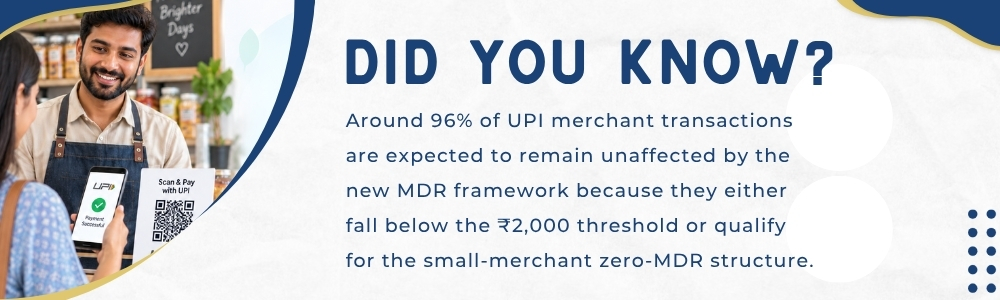
the new 0.4% MDR does not apply.
This is one of the most important parts of the UPI new rules 2026, because most everyday merchant transactions remain outside the new charge.
The official framework applies the MDR threshold to merchant transactions above ₹2,000. It does not create a consumer monthly quota for free UPI use.
Read in Detail About: Person to Merchant Transactions
3. Small Merchants
Small businesses receive an important exemption. Under the Person-to-Person-Merchant, or P2PM, structure, qualifying small merchants receiving up to ₹1 lakh per month through UPI QR codes will continue to receive zero MDR on all transactions.
The government specifically identifies street vendors, neighborhood businesses, and other small merchants as beneficiaries of this protection.
This means the UPI MDR charges 2026 are not simply being applied uniformly to every business that accepts a QR payment.
Merchant classification and transaction type matter.
For small vendors, that distinction could be significant because payment-processing costs can have a greater impact on businesses operating with narrow margins.
What Happens to Transactions Above ₹2,000?
This is where the new UPI charges above Rs. 2000 becomes relevant. For standard person-to-merchant UPI transactions exceeding ₹2,000, the MDR will be 0.4% of the transaction value
For example:
A ₹5,000 merchant payment could attract an MDR of ₹20.
A ₹10,000 payment could attract ₹40.
A ₹25,000 payment could attract ₹100.
However, there is a ceiling. For transactions of ₹75,000 or more, the MDR is capped at ₹300 per transaction.
That means the charge does not continue rising indefinitely with the transaction amount.
Again, these UPI merchant charges are meant to apply within the merchant-payment ecosystem, not as an extra checkout fee charged directly to the consumer.
Railways, Fuel, Telecom and Insurance Get Different Treatment
Not every transaction above ₹2,000 will attract the standard 0.4%. Certain essential and thin-margin categories will instead attract a flat ₹5 MDR per transaction, when the payment exceeds ₹2,000.
The categories identified by the Ministry of Finance include:
- Railways
- Telecommunications
- Insurance
- Fuel
- Agricultural inputs
This creates a different structure for essential services where a percentage-based fee could otherwise become disproportionately expensive on large transactions.
So if you are trying to understand UPI charges above 2000, looking only at the transaction amount is not enough. You also need to know what type of merchant is receiving the payment.
Capital Market Payments Have Their Own Rate
There is another separate category which is payments relating to:
- Mutual Funds
- Securities
- Stockbrokers
- Dealers
They will attract MDR of 0.02%, with the fee capped at ₹300 per transaction. This is significantly lower than the standard 0.4% rate.
The policy therefore creates several layers rather than one universal set of UPI merchant charges.
Will Consumers Have to Pay More?
Under the announced framework, consumers should not be charged with the MDR. The Ministry of Finance says banks have been advised to prevent merchants from passing MDR on to customers, while UPI application providers cannot impose platform or hidden fees on individuals.
Consumers will also continue to have free UPI usage without monthly quotas or tiered limits on the number of free payments.
This is an important distinction between transaction limits and transaction charges.
Banks and NPCI may maintain daily transaction limits for security and risk management, typically depending on the type of transaction, but those limits are not the same thing as the new UPI transaction charges 2026 framework.
What Changed Compared With the February 2026 UPI Rules?
The February and October changes should not be treated as the same update.
The February 2026 developments were primarily focused on how UPI transactions operate, particularly speed, verification, security, and payment flows.
Changes reported at the time included tighter processing expectations and stronger verification controls. Another significant change was the phase-out of the traditional UPI Collect flow for most use cases from February 28, 2026, requiring many merchants to move toward UPI Intent or QR-based payment flows.
The September announcement is different. It changes the commercial structure around merchant payments.
In simple terms:
February 2026:
How UPI payments are initiated, processed, secured, and completed.
October 2026 framework:
When certain merchant UPI payments attract MDR and what rate applies.
That is the biggest difference in the UPI new rules 2026. The newer framework does not replace the February operational changes. It adds a new merchant-pricing layer on top of an ecosystem that has already been evolving technically throughout the year.
Why Is the Government Introducing MDR Now?
The Ministry of Finance says the framework is intended to support the long-term sustainability and expansion of UPI.
Revenue from larger merchant transactions is intended to support banks, payment service providers, and UPI app providers in maintaining and expanding digital-payment infrastructure, including in rural and semi-urban markets.
The framework also creates a dedicated fund for small-merchant adoption.
An amount equivalent to 5% of total MDR collections will be contributed to this fund to support UPI acceptance and continued digital-payment adoption among small businesses.
This makes the UPI MDR charges 2026 partly an infrastructure-financing change, not simply a new merchant fee.
What Should Merchants Prepare Before October 15?
Merchants do not necessarily need to change how customers make a UPI payment. But businesses should understand how they are classified and whether the new MDR applies to them. Before October 15, merchants may want to review:
The most important point is not to assume that every UPI charge above 2000 works the same way.
A ₹5,000 payment to a normal retailer, a ₹5,000 railway booking, and a ₹5,000 investment-related transaction can fall under different MDR structures.
Small Workplace Connection: When UPI Payments Become Employee Expenses
Employees increasingly use UPI for ordinary business expenses such as travel, fuel, meals, supplies, or approved online purchases.
UPI has made paying for work-related purchases almost effortless. Internal administration is not always equally effortless.
An employee can scan a QR code and complete a purchase in seconds, then spend days emailing a receipt, asking whether the claim was received, waiting for manager approval, and then checking when the reimbursement will be processed. That disconnect is where HR processes enter the conversation naturally.
An employee self-service system can give employees a structured place to submit reimbursement requests and supporting documents, while approval of workflows helps route the claim to the appropriate person.
That is where an employee's self-service software can help keep the request and support information together instead of spreading it across emails and messages. HR HUB's Employee Self Service, supports employee requests, reimbursement-related processes, and request status visibility.