Money worries rarely stay at home.
An employee may arrive at work on time, attend meetings, complete assigned tasks, and still spend the day thinking about overdue bills, school fees, loan repayments, or unexpected medical expenses.
From the outside, everything looks normal.
Inside, financial stress is quietly affecting concentration, productivity, and overall wellbeing.
This is becoming one of the biggest workplace challenges for employers today. While organizations have invested heavily in health insurance, flexible working, and employee engagement, financial wellbeing is now receiving the attention it deserves.
That is where employee financial wellness software comes in.
Modern businesses are discovering that supporting employees financially does not always mean increasing salaries. Sometimes, it means giving employees better access to payroll information, loan management, benefits, rewards, financial education, and self-service tools that help them make informed financial decisions.
When employees feel more confident about their finances, they are more likely to stay engaged, productive, and focused on work.
The International Labour Organization highlights that decent work includes promoting workers' wellbeing and social protection. Financial security, access to benefits, and supportive workplace practices contribute to healthier and more productive work environments.
Let's explore why employee financial wellness software is becoming an important part of today's HR strategy.
Why Is Employee Financial Wellness Becoming an HR Priority?
Financial stress is no longer viewed as a personal issue that stays outside the workplace.
It directly affects how employees perform at work.
An employee worried about paying bills or managing debt may struggle to concentrate during meetings, miss deadlines, or feel less motivated throughout the day.
This is why many organizations are investing in employee financial wellness as part of their broader employee experience strategy.
Companies are beginning to realize that supporting employees financially can improve both individual wellbeing and overall business performance. Some common workplace challenges include:
- Employees frequently requesting salary advances
- Increased financial stress during emergencies
- Difficulty understanding salary deductions
- Confusion about employee benefits
- Low participation in savings or retirement plans
- Limited awareness of available financial support
These challenges cannot always be solved with higher salaries alone.
They require better communication, transparency, and access to financial information.
What Is Employee Financial Wellness Software?
Employee financial wellness software is a digital solution that helps businesses support employees through payroll transparency, financial benefits, loan management, employee self-service, rewards, and other financial wellbeing initiatives. The software improves the new employee from the day one and making onboarding easy.
Instead of employees depending on HR for every payroll or benefits question, the software provides secure access to important financial information whenever it is needed.
A good system may allow employees to:
- View digital payslips
- Check salary history
- Access tax documents
- Review employee benefits
- Track loan repayments
- Download payroll reports
- Submit benefit-related requests
- Access financial education resources
- Receive reward and recognition updates
Good employee benefits software makes this information easier to access while reducing administrative work for HR teams.
The goal is not simply to digitize salary using payroll management.
The goal is to improve employee financial wellbeing by making financial information more transparent and accessible.
How Does Financial Stress Affect Workplace Productivity?
Financial concerns often appear in ways that are not immediately obvious. An employee may not openly discuss money problems with a manager. Instead, HR teams may notice different warning signs.
Lower Productivity: Employees distracted by financial concerns may find it harder to focus on their daily responsibilities.
Increased Absenteeism: Unexpected financial emergencies sometimes lead to unplanned leave or repeated absenteeism.
Higher Employee Turnover: Employees experiencing ongoing financial pressure are often more willing to change jobs for relatively small salary increases.
Lower Employee Engagement: When employees constantly worry about personal finances, workplace participation and motivation can also decline.
This is why many organizations now include workplace financial wellness within their broader employee engagement strategy.
Supporting employees financially is no longer viewed as an optional benefit. It is increasingly becoming part of building a healthier workplace.
Is Financial Wellness Only About Paying Higher Salaries?
Not at all.
Higher salaries can certainly help employees, but salary alone does not automatically improve employee financial wellbeing.
Imagine two employees earning the same monthly income.
One understands deductions, manages expenses carefully, uses employee benefits effectively, and plans.
The other struggles to understand payroll deductions, misses repayment deadlines, and rarely uses available company benefits.
Both earn the same salary.
Their financial confidence is completely different.
This is why many organizations are introducing financial wellness programs alongside compensation.
These initiatives may include:
- Payroll transparency
- Employee loan management
- Savings awareness sessions
- Financial education
- Flexible employee benefits
- Rewards and recognition
- Retirement planning guidance
- Digital access to payroll information
Together, these initiatives contribute to stronger workplace financial wellness without requiring businesses to increase salaries every year.

Financial Wellness Programs Must Have
Every organization has different workforce needs, but effective financial wellness programs usually combine education with practical workplace tools.
Payroll Transparency: Employees should clearly understand how their salary is calculated, including deductions, allowances, overtime, and taxes.
Employee Benefits: Good employee benefits software should make it easy for employees to view insurance, retirement contributions, reimbursements, and other workplace benefits.
Loan Management: When businesses provide employee loans or salary advances, employees should be able to track repayments without depending on manual HR updates.
Employee Self-Service: Self-service portals reduce dependency on HR by giving employees direct access to important financial information.
Rewards and Recognition: Financial rewards are only one part of motivation, but recognizing employee contributions can improve overall employee financial wellness and engagement.
How Can Employee Financial Wellness Software Make Everyday HR Easier?
Supporting employees financially does not mean HR has to become a financial advisor.
Instead, HR can provide employees with the right tools, information, and access to manage their workplace finances more confidently.
This is where employee financial wellness software becomes valuable.
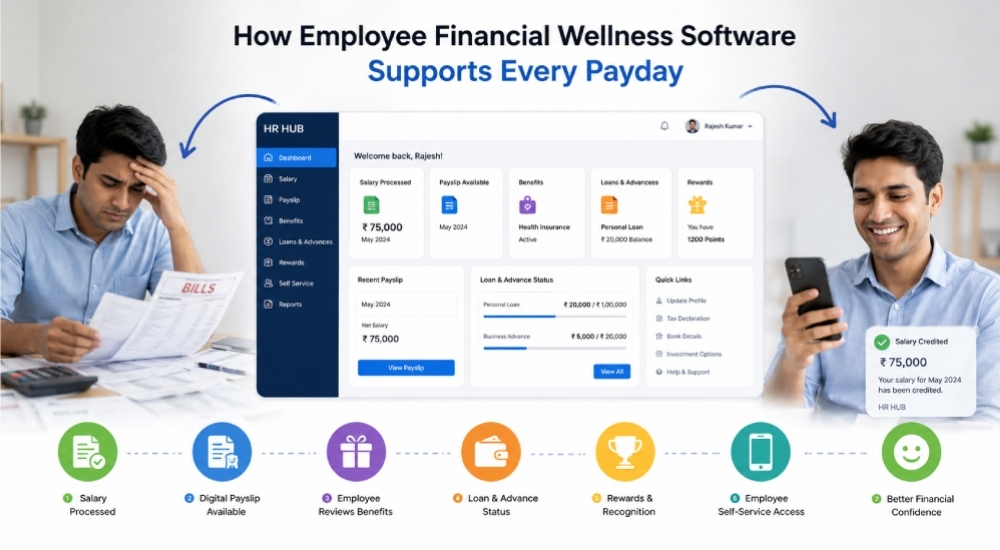
Rather than responding to repeated payroll and benefits queries, HR teams can give employees secure self-service access while maintaining transparency across financial processes.
Employees Gain Better Financial Visibility
Employees can access important information whenever they need it, including:
- Payslips
- Salary history
- Loan balances
- Employee benefits
- Tax documents
- Reimbursement status
- Rewards and recognition history
Instead of emailing HR every payday, employees can find answers themselves.
That improves both convenience and employee financial wellbeing.
HR Teams Spend Less Time on Routine Queries
HR departments often receive repetitive questions such as:
- "Can you resend my payslip?"
- "How much is left on my employee loan?"
- "Why is my deduction different this month?"
- "What benefits am I eligible for?"
With employee financial wellness software, employees can access much of this information independently, allowing HR professionals to focus on higher-value work.
Payroll Becomes More Transparent
Payroll is often one of the most sensitive topics in any organization. Employees want to understand:
- Basic salary
- Overtime
- Allowances
- Tax deductions
- Loan deductions
- Benefit deductions
- Net salary
Providing this information through employee benefits software improves trust while reducing misunderstandings.
What Should Businesses Look for in Employee Financial Wellness Software?
Before choosing employee financial wellness software, businesses should ask practical questions.
✓ Can employees access payslips online?
✓ Does the system support employee loans?
✓ Can employees view benefits digitally?
✓ Is payroll information easy to understand?
✓ Does it include employee self-service?
✓ Can managers approve financial requests digitally?
✓ Are payroll records secure?
✓ Does it connect payroll, benefits, and employee records?
✓ Does it reduce manual HR work?
The right solution should improve both employee experience and HR efficiency.
Build Financial Confidence Workforce With HRMS Software
Financial wellbeing is becoming one of the most important parts of employee experience.
Employees want more than a salary.
They want clarity.
They want transparency.
They want easy access to payroll information, benefits, and financial support without depending on repeated emails or HR follow-ups.
That is why businesses are investing in employee financial wellness software alongside payroll and HR technology.
Supporting employees financially does not always require increasing salaries.
Sometimes, providing the right information at the right time can make an equally meaningful difference.
HR HUB help businesses can combine Payroll, Employee Self Service, Loan Management, Employee Benefits, Rewards & Recognition, and secure employee records into one connected platform that supports stronger workplace financial wellness and a better employee experience.
Frequently Asked Questions
What is employee financial wellness software?
Employee financial wellness software helps businesses provide employees with secure access to payroll information, benefits, loan management, rewards, and other financial resources that improve financial confidence.
Why is employee financial wellness important?
Financial stress can affect productivity, engagement, and employee satisfaction. Supporting employee financial wellness helps employees make better financial decisions while improving workplace experience.
How do financial wellness programs benefit businesses?
Well-designed financial wellness programs can reduce HR queries, improve payroll transparency, encourage better use of employee benefits, and strengthen employee trust.
Can HR software improve workplace financial wellness?
Yes. HR software can improve workplace financial wellness by giving employees self-service access to payroll, benefits, financial documents, and loan information while reducing manual HR processes.