An employee’s relationship with HR is often built through small everyday interactions.
“Can you tell me my remaining leave balance?”
“Can you share my latest payslip?”
“Has my personal information been updated?”
“Can you check the status of my request?”
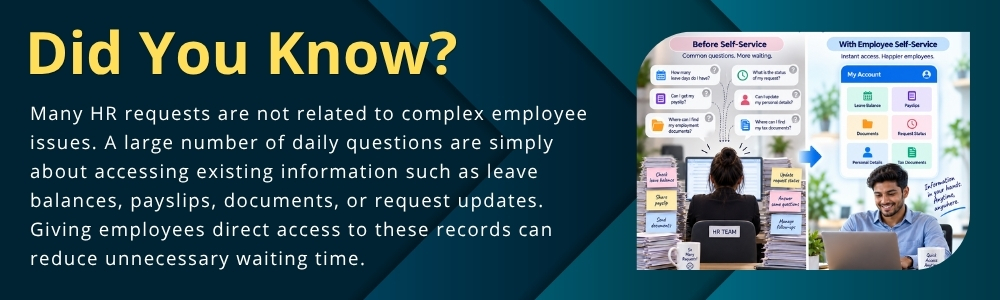
These questions may seem simple, but when hundreds of employees ask similar things every week, they can take a significant amount of HR’s time.
For employees, these are important moments. They need quick access to information that affects their work, planning, and personal records. For HR teams, responding to every small request manually can reduce the time available for more meaningful employee support.
This is where employee self-service changes the way employees and HR interact.
Instead of depending on HR for every routine update, employees can access approved information, submit requests, and complete common HR activities through a centralized platform. The purpose is not to reduce meaningful communication between employees and HR. It is to make everyday HR interactions simpler, faster, and more valuable.
What Is Employee Self Service?
Employee self-service is a way of allowing employees to access and manage their own HR-related information without depending on HR for every routine request.
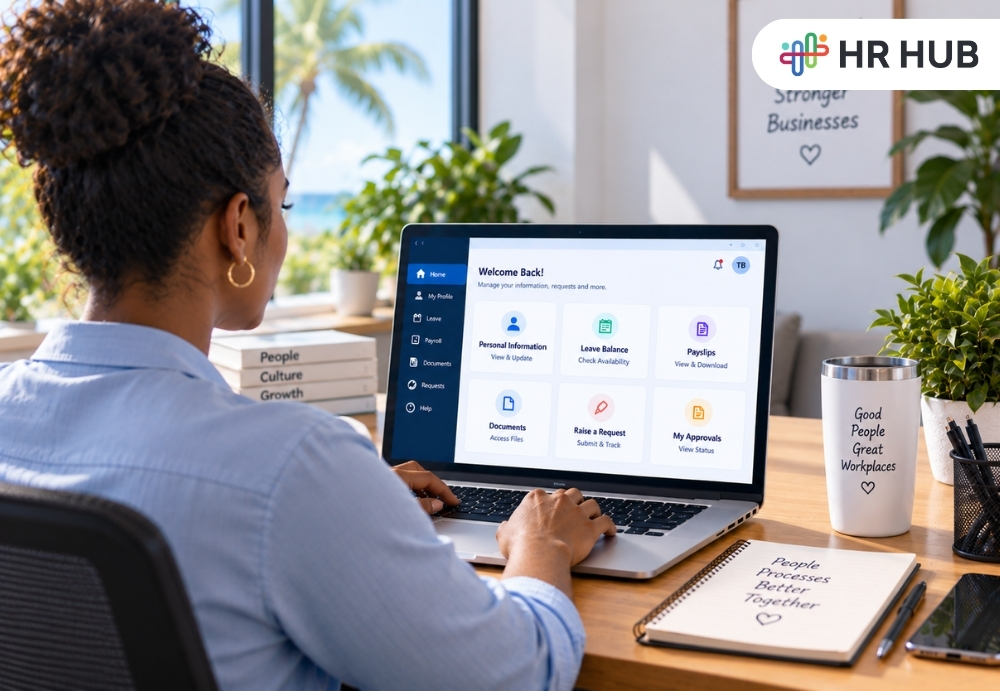
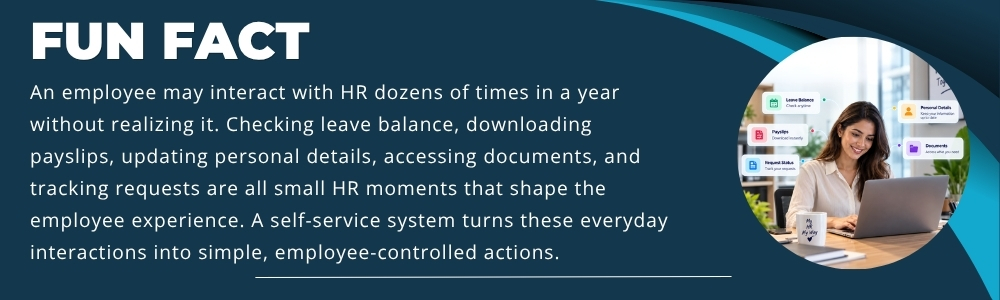
Instead of sending an email or visiting the HR department for basic updates, employees can use a centralized platform to complete everyday activities such as checking leave balances, viewing payslips, updating personal details, accessing documents, submitting requests, and tracking their status.
An employee self-service portal acts as a direct connection between employees and HR processes. It gives employees access to information they are authorized to view while allowing HR teams to maintain control, approvals, and compliance.
The importance of self-service goes beyond saving HR time. In traditional HR processes, even simple questions often follow a longer path:
Employee needs information → Contacts HR → HR searches records → HR responds → Employee receives update
While this process works, it can create delays for employees and repetitive administrative work for HR. With an ESS portal, many routine activities become simpler:
Employee needs information → Opens portal → Views information or submits request
This gives employees clearer visibility into their own records and request status.
For HR teams, it creates more time to focus on areas where human support matters most, such as employee concerns, policy guidance, workplace improvements, and development discussions.
A well-designed employee portal does not replace the relationship between employees and HR. Instead, it improves that relationship by making everyday interactions faster, clearer, and more meaningful.
Why Does Employee Self Service Matter?
Employee self-service matters because modern employees expect easier access to workplace information. Just as people can manage banking, travel, shopping, and other personal services online, they increasingly expect similar convenience in workplace processes. A self-service approach helps organizations:
- Reduce Repetitive HR Queries
- Improve Employee Access To Information
- Create Better Request Visibility
- Reduce Dependency On Manual Communication
- Maintain Accurate Employee Records
- Give HR More Time For Strategic Activities
The goal is simple: employees should be able to handle routine HR activities independently, while HR remains available for situations that require experience, guidance, and human interaction.
Why Employees Often Need HR Support for Simple Questions
HR departments handle a wide range of employee needs, but many daily interactions involve information employees simply want to access. An employee preparing a vacation plan may want to check available leave.
Someone applying for a loan may need their payslip.
A new employee may want to review their documents.
An employee moving to a new address may need to update their details.
None of these requests are complicated.
The challenge comes when every employee needs HR to find the information manually, confirm it, and send it back.
As organizations grow, these small interactions become a regular part of HR’s workload. An employee self-service portal creates a better way by allowing employees to access information that they are already authorized to view.
Employees can get routine information without waiting for HR to respond to each request individually.
Leave Management Becomes Easier for Employees and HR
Leave is one of the most common reasons employees interact with HR. Employees want answers to simple questions:
- How much leave do I have available?
- Has my request been approved?
- What is my leave history?
- When can I plan my next vacation?
Without a self-service system, employees often depend on HR to provide these answers. An ESS portal changes this experience by allowing employees to view their leave information and submit requests through a structured process.
Employees can check leave information and request status, while HR teams can review submitted requests and approvals.
This does not remove HR involvement. Instead, it allows HR to focus on reviewing exceptions, handling complex situations, and ensuring policies are followed.
Payslip Access Should Be Available When Employees Need It
Payslips are another common example of information employees frequently request.
An employee may need a payslip for financial applications, personal records, tax purposes, or salary verification. When employees need to contact HR every time they require a copy, the process can create unnecessary delays. Through an employee portal software solution, employees can access their payroll-related information without waiting for manual responses.
This creates a more convenient experience while also reducing repetitive administrative work for HR. Employees feel more in control because they can access their own information when required.
Employees Should Be Able to Manage Their Own Information
Employee details naturally change over time. A person may update their phone number, address, emergency contact, or other personal information.
Traditionally, employees had to inform HR, wait for the update to be processed, and then confirm whether the change was completed.
With HR self-service, employees can update or submit changes to personal information through a controlled process.
HR still maintains oversight and approval where required, but the employee becomes an active participant in maintaining accurate records. This creates a better balance between employee responsibility and HR control.
Self-Service Does Not Mean HR Becomes Less Important
A common misunderstanding is that self-service reduces the role of HR. In reality, it changes where HR spends its time.
Without self-service:
Employee asks a routine question → HR searches for information → HR provides an answer
With self-service:
Employee accesses routine information → HR supports situations requiring experience and judgment
For example:
- An employee can submit a leave request.
- HR can handle complex leave situations.
- An employee can view a payslip.
- HR can focus on payroll accuracy.
- An employee can update their personal details.
- HR can ensure records remain compliant.
The goal of employee self-service is not to replace HR conversations. It is to improve the quality of those conversations.
Employee Requests Become More Organized
Employees often need HR support for different types of requests:
- Document Requirements
- Information Updates
- HR Queries
- Approval Requests
- Employment-related Questions
When these requests happen through emails, messages, or verbal conversations, employees may not know the status.
HR teams may also struggle to track pending requests. An employee self-service portal provides a more structured way to submit and manage requests.
Employees can submit a recorded request with the relevant details and track its status. HR teams can review requests, maintain records, and respond through a more organized process.
This creates better transparency for everyone involved.
Important Documents Become Easier to Find
Employees often need access to important employment records. These may include:
- Employment Documents
- Company Policies
- Salary Records
- HR Letters
- Personal Information
Searching through old emails or requesting documents repeatedly can create unnecessary delays. An ESS portal provides employees with a central place to access approved information.
This improves employee experience because important records are available when needed. At the same time, HR maintains control over permissions and information security.
Employee-HR Relationship Becomes More Balanced
Traditional HR communication often follows a simple pattern:
- Employees need something.
- Employee contacts HR.
- HR finds the information.
- HR responds.
While this works, it creates dependency on routine activities.
With employee self-service, employees gain more independence for everyday HR tasks while HR becomes more available for discussions that require expertise.
Employees can handle routine activities.
HR can focus on employee engagement, workplace improvements, compliance, development, and support. The relationship changes from simply answering questions to creating better employee experiences.
What Employees Can Manage Through Self Service System?
A useful self-service system should help employees complete routine activities such as:
- Viewing Leave Balances
- Submitting Leave Requests
- Accessing Payslips
- Updating Personal Details
- Viewing Documents
- Tracking Requests
- Checking Employment Information
However, not every situation should become self-service. HR involvement remains important for areas such as:
- Employee Relations
- Career Discussions
- Policy Interpretation
- Workplace Concerns
- Sensitive Employee Matters
The best employee portal software approach creates a balance between employee independence and HR support.
How Does HR Benefits from Employee Self-Service?
The biggest advantage of self-service is not only convenience for employees. It also helps HR teams manage their workload more effectively. By reducing repetitive questions and manual information sharing, HR can spend more time on activities that have a greater impact, such as:
- Employee Engagement
- Workforce Planning
- Compliance Management
- Policy Improvements
- Employee Development
A structured self-service process can also creates clearer records because employee actions and requests are captured in one HR Software. This improves visibility and reduces the chances of information being lost across emails or messages.
Employee Self Service Creates Better Everyday HR Experiences
The best HR technology does not remove the human side of HR. It removes unnecessary delays from routine processes.
Employees should not need to wait for HR to provide information they are already allowed to access. HR teams should not spend most of their time answering repeated questions that a system can handle.
That is the value of employee self-service.
Employees gain transparency.
HR gains time.
Every interaction becomes more meaningful.
Create a More Connected Employee Experience with HR HUB
As organizations grow, managing employee information, leave, payroll records, documents, and requests through manual processes becomes increasingly difficult.
HR HUB helps businesses create a connected employee experience through Employee Self Service, allowing employees to access important information, submit requests, manage routine HR activities, and stay connected with workplace processes.
With HR HUB, employees can take greater ownership of everyday HR tasks while HR teams maintain visibility, control, and support where it matters most.
Better employee experience does not mean less HR involvement. It means making every HR interaction more useful.